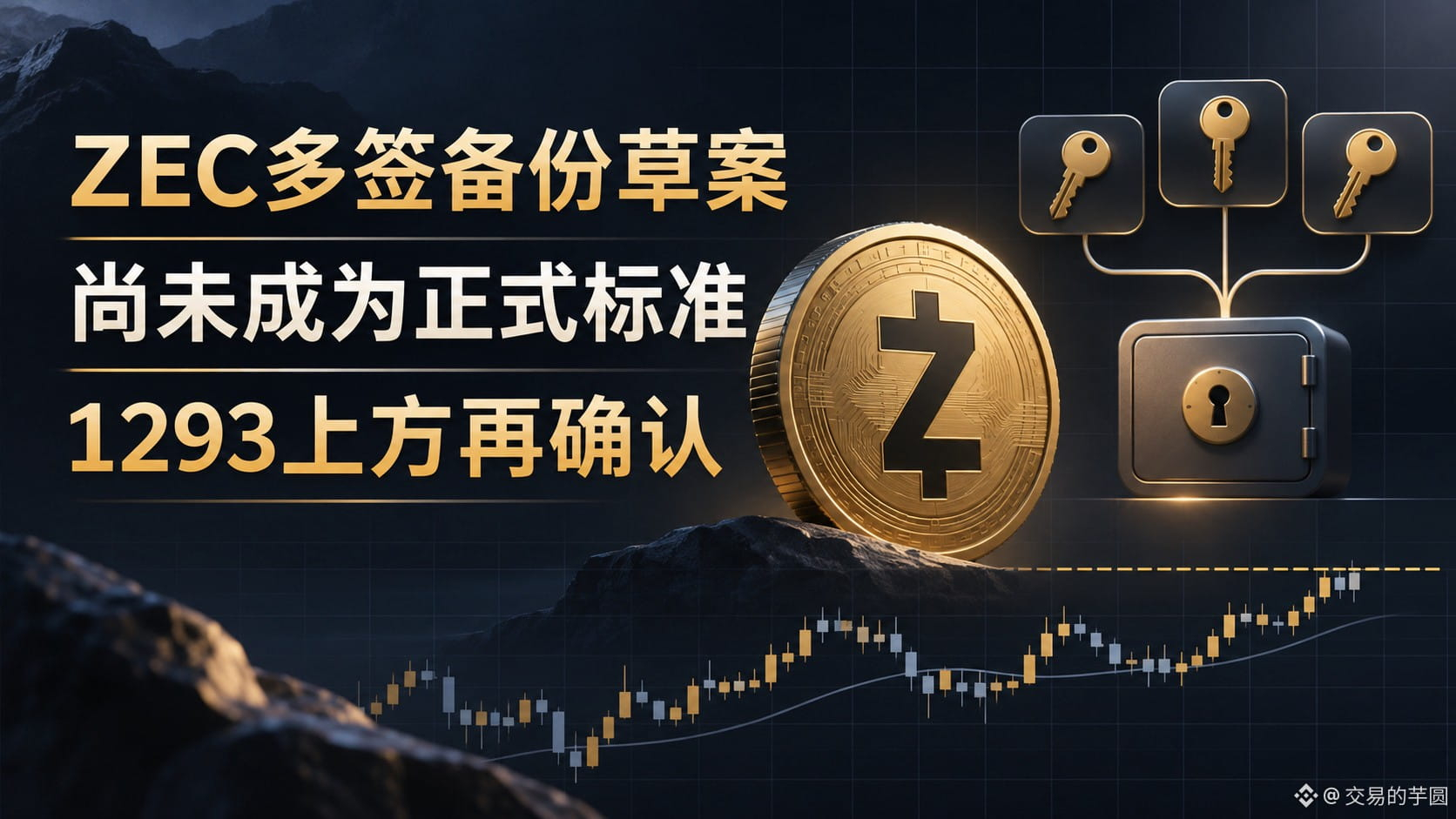
ZEC Multisig Backup Draft Still Under Discussion | Recovery Is a Slow-Moving Variable | I’m Waiting for Confirmation from Both Price and Facts
My stance is to watch cautiously and not chase the rally for now. What’s worth watching today isn’t another slogan about “privacy coins taking off,” but PR #1432 in Zcash’s official ZIP repository: developers have proposed a portable backup string for FROST multisignature participants using shielded addresses. It is still an open draft, not an approved standard, and certainly not a new feature already deployed to all wallets. This distinction matters to holders: an idea entering code review does not mean the asset recovery process has been proven under real-world failure conditions.
The draft aims to package the information needed for an individual participant—such as identity, threshold, participant count, and signing share—into a Bech32m string, and to restore the participant’s state using the group’s full viewing key. FROST’s value lies in collaborative signing among multiple parties. If the backup format is standardized, recovery costs could fall when changing devices or software, or when a participant encounters a failure. But backup material is itself highly sensitive: exposure, transcription errors, or version incompatibility could all change the risk profile. During the project discussion, reviewers also suggested putting test vectors in an official repository so they can be reproduced. A case where participant indices are no longer sequential after a refresh also revealed the limits of the first version’s format; a later version still needs to be designed. These are issues under review. They should not be described as vulnerabilities that have already caused losses, nor treated as evidence that the feature has been fully released.
Why might the market care? In addition to the narrative, long-term demand for privacy assets depends on whether real users can securely custody and recover them. If multisig backups eventually become an interoperable standard, operational friction for institutional custody and team treasury management could gradually decline. But this is a long chain of effects, and today’s PR cannot be directly translated into buying pressure. Farside currently shows net outflows of about $3.6 million from ZCSH on both November 2 and 3; the fund data also offers no evidence that “institutions have already embraced the positive news.” In a Kraken snapshot, ZEC is around $1,280, above the daily open of about $1,218, with an intraday low of about $1,158 and a high of about $1,293. The rise is an observed price fact; it cannot be attributed to this draft.
I’ll treat around $1,293 as the short-term confirmation level and around $1,158 as the lower bound of this round of volatility. If the price repeatedly surges but cannot hold above $1,293, while funds continue to see net outflows, I’ll withdraw my bullish assessment. If the draft is closed or key recovery tests fail, the long-term narrative will also need to be reassessed. The official expectation of a network upgrade around November 5 also means nodes and deposits and withdrawals may need to be checked; the actual block height and exchange status take priority over the announced timing.
If I were trading this myself, I would sit out for now and consider only unleveraged spot longs. I would enter a trial position using no more than 2% of my total capital only if ZEC holds above $1,293 for a full consecutive hour, holds on a retest, and deposits and withdrawals for ZEC are confirmed to be operating normally on the target exchange. My first target would be $1,350, where I’d take half off; my second target would be $1,400, where I’d exit the remainder or use a trailing stop. I’d place the initial stop below the retest low, no more than 3% below the entry price. If the hourly close falls back below $1,293, or if an upgrade issue or major reversal in the backup-format review emerges, I’d close the position proactively. If the trigger conditions don’t occur, I’ll remain flat and won’t present watching as if it were a trade.
#ZEC
The above is only my personal market observation and does not constitute investment advice.