

After the election, it’s worth asking: Is a Democratic victory really bad news for crypto? Or have we become too accustomed to tying its future to one person?
I looked at the election results, campaign promises, and the history of Bitcoin.
What did the Democrats win?
Reuters and AP reported that Democrats had won both chambers of Congress. According to Stand With Crypto’s preliminary scoreboard as of 1:15 a.m. Eastern Time on November 4, Democrats had 228 seats in the House of Representatives and 53 in the Senate. Counting was still underway, so these are not final figures. The new Congress will begin work in January 2027.
Trump remains president. But it will be harder for him to get legislation through Congress: he will have to seek compromises.
Why people voted for them
According to Reuters’ analysis, key reasons included the high cost of living, dissatisfaction with the war with Iran, and the administration’s actions. Voters wanted stronger checks on the president.
Democrats ran on specific promises:
• seek to repeal Trump’s tariffs;
• restore tax credits for health insurance;
• reverse Medicaid cuts;
• push to limit the war with Iran;
• make everyday life more affordable.
The New Democrat Coalition’s platform also included building affordable housing, paid family and medical leave, vocational training, and support for families. These are proposals from an influential group within the party.
Iran, oil, and crypto—what’s the connection?
House Democratic Leader Hakeem Jeffries opposed military action without congressional authorization and called for diplomacy and sanctions. He also criticized additional spending on the war.
If Democrats’ gains help bring about de-escalation and more stable oil supplies, energy prices could fall.
For crypto, the potential chain of events looks like this:
Lower military risk → cheaper oil → less inflationary pressure → more room for the Fed to ease policy → more favorable conditions for risk assets.
This is a scenario, not a guarantee. An IMF study shows that Fed tightening weighs on the crypto market by reducing investors’ willingness to take risks. Energy shocks can also fuel inflation and tighten financial conditions.
But if oil prices fall because of a recession, that is a different story: crypto could fall along with them.
And so far, the Democrats’ victory has not caused oil prices to collapse: on the morning of November 4, Reuters reported that Brent was up about 0.7%, to $104.36. The market is waiting for real changes regarding Iran.
What about tariffs?
A possible reduction could ease pressure on the prices of imported goods and business costs. For the crypto market, this could provide support through lower inflation, interest rates, and stronger investor confidence.
But there is still a political battle ahead between promising to repeal tariffs and actually doing it.
Democrats are not a united anti-crypto camp
Ro Khanna and Ritchie Torres support the development of digital assets. Josh Gottheimer advocates clear rules and investor protection. Kirsten Gillibrand helped advance legislation on stablecoins. The industry has allies within the party.
There is also documented evidence of personal crypto investments: Shri Thanedar reported sales of Bitcoin, Ethereum, and Litecoin. This confirms he owned them in the past, but does not reveal his current portfolio.
And now, the numbers
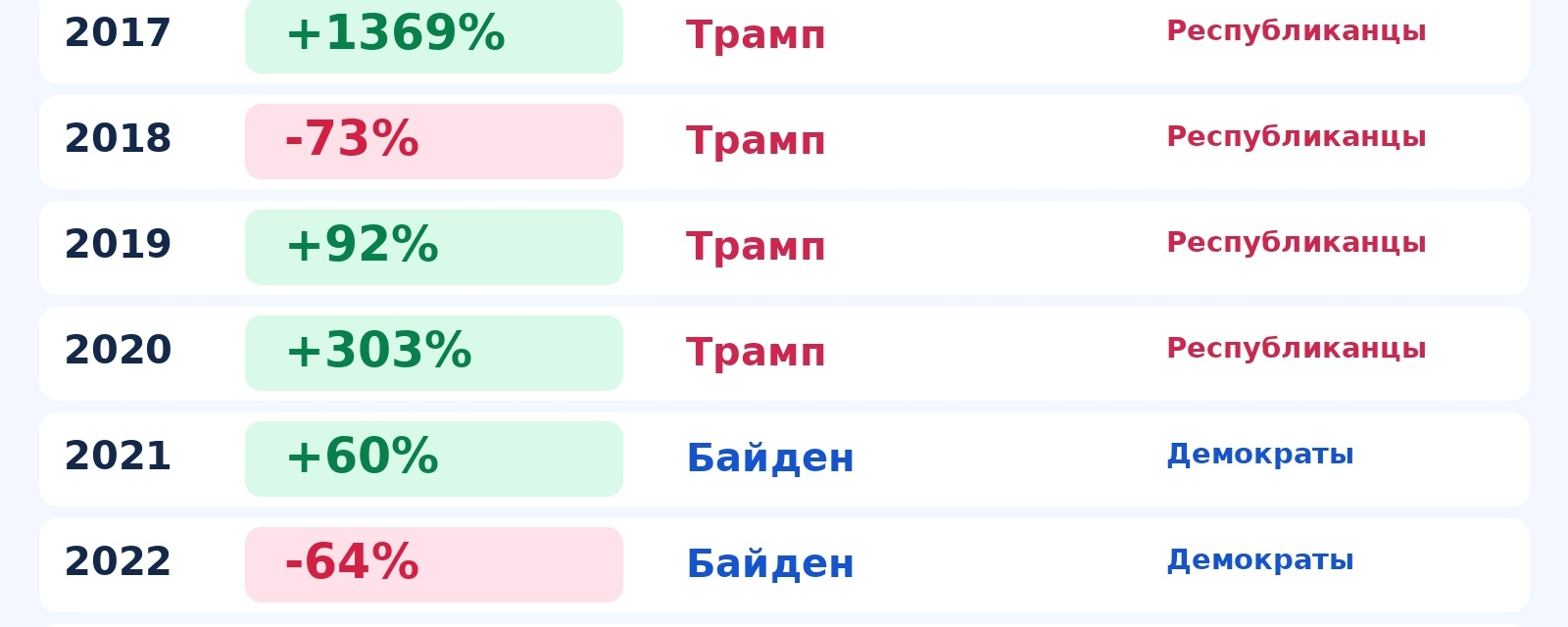
Under Trump and a Republican Senate, Bitcoin rose by about 1,369% in 2017, then fell by 73% in 2018, and gained 303% in 2020.
Under Biden and Democratic control of the Senate: +60% in 2021, −64% in 2022, +155% in 2023, and +121% in 2024.
In 2025, after Trump returned, the result was about −6.3%. From January through October 2026, it was approximately −11.5%. Republicans controlled the Senate during this period.
This does not prove that either party causes prices to rise or fall. But it does show clearly that a politician who supports crypto does not guarantee a bull market. And a Democratic majority alone does not rule out strong growth.
My takeaway: for now, it is worth watching whether Democrats’ promises translate into lower military risks, cheaper energy, a review of tariffs, and clear rules for the industry. This is where support for the crypto market could emerge.
And this is no lament of Princess Jeremiah’s, but the numbers speak for themselves.