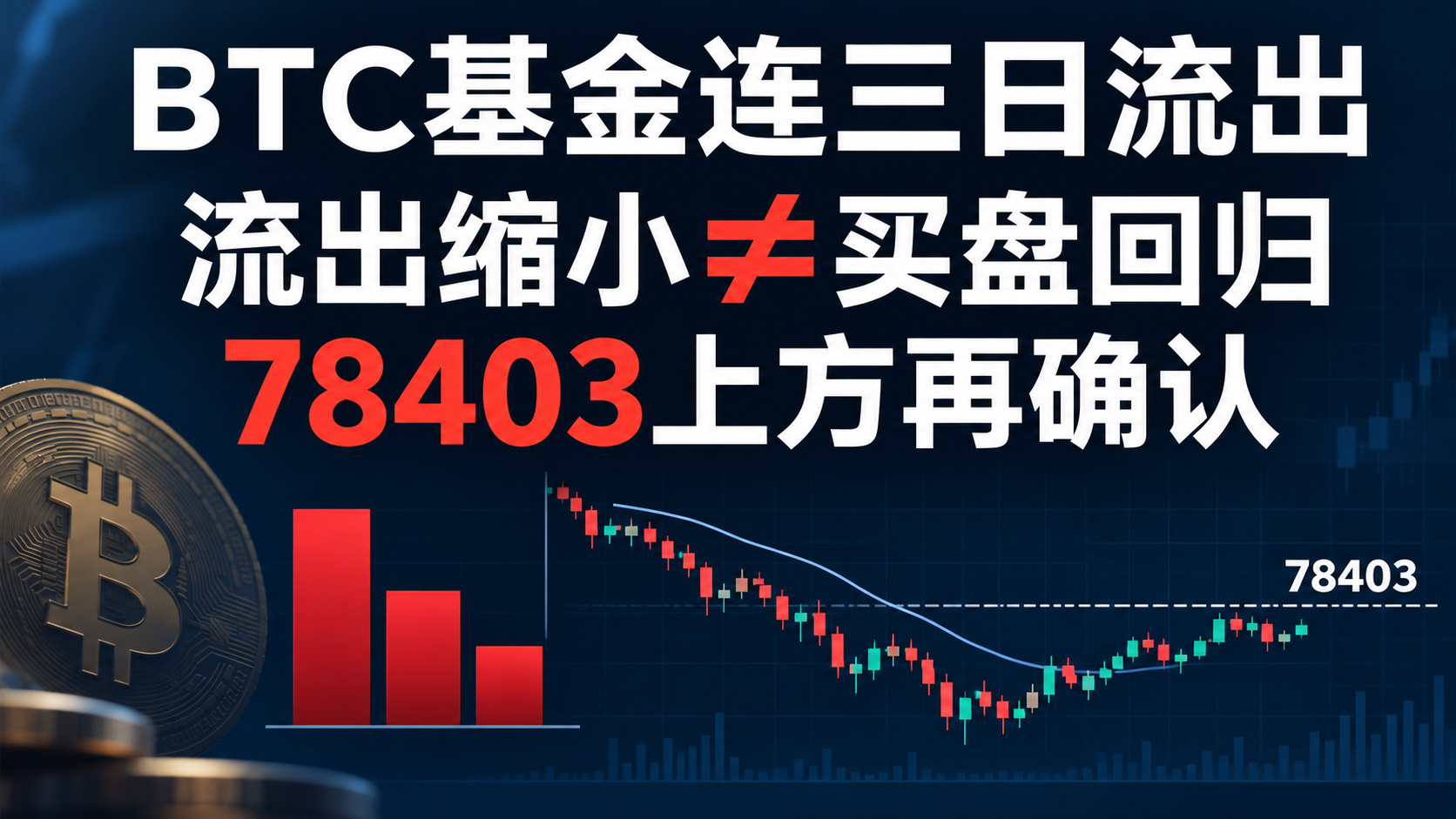
BTC funds see outflows for three consecutive days | Smaller outflows don’t mean buyers have returned | I’m waiting for confirmation above 78,403
My stance is to wait for confirmation first, rather than treating an intraday rebound as proof that institutional funds have already returned. In this round of trending topics on Binance Square, the U.S. midterm elections and exchange security are still drawing attention. BTC appears among the Most Searched topics, but there is no directly related topic about rising fund inflows, so I won’t force that interpretation. Farside has now published complete summaries for the three most recent U.S. trading days of BTC spot funds: a net outflow of $643.2 million on October 30, a net outflow of $398.6 million on November 2, and a net outflow of $115.6 million on November 3, for a total of about $1.1574 billion over the three days. Another tracking site also cross-checked the figure of about $115.6 million in net outflows on November 3. It is true that outflows have shrunk day by day, but all three trading days were still negative; “selling pressure has eased” cannot be presented as “flows have already turned positive.” The U.S. trading session on November 4 is not over yet, so today’s fund net flows cannot be announced in advance.
The mechanism by which this data affects BTC is not as simple as a price button. Fund subscriptions and redemptions reflect net demand through one institutional channel. Consecutive net outflows can weaken marginal spot buying, while some redemptions may also add selling pressure. But prices are also affected by exchange spot trading, futures positioning, macro risk appetite, and global time zones. The resumption of withdrawals following the recent Binance security incident still varies by asset and network, and changes in platform liquidity may also affect short-term price discovery. On October 28, the Federal Reserve kept its policy rate at 3.75% to 4% and did not announce a new easing decision today. The latest formal entry in Strategy’s official ledger records a purchase of 811 BTC on November 2; social media hints should not be written up as another purchase on November 4. These caveats show that slowing fund outflows and companies’ past purchases are not enough, on their own, to prove that a new trend has begun.
The market reaction is worth noting separately: I just checked Kraken, where BTC spot was around $78,233, with a daily open of $77,331.70, an intraday low of $75,625, and a high of $78,402.80. The price has rebounded about $2,600 from the low, but has not yet convincingly broken above the day’s high. The simultaneous presence of consecutive fund outflows and a spot rebound means that selling pressure may be getting absorbed by other buyers, or this may simply be short covering; it’s not possible to draw a causal conclusion from a single rebound candle. $78,403 is the upside confirmation level, $77,332 is support near the daily open, and $75,625 is today’s low. If the price surges and then an hourly close falls back below $77,332, my short-term bullish view is invalidated; a break below $75,625 would invalidate the entire rebound structure.
If I were trading this myself, I would stay out for now and consider only an unleveraged spot long. I would wait for an hourly close above $78,403, a successful retest holding above $78,200, and smooth deposits and withdrawals on the BTC mainnet, then enter in two tranches using no more than 2% of total capital. The first target is $79,500 and the second is $81,000; at $79,500, I would take half off and move the stop on the remaining position up to around the entry price. The initial stop is below $77,300. If an hourly candle loses $77,332, I would reduce the position; below $77,300, I would close it entirely. If subsequent fund data deteriorates sharply again or platform channels become abnormal, I would cancel the plan. If the triggers are not met, I would remain out of the market and would not present a plan as a trade or a profit.
#BTC
This is solely my personal market observation and does not constitute investment advice.