
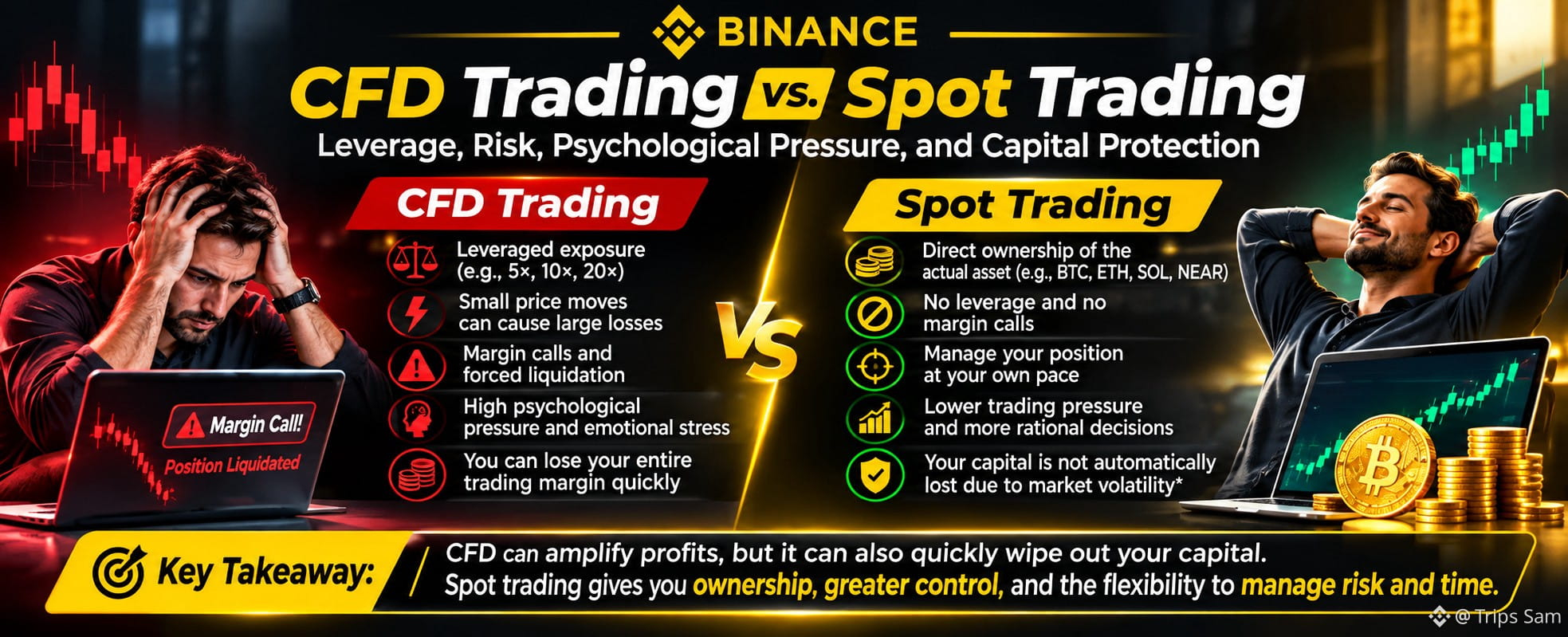

The Hidden Cost of Leverage, the Psychological Pressure of Losing Capital, and the Power of Financial Control
In financial markets, the greatest danger is not always making the wrong prediction. Sometimes, it is choosing a trading instrument that does not give you enough financial flexibility to survive being temporarily wrong.
Every day, traders enter financial markets with the same ambition: to generate profits, grow their capital, and achieve financial independence.
Yet two traders can correctly identify the same long-term market direction and experience entirely different financial outcomes.
One may lose their entire trading margin before the market moves in their predicted direction.
The other may experience a significant temporary decline but retain ownership of the purchased asset and the ability to decide when to sell.
This distinction highlights one of the most important differences between Contracts for Difference (CFDs) and Spot Trading.
Although both provide exposure to financial markets, they operate under fundamentally different mechanisms of risk, leverage, ownership, and capital management.
Understanding these differences is essential not only for financial performance but also for psychological stability and long-term trading discipline.
1. Understanding CFD Trading: When Small Market Movements Become Major Financial Threats
A Contract for Difference, commonly known as a CFD, is a derivative agreement between a trader and a provider.
Rather than purchasing the underlying asset, the trader speculates on changes in its price.
CFDs can provide exposure to stocks, commodities, indices, currencies, and, where permitted, cryptocurrencies.
One of their defining characteristics is leverage.
Leverage allows traders to control positions much larger than the capital deposited as margin.
For example, a trader may deposit $1,000 and establish a $10,000 position using 10:1 leverage, where permitted.
This creates an attractive possibility: generating substantial profits from relatively small market movements.
However, leverage works equally in the opposite direction.
The same mechanism that multiplies potential profits also multiplies the impact of losses on the trader's invested margin.
A relatively small unfavorable price movement can significantly reduce account equity, trigger margin requirements, and force a position to close.
Consequently, a trader can lose their trading margin even when the underlying asset remains fundamentally valuable.
The problem is not necessarily that the original market analysis was entirely incorrect.
Sometimes, the position simply could not survive the volatility required for that analysis to materialize.
2. The Psychological Pressure of CFD Trading
The financial consequences of leveraged trading are only part of the story.
There is also a significant psychological dimension that deserves greater attention.
Imagine opening a leveraged position based on technical analysis, market structure, and a reasonable expectation of future price movement.
Initially, the market moves against the position.
The trader watches account equity decline.
Margin levels deteriorate.
The possibility of forced liquidation becomes increasingly real.
Suddenly, the trader is no longer concentrating exclusively on the market's underlying direction.
Their attention shifts toward a much more immediate concern:
Will my account survive the next market movement?
This pressure can create an emotionally exhausting trading environment.
Fear of losing capital may encourage premature closures.
Anxiety may lead to unnecessary adjustments.
A losing position may trigger revenge trading.
An attempt to recover losses may produce excessive leverage, oversized positions, and progressively weaker decisions.
The trader who originally entered the market with a carefully considered strategy may find themselves responding emotionally to every candle.
Markets are already uncertain.
Adding the threat of forced liquidation can make that uncertainty substantially more difficult to manage.
This does not mean every CFD trader experiences these problems, or that disciplined derivative trading is impossible.
Professional traders may use CFDs for hedging, short exposure, or carefully controlled speculation.
However, leverage reduces the financial margin for error and can intensify emotional pressure, especially among inexperienced traders.
3. Spot Trading: Ownership Instead of Leveraged Exposure
Spot trading operates differently.
When a trader purchases Bitcoin, Ethereum, Solana, or another cryptocurrency through Binance Spot using fully paid funds, they acquire the purchased digital asset rather than merely opening a leveraged derivative contract.
There is no borrowed capital in an ordinary Spot purchase.
There is no margin requirement.
There is no leverage-driven liquidation price.
If the market declines, the market value of the purchased asset declines accordingly.
However, the trader does not face automatic liquidation simply because the asset's price has moved against the original purchase.
The asset remains in the trader's holdings unless it is sold, transferred, or otherwise affected by a separate event.
This creates a fundamentally different trading experience.
A Spot trader generally has greater flexibility to decide whether to hold, reduce exposure, or sell after evaluating market conditions.
There is no requirement to maintain collateral for a leveraged position.
There is no derivative funding obligation simply for holding a fully paid Spot asset.
And there is no automatic margin close-out resulting from ordinary price fluctuations.
The important advantage of Spot trading is not that capital cannot be lost. It is that ordinary market volatility cannot, by itself, trigger leverage-driven liquidation of a fully paid position.
That distinction is extremely valuable.
It separates the risk of declining asset value from the additional mechanical risk of forced position closure.
4. A Practical Example: $1,000 in CFD vs. $1,000 in Spot
Consider two traders, each starting with $1,000.
Both believe that a particular asset will eventually increase in value.
Trader A: CFD Trading
Trader A opens a leveraged position with:
Initial margin: $1,000
Leverage: 10:1
Total market exposure: $10,000
If the underlying asset declines by just 5%, the position experiences an approximate $500 loss before trading costs.
That represents 50% of the trader's initial margin.
If the market declines by 10%, the theoretical loss would equal $1,000 before costs.
In practice, a broker may close the position earlier under its margin close-out rules.
The trader may therefore lose most or all of the committed margin without having the opportunity to wait for a subsequent recovery.
Trader B: Spot Trading
Trader B purchases $1,000 worth of the same asset using personal funds without leverage.
If the price falls 5%, the holdings are worth approximately $950.
If the price falls 10%, they are worth approximately $900.
Even if the price falls 50%, the trader still holds the purchased quantity, now valued at approximately $500.
There is no leverage-driven margin call forcing the sale of those holdings.
If the market subsequently recovers, the trader can benefit from that recovery while continuing to hold.
However, recovery is never guaranteed.
If the asset becomes worthless, the entire $1,000 investment may still be lost.
The key difference is that the CFD trader faces both market risk and leveraged margin risk, while the fully funded Spot trader faces market risk without the additional leverage-driven liquidation mechanism.
This is one of the most important distinctions any trader should understand.
5. The Difference Between Losing Value and Losing Control
One of the most misunderstood aspects of trading is the distinction between an investment declining in value and a position being forcibly closed.
In Spot trading, a market decline creates an economic loss in the value of the holdings, whether or not the assets are sold.
Selling crystallizes that loss, but refusing to sell does not eliminate it.
Nevertheless, the trader generally retains the ability to decide how to manage the remaining position.
With leveraged CFDs, market losses may reach a point where the provider closes the position automatically.
That closure may occur before the market reverses.
A subsequent recovery does not restore an already closed CFD position.
This introduces a concept that every trader should consider:
Being correct about the eventual market direction does not necessarily mean a leveraged position will survive long enough to profit from it.
A trader can correctly anticipate a recovery while still losing their margin during the preceding decline.
That is why position sizing, leverage selection, available margin, and maximum acceptable loss are critical in derivative trading.
6. Why Time and Patience Matter
Financial markets rarely move in perfectly straight lines.
Even strong trends experience corrections, consolidation periods, sudden liquidity events, and unexpected reversals.
The ability to withstand normal volatility can therefore influence long-term outcomes.
With a fully paid Spot position, a trader can potentially remain invested through periods of uncertainty without a margin deadline.
This provides greater flexibility for longer-term strategies.
It may also reduce the psychological pressure associated with rapidly changing margin requirements.
However, patience must be supported by sound investment judgment.
Holding a fundamentally weak asset indefinitely is not a risk-management strategy.
Some cryptocurrencies never recover from major declines.
Others may lose liquidity, become obsolete, suffer technical failures, or collapse entirely.
The objective should never be to hold every losing position without reconsideration.
Instead, traders should distinguish between temporary volatility and a genuine deterioration in the investment thesis.
Patience is valuable when supported by analysis. It becomes dangerous when used as an excuse to ignore risk.
7. What Financial Regulators Reveal About CFD Risk
The risks associated with leveraged CFD trading are not merely theoretical.
Research cited by the European Securities and Markets Authority found that approximately 74% to 89% of retail CFD accounts in the jurisdictions and periods examined lost money.
More recent Australian regulatory information reported that at least 68% of retail CFD investors lost money during the 2023–2024 period.
These figures come from different studies and periods and should not be interpreted as a current global loss rate.
Nevertheless, they illustrate why financial regulators have introduced restrictions on retail leverage, margin close-out requirements, and negative balance protection in certain jurisdictions.
The exact protections vary by country, broker, and client classification.
Some retail clients have legal protections limiting losses to their trading account balance, while other traders may be exposed to losses beyond their original margin.
The broader lesson is clear:
Trading with leverage requires a level of financial preparation, discipline, and risk management that should never be underestimated.
8. The Hidden Costs of CFD Trading
Beyond leverage, CFD traders may face additional expenses.
Depending on the provider and product, these can include spreads, trading commissions, overnight financing, and other contractual charges.
Such expenses can reduce profitability and increase the cost of maintaining positions.
For traders holding positions over extended periods, financing charges may become particularly relevant.
Spot trading also involves costs, including trading fees, bid-ask spreads, and potential withdrawal or custody expenses.
However, fully funded Spot ownership generally avoids the ongoing borrowing-related costs associated with leveraged exposure.
This can make Spot trading more straightforward for investors whose objective is to accumulate and hold digital assets over longer periods.
The absence of leverage-related financing costs does not guarantee that a Spot strategy will be profitable.
It simply removes one additional source of expense and risk.
9. Why Binance Spot Offers a Different Trading Framework
Binance Spot provides direct access to cryptocurrency markets without requiring traders to borrow funds for ordinary purchases.
Investors can purchase assets using available balances, manage holdings, and use supported order types to implement their trading strategies.
This structure can support a more deliberate approach to portfolio management.
Rather than continuously monitoring a leveraged liquidation threshold, traders can focus on questions such as:
Is the asset fundamentally worth holding?
What percentage of my total portfolio should this position represent?
How much of my capital am I prepared to risk?
Does the investment thesis remain valid?
Should I reduce exposure, maintain the position, or exit?
These are important investment decisions that deserve more attention than the constant fear of a margin call.
However, Spot trading also involves platform, custody, cybersecurity, liquidity, and market risks.
Investors should distinguish Binance Spot from Binance Margin and Futures products, which involve different trading mechanics.
Similarly, cryptocurrency CFDs offered by CFD brokers are separate financial products and should not be confused with ordinary Binance Spot transactions.
10. Risk Management Is More Important Than the Trading Instrument
Neither CFDs nor Spot trading can compensate for consistently poor investment decisions.
An undisciplined Spot trader can lose substantial capital by purchasing speculative assets, concentrating an entire portfolio in a single token, or repeatedly buying without sufficient analysis.
A disciplined derivative trader may employ controlled exposure, defined losses, and hedging strategies.
Therefore, the correct comparison is not that every CFD trade is irresponsible or that every Spot trade is safe.
The real difference concerns the structure and magnitude of risk.
Before entering any market, traders should consider their maximum acceptable loss, position size, investment horizon, liquidity needs, and capacity to withstand volatility.
They should also understand the specific product they are trading, including its contractual terms and potential exposure to forced closure.
Most importantly, traders should never confuse greater buying power with greater financial security.
Leverage increases market exposure. It does not increase the quality of the trading decision.
11. The Psychological Advantage of Retaining Financial Flexibility
One of the greatest benefits of avoiding unnecessary leverage is the ability to approach investment decisions with less mechanical pressure.
A trader who is constantly worried about immediate liquidation may struggle to maintain objectivity.
A trader whose position is fully funded has greater flexibility to review market developments without the same collateral pressure.
This does not eliminate fear.
Watching an investment decline by 50%, 70%, or 90% can be psychologically devastating even without leverage.
Nevertheless, removing the risk of forced margin liquidation changes the structure of that pressure.
It gives the trader more control over the timing of position-management decisions.
And in financial markets, the ability to make decisions deliberately rather than under immediate margin pressure can be extremely important.
12. My Perspective: Capital Preservation Must Come Before Profit Expectations
Having examined both trading approaches, I believe every trader should understand one fundamental principle:
The objective is not simply to maximize the return from a successful trade. It is to manage losses so that unsuccessful trades do not destroy the ability to participate in future opportunities.
CFDs can provide useful flexibility for experienced traders, particularly for hedging and short-term directional strategies.
However, leveraged positions introduce additional financial and psychological risks that must be understood before execution.
Spot trading offers a different approach.
By investing available capital without borrowing, traders remove the threat of leverage-driven liquidation and retain direct exposure to the purchased asset.
They still face real market losses, potentially including the loss of their entire investment.
But they are not required to maintain a leveraged position against rapidly changing margin conditions.
For many individual investors, that difference deserves serious consideration.
Capital preservation is not about eliminating every possible loss. It is about avoiding risks that are unnecessary, excessive, or inconsistent with personal financial capacity.
Final Thoughts: The Market Rewards Discipline, Not Desperation
Financial markets will always contain uncertainty.
There will always be unexpected corrections, sudden rallies, unfavorable entry points, and periods when prices behave differently from expectations.
No trader can control those movements.
What traders can control is how much capital they expose, whether they use leverage, and how they respond when their analysis proves incorrect.
CFD trading can magnify both opportunities and mistakes.
Spot trading removes leverage-driven liquidation from fully funded positions, but it does not eliminate investment risk.
Understanding that distinction can help traders make more informed decisions and avoid unrealistic expectations.
A successful trading strategy should not depend on being right every time. It should be designed to survive the times when the trader is wrong.
Because in the long journey of investing, protecting the ability to participate tomorrow may be more important than maximizing profits today.
Never risk your financial future simply because leverage makes a larger position possible.
Choose your exposure carefully.
Protect your capital responsibly.
Trade with discipline rather than emotion.
And remember:
The greatest advantage in trading is not controlling the largest position. It is maintaining control over your financial decisions.


#TripsSam #BinanceSquar #SpotTrading #CFDTrading #RiskManagement $BTC $ETH