
AMD has ended the negative feedback loop in semiconductor earnings.
AMD’s revenue and EPS both exceeded the high end of the company’s own guidance. The only point anyone could seize on was gross margin, which slipped from 56% to 55%.$AMD

At 4:15 p.m. Eastern Time on November 3, after the market close, AMD released its fiscal third-quarter 2026 earnings (for the quarter ended September 26), with a conference call scheduled for 5:00 p.m. The report came at a delicate moment: over the past month, AMD had fallen from its October high of $658.52 to $483.90, a 26.5% decline. It wasn’t the results that were falling, but the valuation assumption that “AI capital spending can keep going.” The same trading day was also Election Day for the U.S. midterms, and the semiconductor sector had only just caught its breath after Intel’s plunge last week.
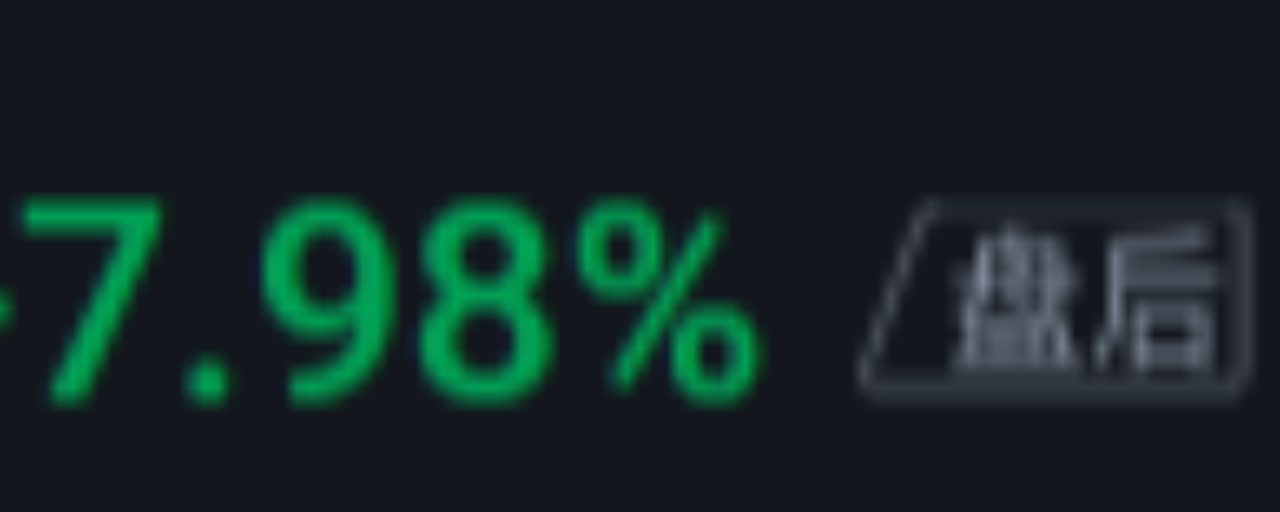
The earnings report landed at 4:15 p.m. In less than half an hour, the after-hours share price jumped from $483.90 to around $511, taking the gain from 3.65% at the close to 7%. In the same news cycle, Arm rose 3%, while Nvidia gained just 1.2%. The market was reacting to AMD’s own numbers, not a broad sector rally.
So the first significance of this report is that it answers a very basic question: Is demand still there? The answer is an unequivocal yes.
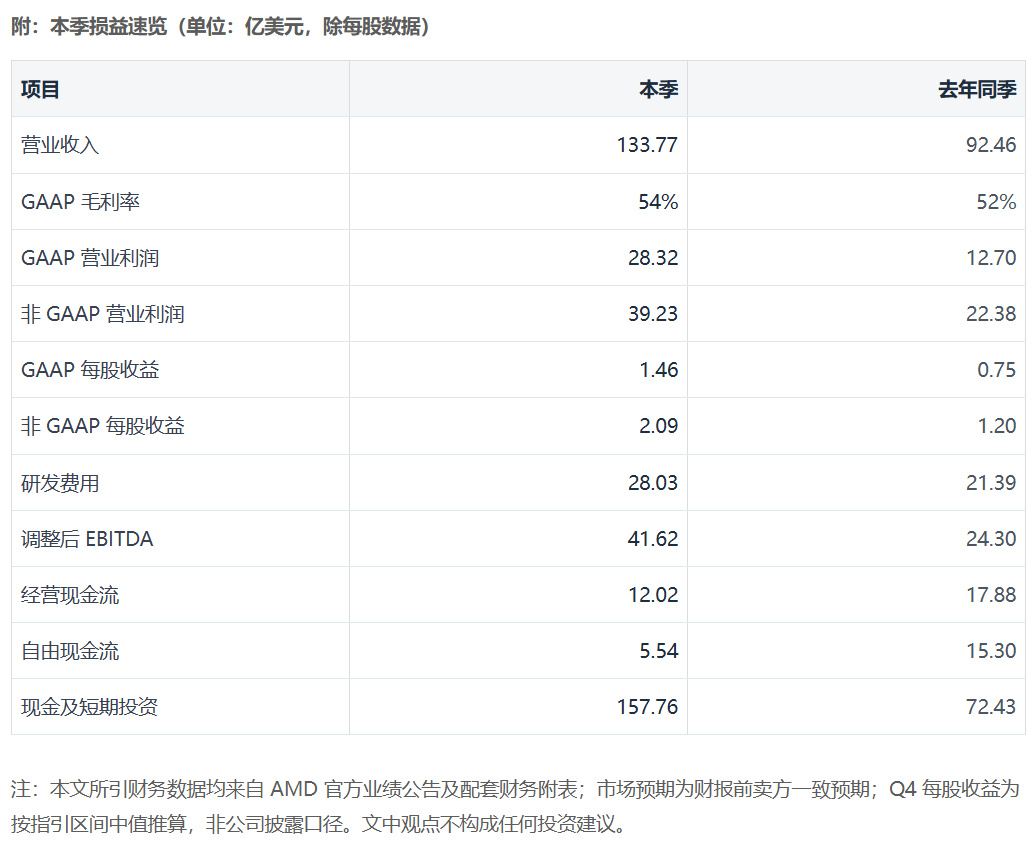
In a nutshell: revenue of $13.377 billion, non-GAAP EPS of $2.09, and Q4 guidance of $17 billion—all three beat expectations. Data center growth of 97% year over year was the clear star. There were two costs: gross margin guidance fell from 56% to 55%, and free cash flow dropped from $1.558 billion to $554 million. The market chose to focus on revenue first: the stock rose 6% after hours.
I. First, let’s lay out the numbers
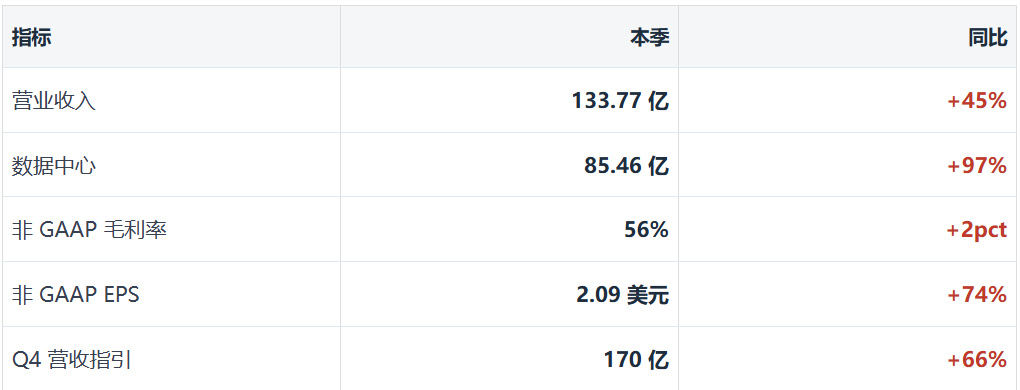
Source: AMD FY2026 third-quarter earnings release; quarter ended September 26, 2026. Guidance: $17 billion, ±3%.
For comparison, the original sell-side expectations were revenue of $13.08 billion to $13.1 billion, non-GAAP EPS of $1.93 to $1.95, and Q4 guidance of $16.14 billion. The actual figures were $13.377 billion, $2.09, and $17 billion—revenue beat by about 2.5%, EPS by about 7%, and Q4 guidance by 5.3%.
One line worth singling out was Lisa Su’s wording in the release: “Revenue exceeded the high end of our guidance range.” That’s not something you hear often in AMD’s context. In recent quarters, the company has tended to set guidance at a level it could “come in at the high end of, or slightly above.” This time, it clearly beat the top end. She also said Q4 would “accelerate” as Helios and “Venice” ramp up. That’s a commitment about next quarter, not this one, which makes it more significant.
II. Data center: not just growth, but expanding margins
$8.546 billion, up 97% year over year and 27% quarter over quarter, accounting for 63.9% of total revenue. In the same quarter last year, this segment generated $4.341 billion, or 47% of revenue. In just one year, AMD’s revenue mix has been completely transformed.
The more important figure is buried in segment profit: data center operating profit was $2.882 billion, for a margin of 33.7%. The same quarter last year, it was $1.074 billion, or 24.7%. In other words, as this business nearly doubled in size, its operating margin also expanded by 9 percentage points. That says more than the revenue growth rate: it means the scale benefits and pricing power of EPYC are, for now, outweighing the costs of the early MI450 ramp.
Growth is being driven by two businesses. One is EPYC server CPUs, with sixth-generation “Venice” preparing to take over while Turin and Genoa remain the mainstays this quarter. The other is the Instinct MI450 series GPUs, which officially launched this quarter. The release named the customers running the first Helios rack-scale systems: Anthropic, Meta, Microsoft, OpenAI, and Oracle Cloud Infrastructure (OCI). HPE won Vultr’s first Helios order, while European supercomputer initiative EuroHPC selected MI430X and sixth-generation EPYC to build LUMI-AI. This customer list is the strongest possible endorsement of capacity: five of the world’s largest AI buyers are all on board.
There’s another factor: ROCm 10 launched this quarter. Software has long been AMD’s biggest weakness compared with Nvidia. Every step forward here makes the unit economics of the MI450 look a little better.
III. Client and gaming: more resilient than expected
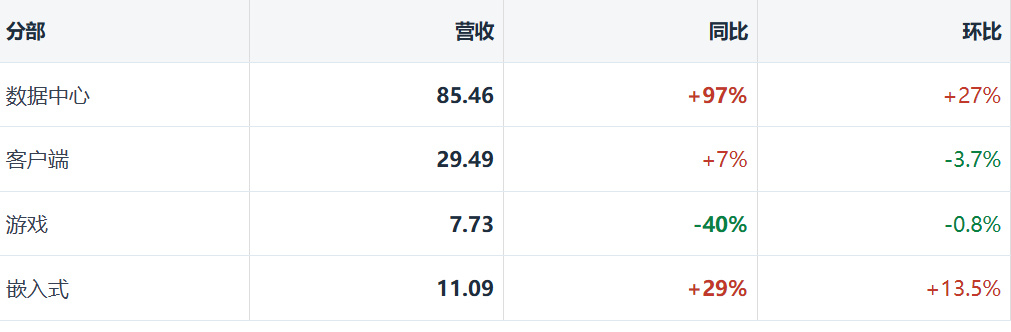
Units: billions of dollars. Client and gaming combined: $3.722 billion, down 8% year over year.
The market’s biggest concern was gaming. The sell-side expected a 49% year-over-year decline, down to $655 million. Actual revenue was $773 million, down 40%—a good deal better than even the most pessimistic expectations. The release was blunt about the reason for the decline: lower semi-custom (console chip) and discrete graphics revenue. Rising memory and storage prices pushed up the cost of complete systems, weighing on end demand. Apple also called this out on its earnings call; it’s not an AMD-specific issue.
Client revenue was $2.949 billion, up 7% year over year. It held up despite an overall decline in PC shipments, thanks to Ryzen mobile. But it was down 3.7% sequentially, and the seasonal PC slowdown in Q4, combined with rising memory prices, will probably push this segment down a bit further.
Embedded revenue was $1.109 billion, up 29% year over year and 13.5% sequentially. Operating profit was $453 million, for a margin of 40.9%—the highest among the four segments. Aerospace and defense, automotive, communications, and industrial all recovered together. This has been the market’s most overlooked segment, but it delivered a surprise contribution this quarter.
IV. The $17 billion Q4 outlook is the real highlight of this report
Guidance of $17 billion, ±3%, implies 66% year-over-year growth and 27% sequential growth. It beats the market’s original $16.14 billion estimate by about 5.3%. What makes this figure significant is that it isn’t driven by price hikes or a one-off order; it clearly reflects large-scale Q4 deliveries of Helios rack-scale systems.
Let’s do a quick estimate. At $17 billion in revenue and a 55% non-GAAP gross margin, gross profit would be about $9.35 billion. Assuming expenses rise around 4% sequentially to roughly $3.7 billion, operating profit would be about $5.6 billion, for an operating margin of 33%. Then, using a normalized tax rate of 13%, non-GAAP EPS would likely land between $2.90 and $3.00. The market’s original estimate was $2.65. In other words, the guidance already implies another roughly 10% upward revision to EPS—something sell-side analysts will need to build into their models over the next two weeks.
Full-year basis: 35.166 billion for the first three quarters, plus 17 billion in Q4, puts FY2026 at about $52.17 billion. FY2025 was $34.639 billion, for full-year growth of about 51%. Two years ago, that figure was still $25.7 billion.
V. Three details to keep a close eye on
1. Gross margin guidance falls from 56% to 55%
This is the only figure to move “down” this quarter, and the only thing the bears can latch onto. Since the start of 2026, AMD’s non-GAAP gross margin has held steady at 56%; Q4 guidance marks the first time the company has proactively lowered it, to 55%. The explanation makes sense: Helios is a rack-scale system delivered as a complete unit, including networking, liquid cooling, and assembly, so that revenue is naturally less profitable than selling chips alone. On top of that, HBM and memory prices are rising, pushing up material costs. CFO Jean Hu has also said that data center AI gross margins are slightly below the company average during the ramp-up phase.
The consensus sell-side forecast for Q4 gross margin was 55.5%, versus the company’s 55% guidance—a half-point shortfall. This quarter’s actual 56% also came in slightly below the 56.1% expected. It was the only miss in the entire earnings report. Before the report, one analyst wrote that the stock could fall more than 10% if gross margin guidance dropped below 56%. It didn’t fall; it rose instead. Revenue beat by $300 million and Q4 guidance by $700 million, overshadowing the half-point gross-margin shortfall. The real takeaway is that AMD is shifting from “selling chips” to “selling systems.” Revenue is getting heavier and margins thinner; that’s an inevitable cost of changing the business model, not a sign of weakening competitiveness.
2. $3.5 billion in profit, but just $550 million in free cash flow
Few people have mentioned this contrast. Operating cash flow this quarter was $1.202 billion, capital expenditure was $648 million, and free cash flow was $554 million, for an FCF margin of 4%. The sell-side had expected $1.97 billion, leaving a shortfall of $1.4 billion, down 64% year over year. The previous quarter came in at $1.558 billion, or 14%; the same quarter last year was $1.530 billion, or 17%.
Where did the cash go? Three balance-sheet figures tell the story: inventory rose from $7.920 billion at the start of the year to $11.463 billion (+45%); accounts receivable was $9.209 billion, up from $6.315 billion at the start of the year; and prepaid expenses and other current assets were $3.023 billion, up from $2.160 billion. Meanwhile, accounts payable surged from $2.929 billion to $7.756 billion. Suppliers are extending payment terms, but that’s nowhere near enough to cover the inventory build.
This is a standard inventory build ahead of large-scale Helios deliveries: racks need to be stocked with GPUs, CPUs, HBM, networking chips, and structural components before they can be delivered and converted into cash. The problem is that this quarter brought “strong profits, weak cash.” If Q4 deliveries go smoothly and cash flow turns positive, this will have been a smart move made ahead of time. If Q4 deliveries are delayed, $11.4 billion in inventory will immediately become a stone weighing on the valuation. The most important line to watch in next quarter’s report is actually operating cash flow, not revenue.
3. The $1.1 billion warrant expense
GAAP net income was $2.428 billion, or $1.46 per share; non-GAAP net income was $3.471 billion, or $2.09 per share. The $1.04 billion gap is mostly explained by one item: a $1.097 billion fair-value remeasurement of customer warrants—the expense recorded as warrants issued to OpenAI, Meta, and Anthropic rose in value along with AMD’s share price.
This expense doesn’t use cash, but it isn’t mere accounting noise either. It’s real consideration AMD is paying to secure gigawatt-scale orders, just in the form of equity. The side effect is awkward: the more the share price surges, the harder GAAP profit gets squeezed. AMD has more than doubled this year, and this expense has risen right along with it. There was another item this quarter: income tax was a $555 million benefit, not an expense, which lifted GAAP net income back up somewhat. Together, these two items made the gap between GAAP and non-GAAP large enough to invite misinterpretation. When looking at AMD’s profits, you have to use non-GAAP figures—but you also need to understand what accounts for the difference.
VI. Four questions likely to come up on the earnings call
First, Helios capacity. Management has previously said that 2027 data center revenue will at least double, with GPU revenue “well above $30 billion.” Q4’s $17 billion is the first building block on that path. Whether management can provide a volume outlook for the first half of 2027 will be the most important thing said on the call.
Second, Venice supply. The company has already guided to 80% year-over-year growth in server CPUs in the second half, but supply has remained tight. Last quarter, management acknowledged that a considerable portion of demand had been “unforecast.” The extent of any upward revision here will determine how high the CPU leg of the business can climb in 2027.
Third, is 55% a floor or just a waystation? If it’s a temporary low during the Helios ramp-up, the market can accept it. But if gross margin heads toward 54% for all of 2027, the “selling systems” story will need to be valued differently.
Fourth, customer concentration and guarantees. AMD previously disclosed that it had provided up to $4.1 billion in guarantees for customer leases. It also agreed to invest $1 billion in Meta’s equity offering and up to $5 billion in Anthropic. These arrangements secure orders, but they also tie AMD’s balance sheet to its customers’ ability to raise financing. A report last week said that smaller cloud providers had “effectively been shut out of the bond market in recent weeks.” That—not AMD’s own performance—is the real reason valuations have been slashed over the past month.
VII. The stock’s position: cheaper, but not cheap enough to buy with your eyes closed
AMD closed at $483.90 on November 3, up 3.65%, with a market cap of about $790 billion. After the report, it rose to around $530 in after-hours trading, up 10%, bringing its market cap back to roughly $835 billion or more. It’s still 20% below the October high of $658.52, and there’s still a way to go before it can claim a “trillion-dollar market cap”—that would take a share price above $610. The stock is still up more than 100% year to date.
On valuation, using the 2027 consensus EPS estimate of about $15.80, a share price of $511 implies a forward P/E of around 32 times, down from 36 times a month ago. But note that the $15.80 figure predates the earnings report. This quarter’s guidance is likely to push it above $17, which would bring the forward P/E back to around 30 times. That’s not expensive for a company growing revenue by 45% and potentially still above 40% next year. But it’s not cheap for a company with declining gross margins and deteriorating cash flow, either.
I originally thought this report wouldn’t trigger a one-way move: demand was fine and execution was fine, but margins were declining, giving bulls and bears arguments of their own. Instead, the stock jumped 8% to 9% after hours. This time, the market voted for revenue and guidance first, accounting for the half-point gross-margin decline but not pricing it in. The options market had implied a 9% move in either direction ahead of the report; the actual move landed near the lower end of that range. The report still confirms that demand and execution are fine. What it doesn’t answer is where AMD’s margin floor lies as revenue shifts from “selling chips” to “selling racks.”
Closing thoughts
If I had to sum up this earnings report in one line, it’s proof that AMD is moving from being an “AI story stock” to an “AI revenue stock.” With data center accounting for 64% of revenue, quarterly revenue of $8.5 billion, and nearly doubling year over year, there’s no need to tell the story with PowerPoint slides anymore.
The real uncertainty has shifted to 2027: As revenue grows from $17 billion to $25 billion, will gross margin keep sliding? Can $11.4 billion in inventory be turned into cash? And when will a sixth or seventh hyperscaler emerge beyond the five largest customers? The answers to these three questions matter far more than whether this quarter beat expectations.
As for the share price, short-term moves will be driven by sentiment. The midterm election results, the financing environment for AI capital spending, or Nvidia’s next earnings report could each overshadow AMD’s own numbers. That’s why, once the earnings report is out, the real pricing power lies elsewhere.