On Tuesday night, Binance released its first full investigation report, explaining how $6.34 billion got out.
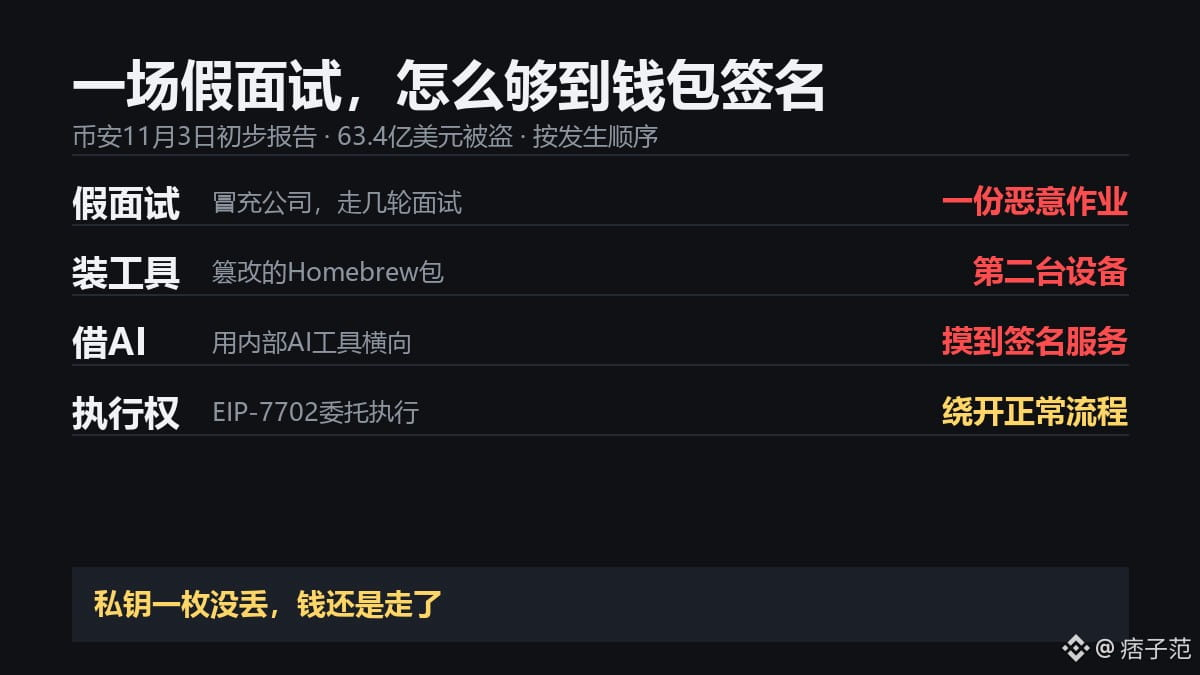
It started with a job application. The attackers impersonated a company and got in touch with a Binance employee. They went through several rounds of interviews, then gave him an “assignment” to run on his work computer. The assignment was malware. On another computer, a tampered Homebrew package was installed while setting up an AI coding tool.
Once they had both devices, the attackers didn’t go looking for private keys. They used Binance’s own internal AI tool to reach its wallet infrastructure and obtain signing privileges. The first announcement, on October 30, said an operations laptop had been compromised and the attackers had entered a service container. The report now says that there was more than one point of entry.
As in the previous announcement, the funds were moved out using EIP-7702: execution authority for the hot wallets was delegated to the attackers’ contract, bypassing the normal withdrawal process.
On the funds side, Binance had set aside compensation funds worth more than 100% of the losses. It has replenished 98% of the affected tokens, and about $2.85 billion has been frozen or intercepted, with reconciliation still underway. The frozen funds haven’t been returned to the accounts yet. Binance is bearing the losses itself.
One analyst said plainly that there’s no evidence AI was involved in planning the attack. The permissions of that internal AI tool are what let an employee’s computer reach the wallet signing service.
Going forward, when judging whether an exchange is safe, don’t just look at whether it says its private keys are intact—this time, not a single one was lost. Look at whether it explains the points of entry and how they were isolated. If those two things aren’t in the announcement, then they haven’t really been addressed.
It started with a job application. The attackers impersonated a company and got in touch with a Binance employee. They went through several rounds of interviews, then gave him an “assignment” to run on his work computer. The assignment was malware. On another computer, a tampered Homebrew package was installed while setting up an AI coding tool.
Once they had both devices, the attackers didn’t go looking for private keys. They used Binance’s own internal AI tool to reach its wallet infrastructure and obtain signing privileges. The first announcement, on October 30, said an operations laptop had been compromised and the attackers had entered a service container. The report now says that there was more than one point of entry.
As in the previous announcement, the funds were moved out using EIP-7702: execution authority for the hot wallets was delegated to the attackers’ contract, bypassing the normal withdrawal process.
On the funds side, Binance had set aside compensation funds worth more than 100% of the losses. It has replenished 98% of the affected tokens, and about $2.85 billion has been frozen or intercepted, with reconciliation still underway. The frozen funds haven’t been returned to the accounts yet. Binance is bearing the losses itself.
One analyst said plainly that there’s no evidence AI was involved in planning the attack. The permissions of that internal AI tool are what let an employee’s computer reach the wallet signing service.
Going forward, when judging whether an exchange is safe, don’t just look at whether it says its private keys are intact—this time, not a single one was lost. Look at whether it explains the points of entry and how they were isolated. If those two things aren’t in the announcement, then they haven’t really been addressed.