CAN CRYPTO NETWORKS FREEZE YOUR WALLET? 🚨🔒
Crypto users are taught that keeping their 12-word private key safe means complete ownership, but network control tells a different story. 👛🛡️
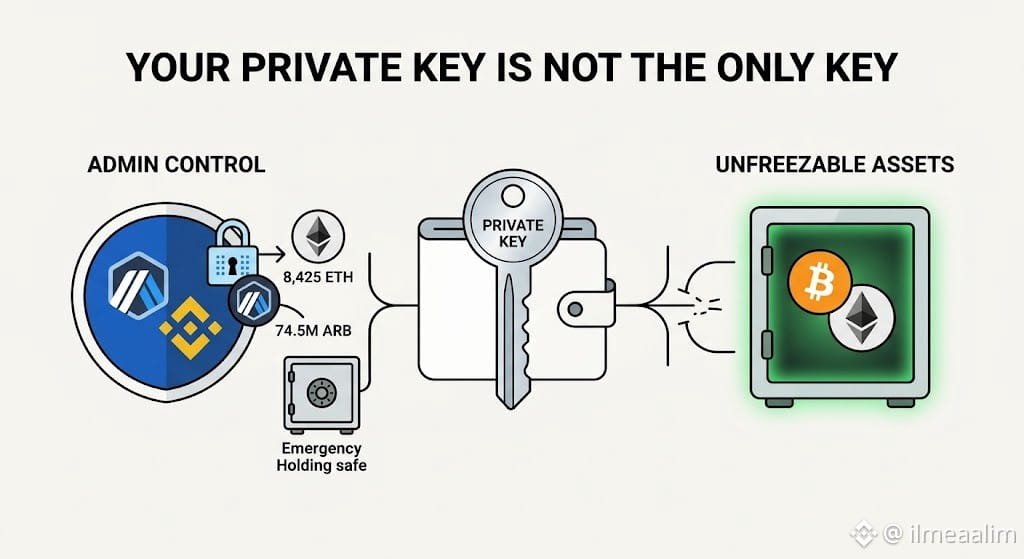
On 30 October 2026 after the Binance exploit, Arbitrum’s Security Council used a 9-of-12 emergency vote to move 8,425 ETH and 74,559,805.2 ARB (about $30.5M) out of an attacker-linked wallet into a frozen holding address without having the hacker’s private key. ⚙️🛑
Who holds freeze power vs who cannot:
🔶 Major Layer-2 networks like Arbitrum, Optimism, Base, and zkSync have emergency councils that can upgrade code or pause bridges.
🔷 Centralized stablecoins like USDT, USDC, and PYUSD have built-in address blacklists.
🔸 Upgradeable DeFi apps like Aave and cross-chain bridges operate under admin rules and verifiers.
🟩 Native Layer-1 coins held on their base networks like Bitcoin ($BTC), Ethereum ($ETH), and Litecoin ($LTC), along with immutable contracts like Uniswap V2/V3 pools, have zero admin keys and cannot be frozen. 🟢✨
Control is justifiable in recovery? 👇
#Crypto #Arbitrum #Security #Bitcoin #Binance