

Have you seen a coin like this: hundreds of thousands of U in spot trading volume in a day, several hundred million in futures volume, a 4x gain in 3 days, then a single candle plunges 30%? Why does this happen? Let’s discuss it together today.
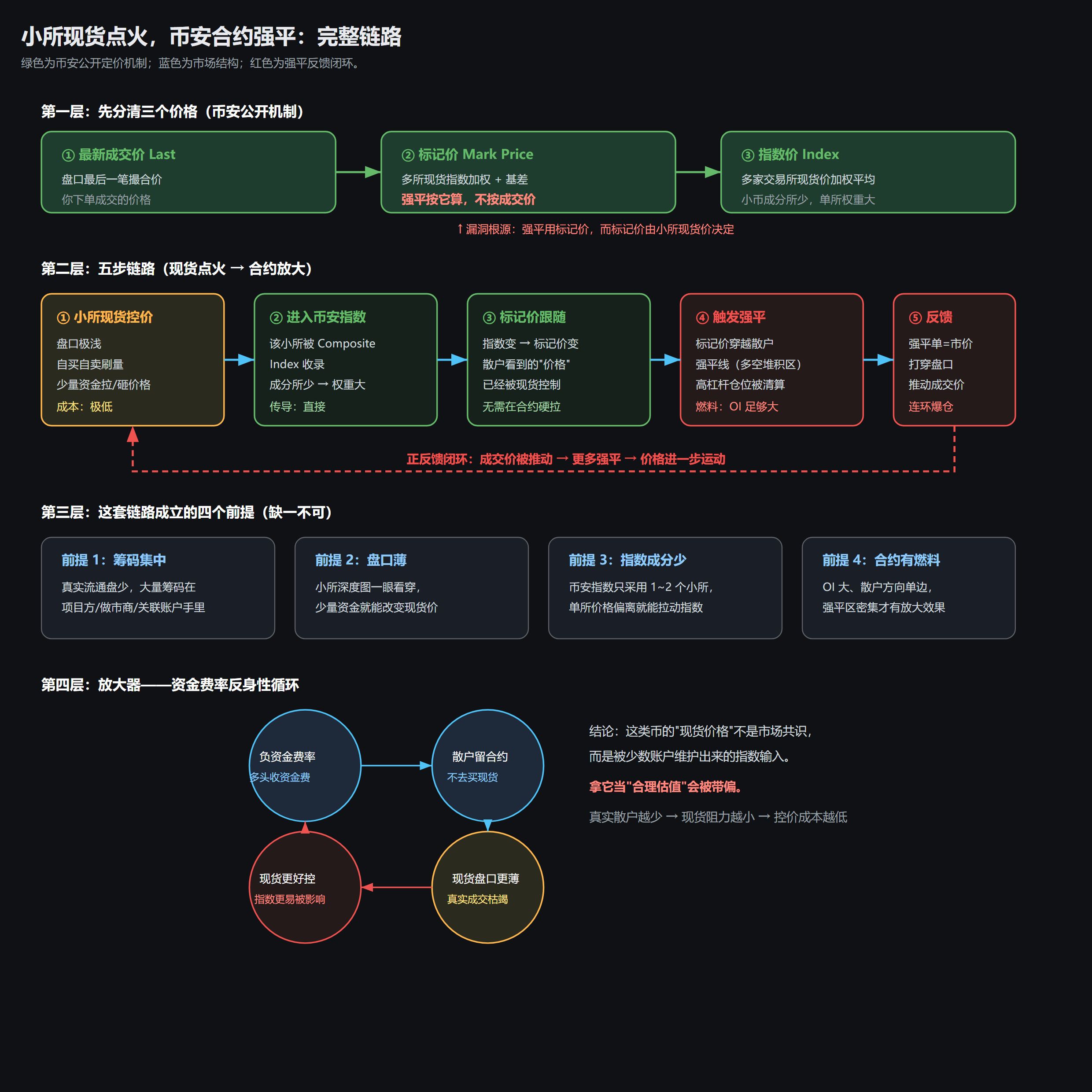
I. First, Distinguish the Three Prices
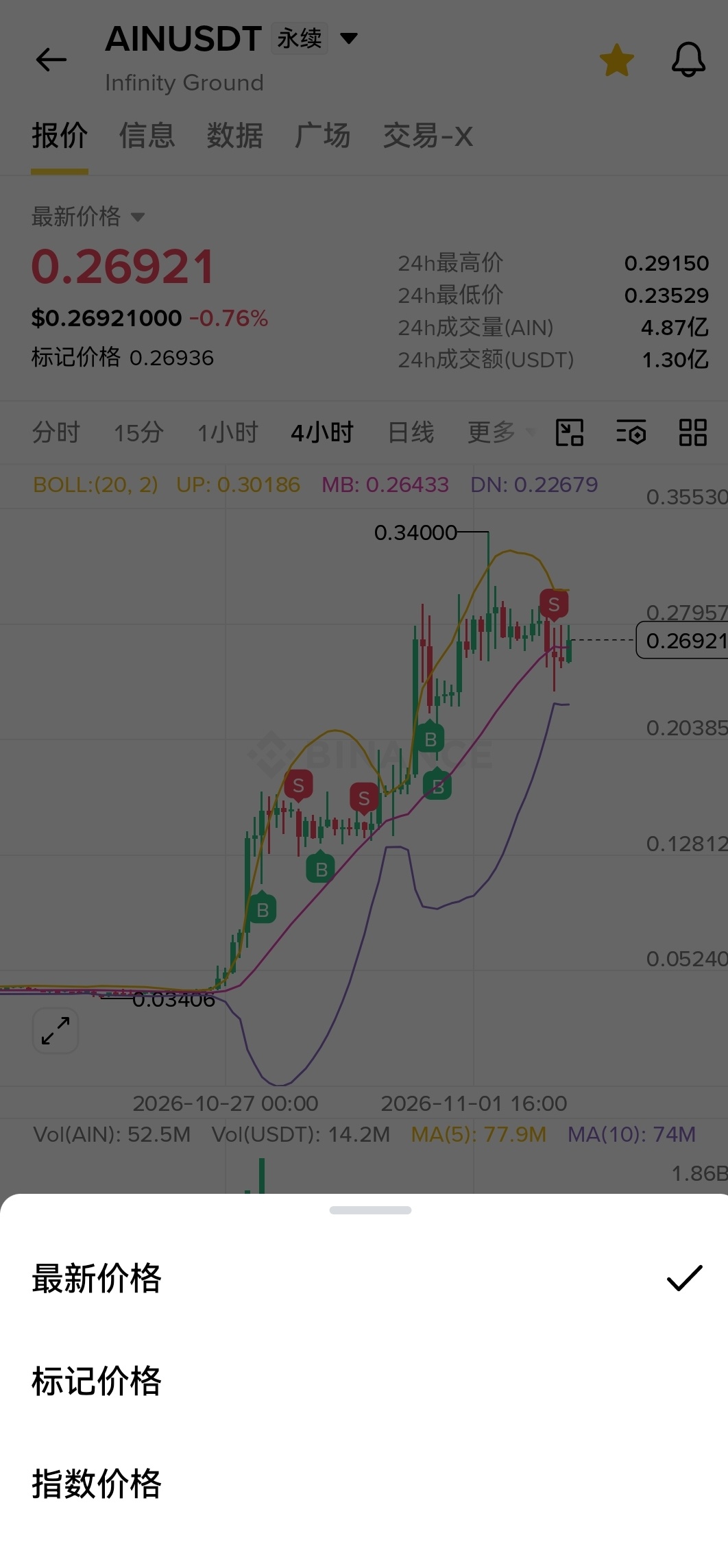
There are three prices in Binance futures, and many people confuse them. Understanding them is the foundation for understanding the whole mechanism:
① Last Price (Last): The price of the latest matched trade in the order book; it is also the price at which your order is actually filled.
② Mark Price: A price calculated as the weighted average of spot indexes from multiple exchanges. Binance uses it to determine liquidations, not the last traded price.
③ Index Price (Index): The weighted average of spot prices from multiple exchanges, which is fed into the mark price.
The key point: Liquidations are determined by the mark price, not the last traded price.
This is the root vulnerability in the whole chain: the mark price is not determined by Binance’s futures order book, but by spot prices on small external exchanges. The index for a small-cap coin often includes only one or two exchanges, so a price deviation on a single exchange can move the entire index.
II. The Five-Step Chain: Spot Ignites, Futures Amplify
Step 1: Controlling prices on a small exchange’s spot market: The order book on small exchanges is extremely shallow, and the amount of genuinely circulating tokens is small. Market manipulators trade with themselves to fabricate volume, using very little capital to push the spot price up or drive it down.
Step 2: Inclusion in the Binance index: The spot price on this small exchange is included in Binance’s Composite Index. Small-cap coin indexes include few exchanges, so each exchange carries significant weight and price deviations are passed straight through.
Step 3: The mark price follows: When the index changes, the mark price changes with it. The “price” retail traders see in futures is, in effect, already controlled by external spot markets; there’s no need to aggressively push the price up or down on Binance’s order book.
Step 4: Triggering liquidations: The mark price crosses liquidation levels where retail traders’ positions are clustered—the one-sided areas with an imbalanced long/short ratio—and highly leveraged positions are liquidated in a concentrated wave.
Step 5: Liquidation feedback: Liquidation orders are market orders that sweep through the futures order book, pushing the actual traded price further and triggering more liquidations, creating a positive-feedback loop.
In short: A small amount of money is spent to “ignite” the spot market, while highly leveraged futures positions and the liquidation system do the “amplifying.”
III. Four Prerequisites for This Chain to Work
Not every coin can be manipulated this way; all of the following conditions must be met:
Prerequisite 1: Concentrated token holdings: The genuinely circulating supply is small, with a large number of tokens held by the project team, market makers, or affiliated accounts.
Prerequisite 2: A thin order book: The depth chart on a small exchange is easy to read, and a small amount of capital can change the spot price.
Prerequisite 3: Few index constituents: Binance’s index uses only 1–2 small exchanges, so a price deviation on a single exchange can move the index.
Prerequisite 4: Fuel in the futures market: Open interest must be large enough, retail positions must be heavily concentrated in one direction, and liquidation levels must be densely clustered for amplification to work.
IV. Amplifier: The Funding Rate Reflexive Loop
This mechanism also has a self-reinforcing amplifier: the funding rate:
1. When the funding rate is negative, longs receive funding payments. Rational retail traders are willing to stay in futures and go long rather than buy spot.
2. With retail traders all moving to futures, real participation in the spot market keeps declining, making the order book thinner.
3. The thinner the spot order book, the less it costs market manipulators to control the price, and the easier it is for a handful of people to support the spot price.
4. The easier the spot price is to manipulate, the easier it is to affect futures liquidations through the index and mark price.
Conclusion: The “spot price” of these coins is not a market consensus; it is an index input that has been propped up. Treating it as a “fair valuation” will lead you astray.