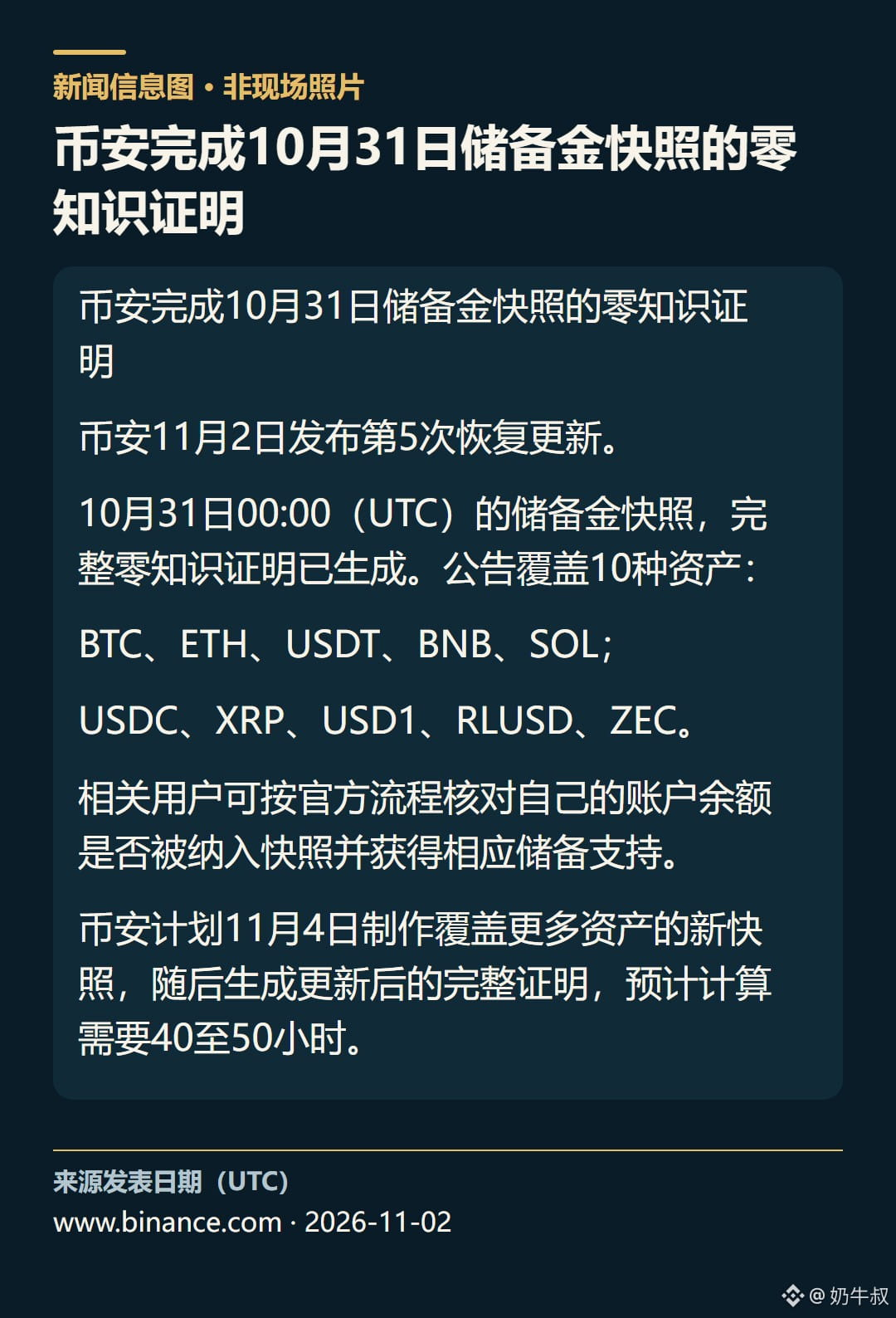

Binance completes zero-knowledge proof for October 31 proof-of-reserves snapshot
Binance发布 its fifth recovery update on November 2.
The complete zero-knowledge proof for the proof-of-reserves snapshot taken at 00:00 (UTC) on October 31 has been generated. The announcement covers 10 assets:
BTC, ETH, USDT, BNB, SOL;
USDC, XRP, USD1, RLUSD, ZEC.
Relevant users can follow the official process to check whether their account balances were included in the snapshot and are backed by the corresponding reserves.
Binance plans to take a new snapshot covering more assets on November 4, then generate an updated complete proof. The computation is expected to take 40 to 50 hours.
#Binance’s October 31 proof-of-reserves snapshot zero-knowledge proof has been generated
In my view, when verifying, the first things to check are the snapshot time, the asset scope, and what questions the proof can answer. A snapshot reflects only the point in time and scope it covers; by itself, it cannot establish the status of any later time or of other assets not covered. It’s worth continuing to track which assets the next round will add and whether individual verification is easy enough to use.
Would you prioritize checking whether your account balance was included, or first learning about the scope of zero-knowledge proof verification?