
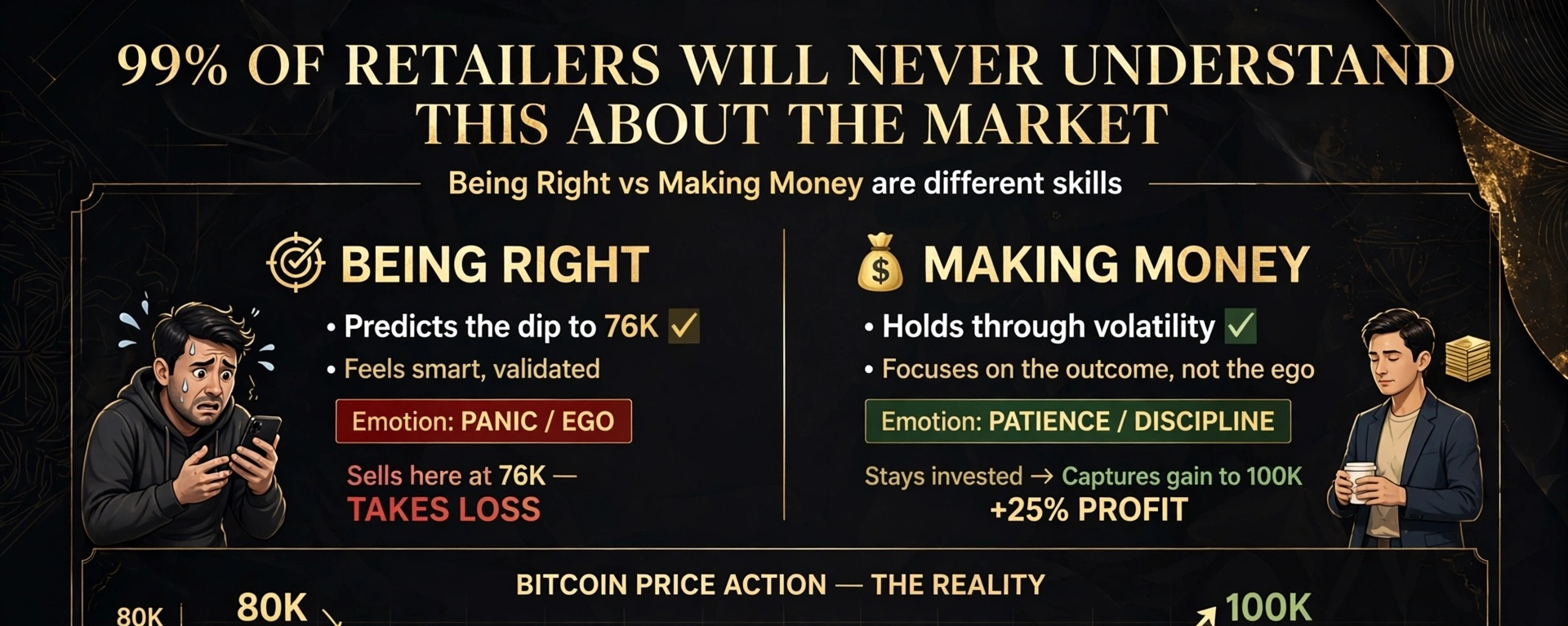

99% OF RETAILERS WILL NEVER UNDERSTAND THIS ABOUT THE MARKET.
After spending years in financial markets, I’ve noticed two big mistakes that almost every beginner makes.
1. Everyone wants the PERFECT ENTRY.
Why?
Because most people have limited capital.
They have $1,000, $5,000 or $10,000, and they want to buy the exact bottom and see the market pump immediately.
But think about it.
If making money was that easy, everyone would be a millionaire.
You enter Bitcoin at $80K and expect it to go straight to $100K.
But what happens?
It drops to $78K, then $76K.
Suddenly everyone starts talking about $60K.
You start doubting yourself.
You check the 5-minute chart.
Then the 15-minute chart. Then the 30-minute chart.
Every red candle scares you.
Eventually, you sell at a loss.
And a few weeks or months later, the market starts moving toward the exact levels you originally expected.
You got the direction right, but you still lost money.
Why?
Because being right about the market and making money from the market are two completely different skills.
The market doesn’t owe you a perfect entry.
It doesn’t care about your average price, your emotions or how badly you need money.
And most importantly, the market can move against you before it moves in your favor.
That’s where most people lose the game.
1. PEOPLE WANT TO GET RICH QUICKLY, BUT THEY DON’T KNOW HOW TO SURVIVE.
This is the biggest difference between an investor and a gambler.
A gambler asks:
“How much can I make from this trade?”
A professional asks:
“How much can I lose if I’m wrong?”
Read that again.
Smart investors don’t need to catch the exact bottom.
They identify good assets, important levels, accumulation zones and potential catalysts.
They build positions slowly.
They keep cash available.
They use DCA instead of going all-in at one price.
They understand that even a good asset can fall another before recovering.
And they don’t put themselves in a position where one bad move can destroy their entire portfolio.
That’s why I always tell beginners to focus on SPOT instead of futures and leverage.
No liquidation price.
No perpetual funding payments.
No forced exit from a leveraged position.
You can still lose money in spot, but you have more control over your holding period and position size.
Now imagine something.
You accumulate a quality asset during a major correction.
Your research suggests a possible 60–70% upside over the next 6–8 months.
That’s an opportunity worth studying.
But before buying, ask yourself:
* Why am I buying this asset?
* What is the catalyst behind the move?
* What is my expected upside?
* What happens if it drops & what’s my plan ?
* How much of my portfolio should I allocate?
* Where will I add, take profits or exit?
* How long am I willing to hold?
* What would prove my thesis wrong?
If you cannot answer these questions, you don’t have an investment plan. You have hope.
And hope without risk management is one of the most expensive things in financial markets.
Another thing I’ve noticed:
When markets are falling, retailers keep waiting for lower prices.
When markets start recovering, they don’t believe the move.
They short every bounce.
They get stopped out or liquidated.
Then they short again because they think the market has already pumped too much.
And eventually, the same people who were waiting for cheaper Bitcoin start buying it much higher.
They were afraid to buy when prices were low, and afraid to miss out when prices were high.
That’s how emotions destroy portfolios.
Understand something very important:
You don’t need to catch every move to become wealthy.
You need to survive long enough to catch the moves that matter.