
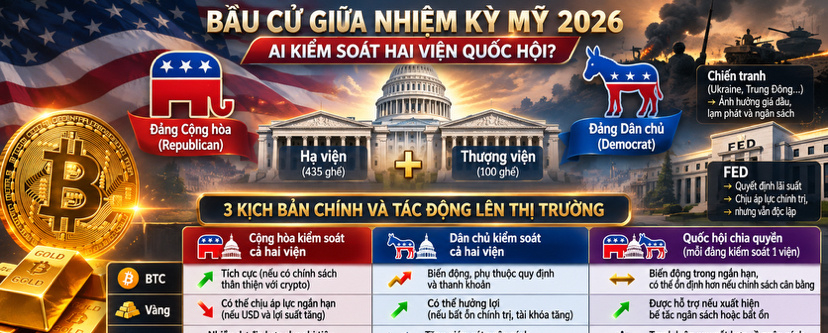

🇺🇸 2026 U.S. MIDTERM ELECTIONS: WHO WILL CONTROL BOTH HOUSES OF CONGRESS? WHERE ARE BITCOIN, GOLD, AND THE MARKETS HEADED?
On November 3, 2026, the United States enters a pivotal midterm election.
This is not simply a contest between the Republican and Democratic parties. The election results could shape the final two years of President Donald Trump's term, affecting tax policy, defense spending, wars, the national debt, cryptocurrency regulations, and even political pressure on the Fed.
But investors should focus on more than just who wins.
The key questions are: WHO CONTROLS THE HOUSE, WHO CONTROLS THE SENATE, AND WHAT CAN THEY DO TO U.S. POLICY?
1. A look back at midterm election cycles and Bitcoin
Bitcoin has experienced several noteworthy midterm elections:
* 2014: BTC entered a bear market after its 2013 peak, continued falling sharply, and bottomed in early 2015.
* 2018: BTC weakened during the election year, continued to plunge, and bottomed around December 2018.
* 2022: BTC came under pressure from high interest rates, a liquidity crisis, and the collapse of FTX. The cycle bottom formed in November 2022.
* 2026: BTC is going through a correction, and the market is watching for the possibility of a new cycle taking shape.
One statistic is particularly noteworthy: According to CoinDesk’s analysis, Bitcoin rose by an average of about 53.7% in the 12 months following the three midterm elections of 2014, 2018, and 2022.
However, don’t rush to conclude that the election caused BTC to rise.
These three elections also coincided with important periods in Bitcoin’s four-year Halving cycle. Therefore, the supply-and-demand cycle, liquidity, and macroeconomic conditions may better explain the price action.
Elections can act as a catalyst, but liquidity is the factor to watch.
2. What if the Republicans control both the House and the Senate?
This scenario would make it easier to implement President Trump’s agenda.
The administration could have more room to advance:
* Tax cuts and business support policies.
* Defense spending and the administration’s priority programs.
* Trade and energy policies.
* Initiatives related to digital assets and the crypto regulatory framework.
Impact on Bitcoin:
If crypto-friendly policies are advanced, the regulatory environment could become more favorable for businesses, exchanges, and institutional investors.
BTC could benefit from long-term expectations, but ETF inflows, liquidity, and actual demand would still need to confirm the trend.
Impact on gold:
If the market expects economic growth, tax cuts, and a stronger U.S. dollar, gold could face short-term pressure.
However, if defense spending, budget deficits, and public debt continue to rise, gold could still receive long-term support.
Impact on the war:
The administration may have an easier time passing defense budgets and foreign policy programs.
But that does not mean the war is certain to continue. Military decisions also depend on the President’s strategy, conditions on the ground, and the international response.
3. What if the Democrats control both chambers?
This scenario would significantly shift the balance of power in Washington.
The Democrats could:
* Strengthen oversight of the Trump administration’s decisions.
* Hold hearings and investigate foreign policy.
* Put pressure on war budgets and defense spending.
* Advance bills related to taxes, the cost of living, and limits on executive power.
Impact on the war:
This is a particularly noteworthy point.
Congress has the power to legislate and control the budget. If the opposition controls both chambers, the administration could face greater difficulty maintaining political and budgetary support for prolonged military operations.
Debates over the authority to use military force, the cost of war, and foreign aid could become more heated.
However, Congress cannot automatically end a war simply by gaining control of both chambers. Under the Constitution, the President retains executive authority and the role of Commander in Chief.
Impact on gold:
If political conflict, a budget impasse, geopolitical instability, or concerns about the fiscal deficit emerge, gold could benefit from safe-haven demand.
But if war tensions ease, oil prices cool, the U.S. dollar strengthens, and bond yields rise, gold could still see a pullback.
Impact on Bitcoin:
BTC could move in either direction.
On the one hand, political instability and concerns about public debt could lead some investors to seek out scarce assets.
On the other hand, if markets turn defensive and money flows out of risk assets, Bitcoin could fall alongside technology stocks.
You should not assume that Bitcoin always rises when political instability occurs.
4. What if control of Congress is split?
This is a scenario worth paying close attention to.
For example:
* The Democrats control the House.
* The Republicans continue to control the Senate.
In that case, the Trump administration would face a Congress that is harder to unite.
Major policies could be delayed, revised, or face hurdles during the approval process.
This could lead to:
* Prolonged budget debates.
* Difficulty passing major bills.
* Increased oversight of the administration.
* Political instability ahead of the 2028 presidential election.
For financial markets, this is not necessarily bad news.
A divided Congress can sometimes limit overly rapid policy changes and create a balance of power.
However, if a deadlock leads to the risk of a government shutdown or a debt-ceiling crisis, markets could react negatively.
5. The FED: Who really decides interest rates?
This is probably the most important issue for BTC, gold, and stocks.
Many people believe that if one party controls Congress, it can directly pressure the FED to cut interest rates.
But the reality is more complicated.
The FED is an independent central bank. Congress sets monetary policy objectives, but the FOMC is the body that decides the stance on interest rates.
Congress can:
* Oversee and question the FED Chair.
* Amend the laws governing the FED’s operations.
* Take part in confirming nominees to the Board of Governors through the Senate.
The President can nominate FED governors, but the Senate must confirm them.
Therefore, election results can affect the political environment and future appointments, but they do not mean that one party can order the FED to cut interest rates immediately.
What investors should watch:
* CPI and PCE inflation.
* The unemployment rate.
* U.S. Treasury yields.
* The DXY index.
* Statements by the FED Chair.
* Market interest rate expectations.
If the FED cuts interest rates while inflation is under control, liquidity improves, and the U.S. dollar weakens, that could create favorable conditions for BTC and gold.
But if the FED has to keep interest rates high because the war drives up oil prices and inflation returns, both assets could face pressure.
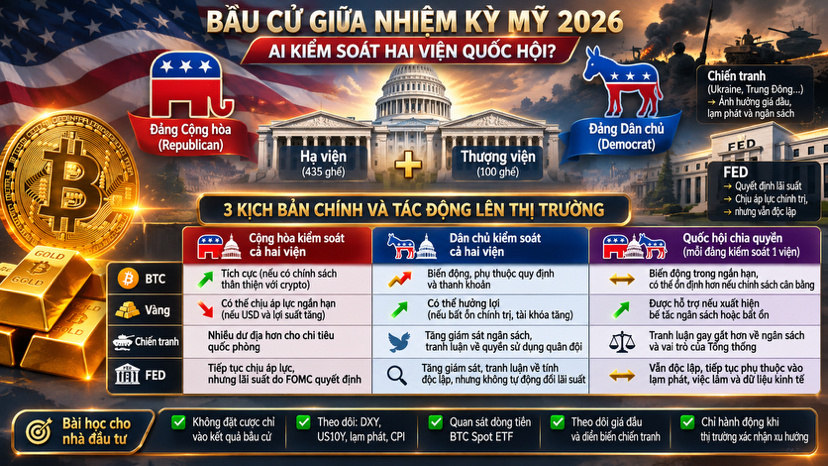
6. Summary table: Three political scenarios and their impact on markets
Scenario A – Republicans control both chambers
* BTC: Could benefit if crypto-friendly policies are introduced and inflows increase.
* Gold: Could face pressure if the U.S. dollar and yields rise; still supported if public debt and geopolitical risks increase.
* War: The administration would have more political leeway, but that does not mean the war will necessarily expand.
* FED: Political pressure could continue, but interest rate decisions remain with the FOMC.
Scenario B – Democrats control both chambers
* BTC: Could be volatile due to policy uncertainty; the outlook would still depend on crypto regulations and liquidity.
* Gold: Could benefit if instability, fiscal risks, and geopolitical risks increase.
* War: Oversight and debate over budgets and the authority to use military force could increase.
* FED: Could face greater scrutiny and debate over its independence, but interest rates would not automatically change.
Scenario C – Congress is divided
* BTC: Could be volatile in the short term, but policy gridlock could also limit major changes.
* Gold: Could receive support if fiscal, political, or war-related instability emerges.
* War: Budgets and executive authority could become subjects of heated debate.
* FED: Remains independent in conducting monetary policy, despite political scrutiny.
Note: These are conditional potential impacts, not definite price forecasts.
7. What should investors watch after November 3?
I wouldn’t rush to buy or sell just because of the election results.
I would watch six signals:
1. DXY: Is the U.S. dollar strengthening or weakening?
2. US10Y: Are 10-year Treasury yields rising or falling?
3. Gold: Is its uptrend holding?
4. BTC: Is it holding key support levels?
5. BTC Spot ETF: Is institutional capital flowing in or out?
6. Crude oil: Is the war disrupting supply and driving inflation higher again?
If BTC rises, DXY falls, yields decline, and ETFs see inflows, that would be a more positive combination for the crypto market.
Conversely, if the war drives up oil prices, inflation heats up, the FED has to keep interest rates high, and the U.S. dollar strengthens, markets could face another correction.
8. My personal view: Don’t just look at the election results—watch the money flows
I believe three major variables will determine the direction of the market in late 2026 and 2027:
First: U.S. fiscal policy.
Public debt, budget deficits, defense spending, and the possibility of issuing more bonds.
Second: FED monetary policy.
Interest rates, liquidity, bond yields, and the strength of the U.S. dollar.
Third: Geopolitics and war.
If the conflict continues, oil prices rise, and inflation increases, the FED may find it difficult to ease policy. This is a paradox: war-related uncertainty could support gold while simultaneously putting pressure on BTC through interest rates and liquidity.
CONCLUSION
U.S. midterm elections are not an independent buy signal for Bitcoin or gold.
They are an event that can shift the balance of power, shape fiscal policy and war budgets, and affect political pressure on the FED.
History shows that Bitcoin has risen sharply in the 12 months following recent midterm elections, but the Halving cycle and liquidity conditions have also played a major role.
In my view, a sensible strategy is not to guess which party will win and bet all your assets on it.
Watch the election results, track how the U.S. dollar, yields, and ETF flows respond. Act only when the market confirms a trend.
In investing, sometimes missing an upside opportunity is better than buying at the wrong time and paying for it with your own assets.
#Bitcoin #BTC #Gold #XAUUSD #MidtermElections #FED #Trump #Crypto #MacroEconomics