


Source: Jin10 Data
Voting in the 2026 U.S. midterm elections got underway nationwide on November 3, as Wall Street began assessing the impact of different political scenarios on stocks, bonds, and the tech sector.
JPMorgan conducted a scenario analysis of four possible post-election configurations of congressional control. The results show that Democrats have the highest chance of regaining control of both the House and Senate, at 66%; the probability of Democrats controlling the House while Republicans hold the Senate is 26%; the chance that Republicans retain control of both chambers is just 7%; and the probability of the two parties splitting control of the chambers in opposite directions is the lowest, at only 1%.
However, the most likely outcome does not necessarily mean the most favorable one for stocks. J.P. Morgan estimates that Republicans retaining control of both chambers of Congress could instead lift the S&P 500 by 1% to 1.25%, more than under any of the other three scenarios.
This view finds some support in historical experience. CNBC’s analysis of market performance following past U.S. elections also showed that U.S. stocks typically post positive returns after an election. Still, different political configurations could alter market expectations for regulation, fiscal spending, and the risk of corporate investigations.
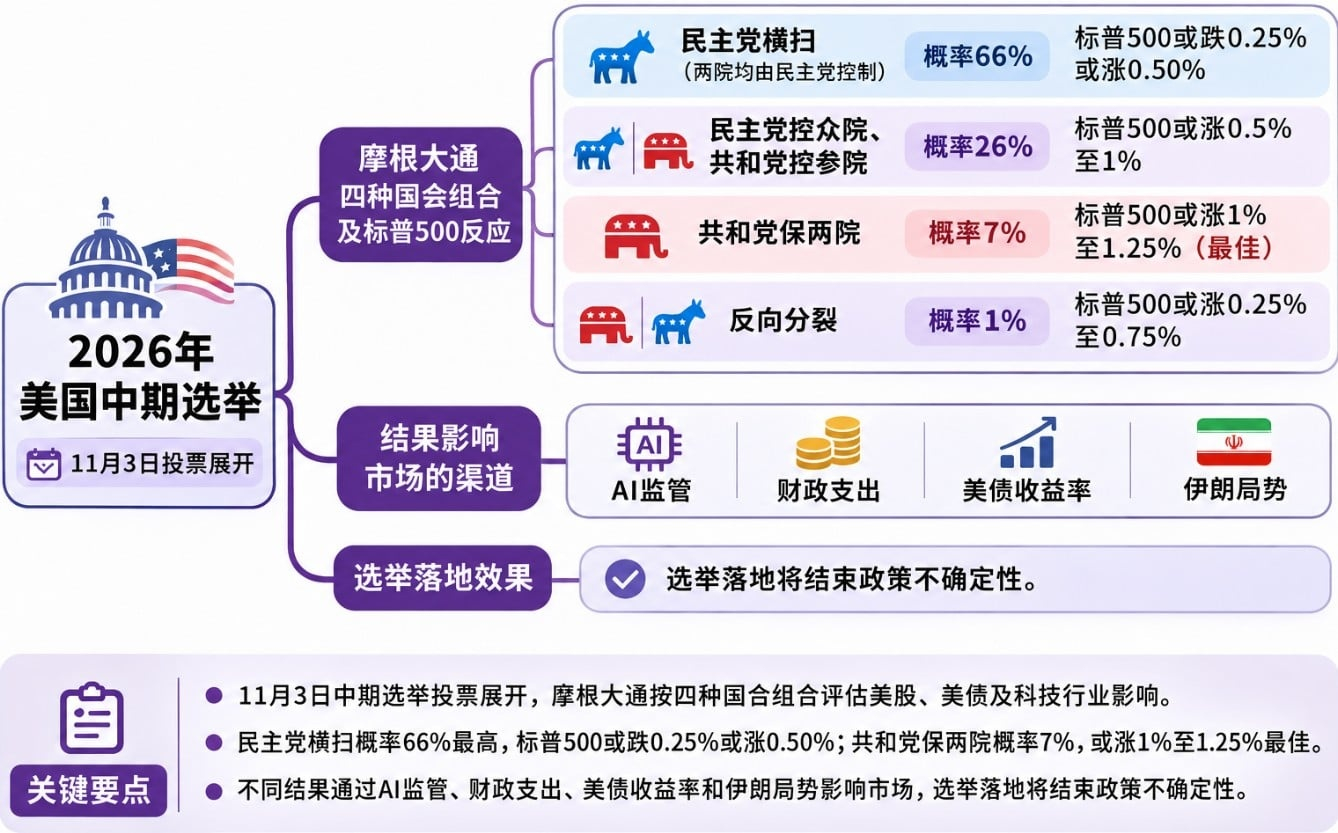
Four possible election outcomes and their market impact
1. Democratic sweep of Congress: 66% probability; the S&P 500 could fall 0.25% or rise 0.50%.
This is the outcome J.P. Morgan considers most likely: Democrats gain control of both the House of Representatives and the Senate.
Under this scenario, the S&P 500 is projected to fall 0.25% or rise 0.50%.
The AI industry could be among the first areas affected. The market is concerned that a Democratic sweep of Congress could lead to stricter regulations that constrain data center construction and tech company expansion, triggering a sell-off in AI-related stocks.
However, J.P. Morgan believes that even if Congress passes legislation restricting the development of the AI industry, it would be difficult to secure enough votes to override President Trump’s veto. The firm therefore advises traders to consider buying tech stocks on pullbacks.
The bond market could react differently. With Democrats in control of Congress, deficit-financed spending could decline, putting downward pressure on long-term U.S. Treasury yields and potentially lifting bond prices.
Meanwhile, executives at some companies linked to political donations to Trump could face greater risk of congressional investigations.
2. Divided Congress: Democrats control the House, Republicans control the Senate; 26% probability; the S&P 500 is projected to rise 0.5% to 1%.
This scenario means Democrats regain the House while Republicans retain control of the Senate.
J.P. Morgan expects the S&P 500 to rise 0.5% to 1%.
Markets could welcome this divided balance of power, as legislation could easily stall in Congress, making it difficult for either party to push through major policies or expand government spending on its own.
However, with Democrats in control of the House, they could still influence government fiscal affairs, potentially pushing long-term U.S. Treasury yields lower.
In addition, the risk of congressional investigations facing some companies and their leaders would not go away.
3. Republican “red wave”: 7% probability; the S&P 500 is projected to rise 1% to 1.25%.
The likelihood of Republicans retaining control of both the House and the Senate is relatively low, with J.P. Morgan assigning this scenario a probability of just 7%.
But if this outcome occurs, the S&P 500 could rise 1% to 1.25%, making it the best-performing of the four scenarios for the market.
The main reason is that continued Republican control of Congress would mean markets would not immediately face new congressional regulatory risks, while tech companies could avoid additional policy pressure stemming from a change in the political landscape.
But this scenario also carries potential risks. Trump could continue military action against Iran, while the federal government’s deficit-financed spending could increase further, driving long-term U.S. Treasury yields higher.
4. Reverse split of Congress: Republicans control the House, Democrats control the Senate; 1% probability; the S&P 500 is projected to rise 0.25% to 0.75%.
This is the outcome J.P. Morgan considers least likely, with a probability of just 1%.
Under this scenario, the S&P 500 is projected to rise 0.25% to 0.75%.
With the two parties controlling separate chambers of Congress, legislation would still face obstacles, but this could also lead to more intense budget battles and even a federal government shutdown.
In addition, Democrats would retain the power to conduct congressional investigations with control of the Senate, meaning related companies and individuals could continue to face the risk of investigations.
Markets may be waiting for political uncertainty to fade
Across the four scenarios, J.P. Morgan’s estimates reveal a noteworthy pattern: a Democratic sweep of Congress is the most likely outcome, but the expected boost to U.S. stocks is limited. By contrast, Republicans retaining control of both chambers—a scenario with just a 7% probability—could deliver the largest short-term gain.
The projected performance under the two divided-government scenarios falls between these outcomes, with the S&P 500 expected to rise 0.5% to 1% and 0.25% to 0.75%, respectively.
Different outcomes could also affect markets through different channels. AI regulation and the risk of corporate investigations could affect tech stock valuations, changes in fiscal spending could drive volatility in long-term U.S. Treasury yields, and developments in Iran could further affect energy prices and market risk appetite.
Whatever political configuration ultimately emerges, the election results will bring an end to a period of policy uncertainty. For traders waiting for a signal on direction, that may be exactly what the market needs most.