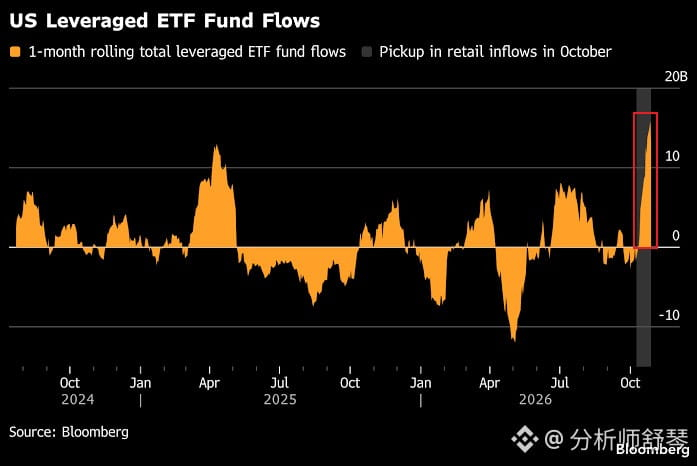
Have U.S. retail investors gone crazy? Leveraged ETF inflows hit their highest level in nearly two years. What’s next for U.S. stocks...?
As shown in the chart, the orange area represents rolling monthly flows into leveraged ETFs. For more than two years, they fluctuated between negative $12 billion and positive $8 billion, then suddenly surged above $15 billion in October—a striking anomaly.
The most popular fund among retail investors was SOXL, which offers three times leveraged exposure to semiconductor stocks. It saw net inflows of around $7.3 billion in October, a monthly record, with most buying concentrated at relatively high levels in early to mid-October.
Historically, periods of retail investors going wild with leverage have often been followed by sharp volatility. With so much money concentrated in leveraged tech funds, even a slight change in the wind could magnify selling pressure.
Leveraged ETFs reset daily. They’re designed as short-term tools, but people are treating them like long-term bets. If the market pulls back again, forced liquidations can happen even faster than the rally did.
Then there’s the so-called midterm election curse in the U.S.—the market takes a big hit every time there’s a midterm election. I’ve reminded you about this four or five times in the second half of this year. I hope it’s been helpful.
So now we’re seeing all kinds of baffling crashes. Intel, for example, can fall 30% in a single day, and Google hasn’t fared much better.
But have you ever considered this: if retail investors are wiped out and leveraged positions are heavily liquidated, could that be our opportunity?
It’s possible! Of course, U.S. stocks are still falling hard, and we may not be at the bottom yet. But their value is gradually becoming more compelling.
It’s probably best to build positions gradually, entering in at least two or three stages. The same goes for Bitcoin. Getting things roughly right can already help you significantly outperform the market.
I’m Xiaoqin. Follow me for daily updates on the U.S. markets~