Seven in ten stocks were rising—so how did SOXL lose 15% in a day?
Let’s start with the numbers: I’m siding with the bears.
U.S. stocks didn’t actually crash at Monday’s close. The Dow was up 0.41% at 51,983, the S&P 500 fell just 0.51%, and the Nasdaq dropped 1.07% to 25,164.
But chip stocks crashed on their own.
The Philadelphia Semiconductor Index fell 3.37%, and the Nasdaq 100 has dropped more than 10% from its early-October high, officially entering a technical correction.
One market recap counted that seven in ten S&P 500 components still closed higher on Monday, while chip stocks shed over $400 billion in market value in a single day.
The 3x leveraged semiconductor ETF SOXL got hit hardest.
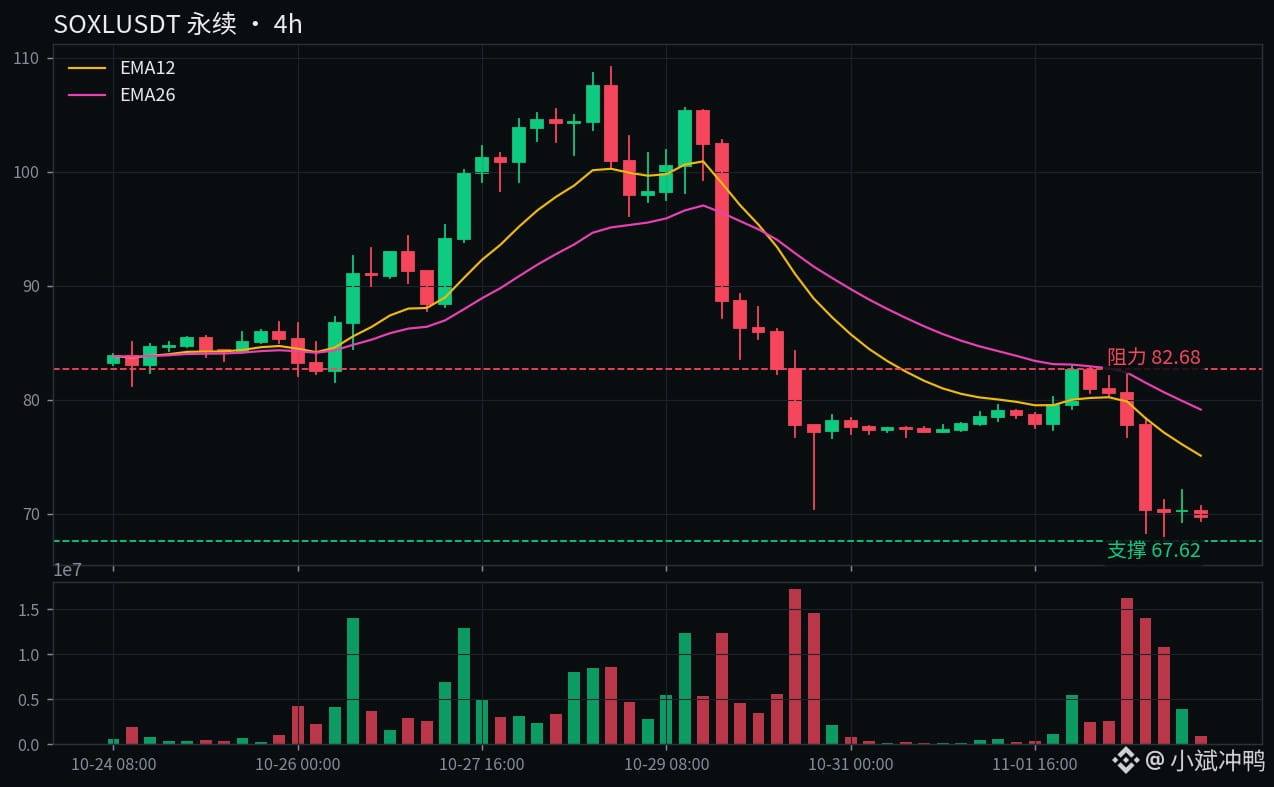
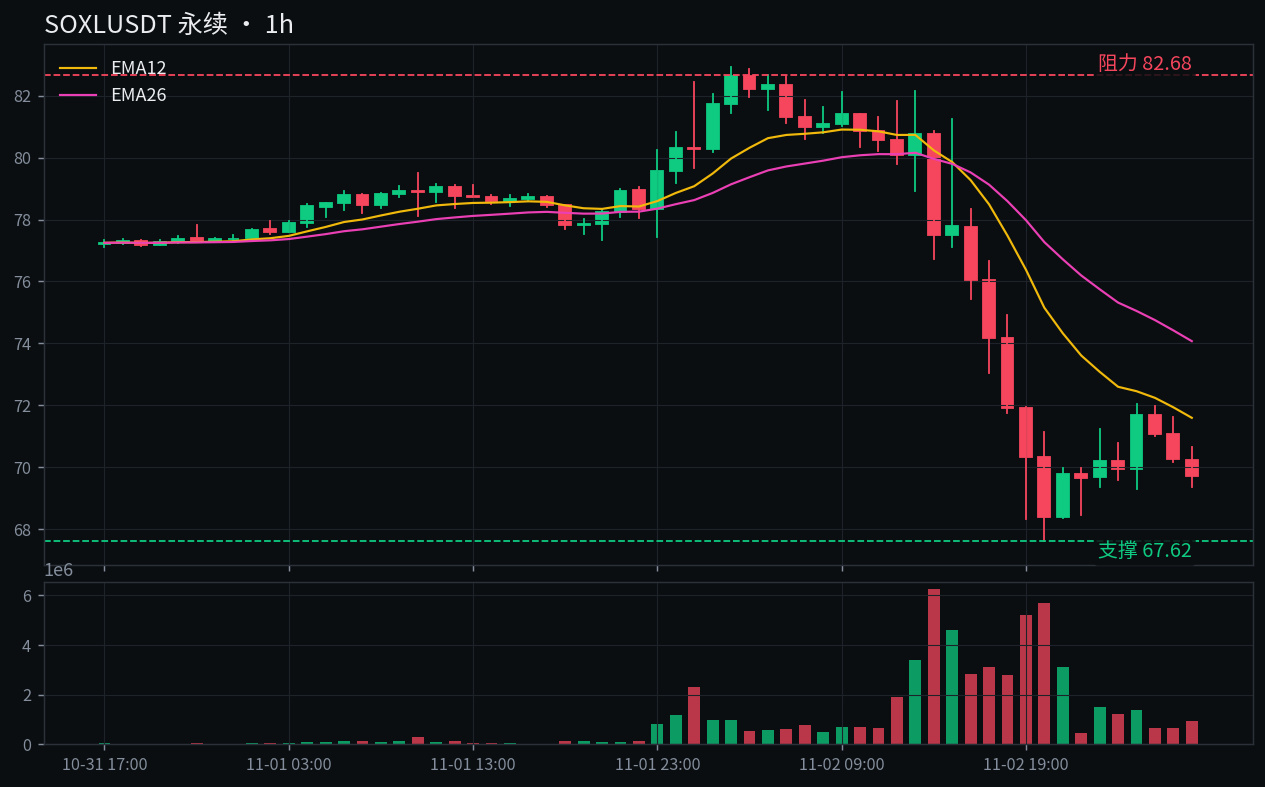
Spot SOXL closed Monday at $68.17, down 11.5% for the day. The token was down 15.2% over 24 hours and is now around $69.70.
The 24-hour high was $82.68, the low was $67.62, and trading volume for the day was $3.76 billion.
Its inverse counterpart, SOXS, surged 16.8% on the flip side, with $420 million in volume. The shorts really made money that day.
Here’s the bull case.
Nvidia fell just 1.23%, holding up much better than the sector. The leader hasn’t caught up on the downside yet, which suggests the market hasn’t written off AI across the board.
AMD reports after the close tonight. If its Q4 guidance beats expectations, one strong green candle could pull SOXL from $67 back toward $80.
The Philadelphia Semiconductor Index has already fallen nearly 12% in three days. It’s oversold in the short term, and the fuel for a rebound is already there.
Here’s the bear case.
Intel was the source of the guidance shock. It fell another 8.8% on Monday to $59.97, after Friday’s disastrous guidance sent it tumbling nearly 29%.
The entire memory chain has broken down: Micron fell 5.78%, SanDisk dropped more than 6%, and Western Digital and Seagate fell more than 7%. This isn’t a problem with just one or two stocks.
Both sides’ shareholders voted with their feet on Marvell’s $115 billion acquisition deal: the buyer and seller were both crushed on the same day. Nobody trusts the math behind AI spending anymore.
The most painful part is leverage itself. The sector fell 3.37% in a day, but spot SOXL dropped 11.5% in a day and is down 48% over the month. In a choppy market, holding 3x leverage means getting worn down day after day.
Here’s what I think.
Put simply, this isn’t a U.S. stock market crash. Chip stocks are being repriced on their own.
People used to take AI spending on faith. Now they’re checking the receipts one by one.
I’m siding with the bears—not because I’m bearish on AI, but because until those receipts have been checked, there’s no floor under high-valuation stocks, and there’s even less of one under 3x leverage.
Tonight’s AMD report is the next receipt. If its Q4 guidance is vague, the sector will have to look for support lower down.
Scenarios.
A move back above $77.78 would count as a recovery attempt. That was the closing price of Monday’s sell-off candle on the 4-hour chart. If it gets back above that level, watch $82.68.
If it breaks below $67.62, the next stop is the round-number level of $60. With 3x leverage, the drop could happen faster than you think.
What am I going to do?
I’m staying out of this one. I can’t handle the volatility of 3x leverage, and I’ve learned the hard way often enough that trying to catch the bottom can leave you buying halfway down.
If it gets back above $77.78, I’ll admit I was wrong—I won’t stubbornly defend my call. If it breaks below $67.62, my thesis still holds.
Will it recover above $77.78 and bounce, or break below $67.62 and get dragged down further by 3x leverage? I’m betting on the latter. What about you?
$SOXL $SOXS $NVDA
#半导体 #U.S.Stocks