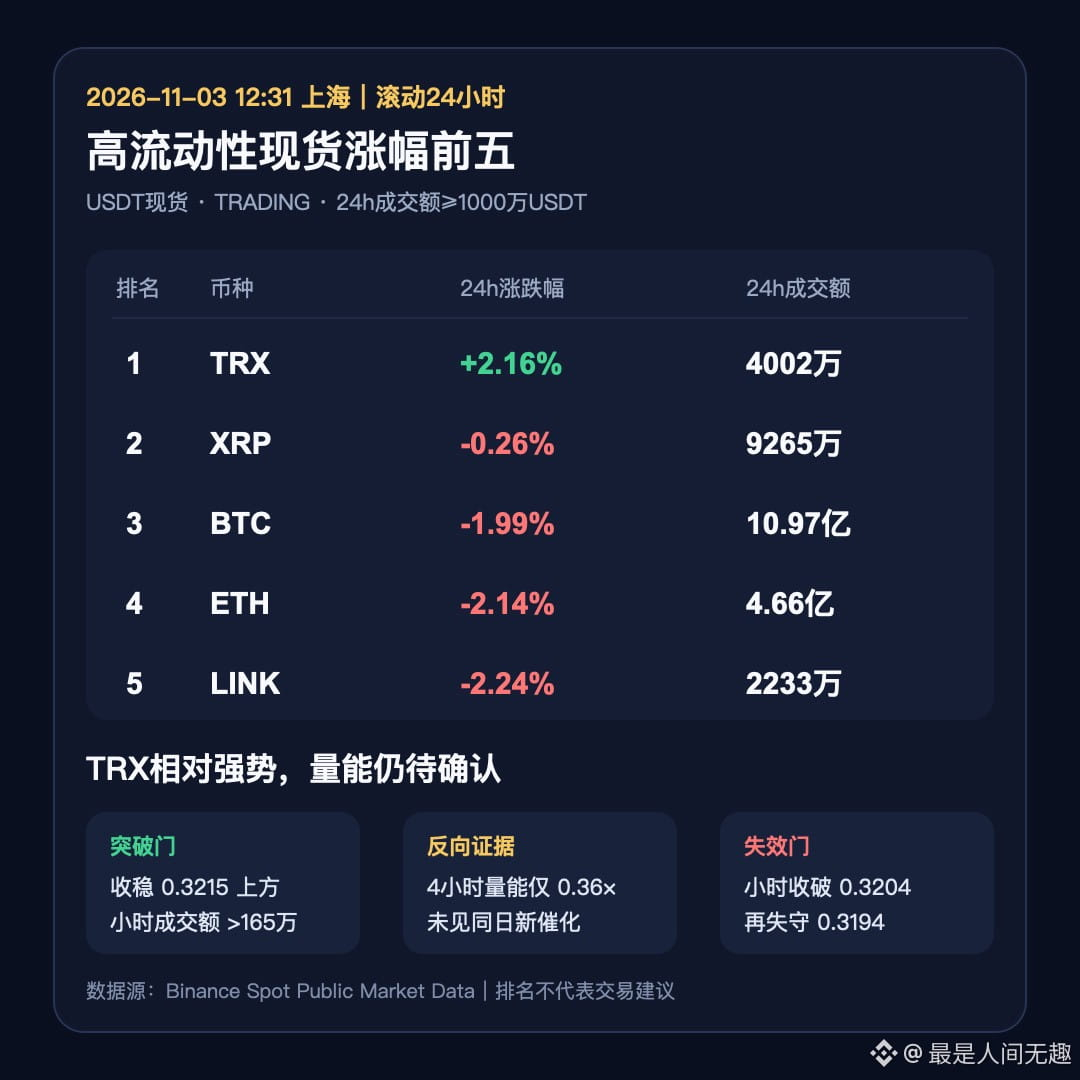
Only $TRX is positive among the top five gainers: relative strength does not mean a breakout has already occurred
The rolling 24-hour leaderboard at 12:31 showed a counterintuitive result: among 21 eligible assets, only TRX was up. The criteria were Binance spot TRADING pairs quoted in USDT, with trading volume of at least 10 million USDT, excluding stablecoins, fiat currencies, leveraged tokens, and abnormal assets.
The top five, in order, were: TRX +2.16%, with approximately 40.02 million USDT in trading volume; XRP -0.26%, approximately 92.65 million; BTC -1.99%, approximately 1.097 billion; ETH -2.14%, approximately 466 million; and LINK -2.24%, approximately 22.33 million. Note that this is a rolling 24-hour ranking, not a calendar-day return. When the broader market is falling, assets in the “top five gainers” may still have negative returns.
Why is TRX worth watching, and why shouldn’t you follow the leader based on its ranking alone?
Fact one: TRX’s snapshot price was 0.3212, close to its 24-hour high of 0.3215. The latest completed hourly candle closed at 0.3215, up 0.28%, with trading volume of approximately 1.61 million USDT—about 0.97 times the average of the previous 24 completed hourly candles. The price is near its high, but hourly volume is only around its usual level, with no clear increase yet.
Fact two: TRX rose 0.63% over the latest completed 4-hour period, closing at 0.3215, with trading volume of approximately 4.66 million USDT—just 0.36 times the average of the previous 24 completed 4-hour candles. By comparison, XRP’s trading volume over the same 4-hour period was about 0.94 times its average, while BTC’s reached 1.50 times its average. The market has indeed favored TRX’s relative price strength, but higher-timeframe volume has not confirmed sustained acceptance.
Primary sources provide context only: on October 28, TRON DAO confirmed that Blockchain.com had launched TRX options in eligible regions. Binance’s initial resumption of withdrawals on November 1 also included TRX and the TRON network. However, I found no new official catalyst on November 3 that could independently explain this rally. Presenting older background as the direct cause of today’s rise would overstate the causal link.
Here’s a three-step way to verify the move: if a completed hourly candle closes above 0.3215, trading volume exceeds approximately 1.65 million USDT, and volume picks up over the next completed 4-hour period, the strength may develop from “holding up better” into a “confirmed breakout.” If the price stays between 0.3204 and 0.3215 while volume remains low, it looks more like consolidation near the highs. If a completed hourly candle closes below 0.3204, followed by a break below 0.3194, the strength behind its top ranking is starting to fail; the 24-hour low of 0.3138 is a deeper risk level.
The main risks are sudden ranking changes as the rolling window moves, weakness across the broader market, low-volume false breakouts, and overinterpreting the options product or resumption of withdrawals. First, open $TRX and check whether real-time hourly trading volume can exceed approximately 1.65 million USDT. Then see whether 0.3215 holds on a closing basis and whether 0.3204 holds. Decide for yourself whether to participate only after confirming that relative strength has turned into genuine additional buying.