$CL $BNB
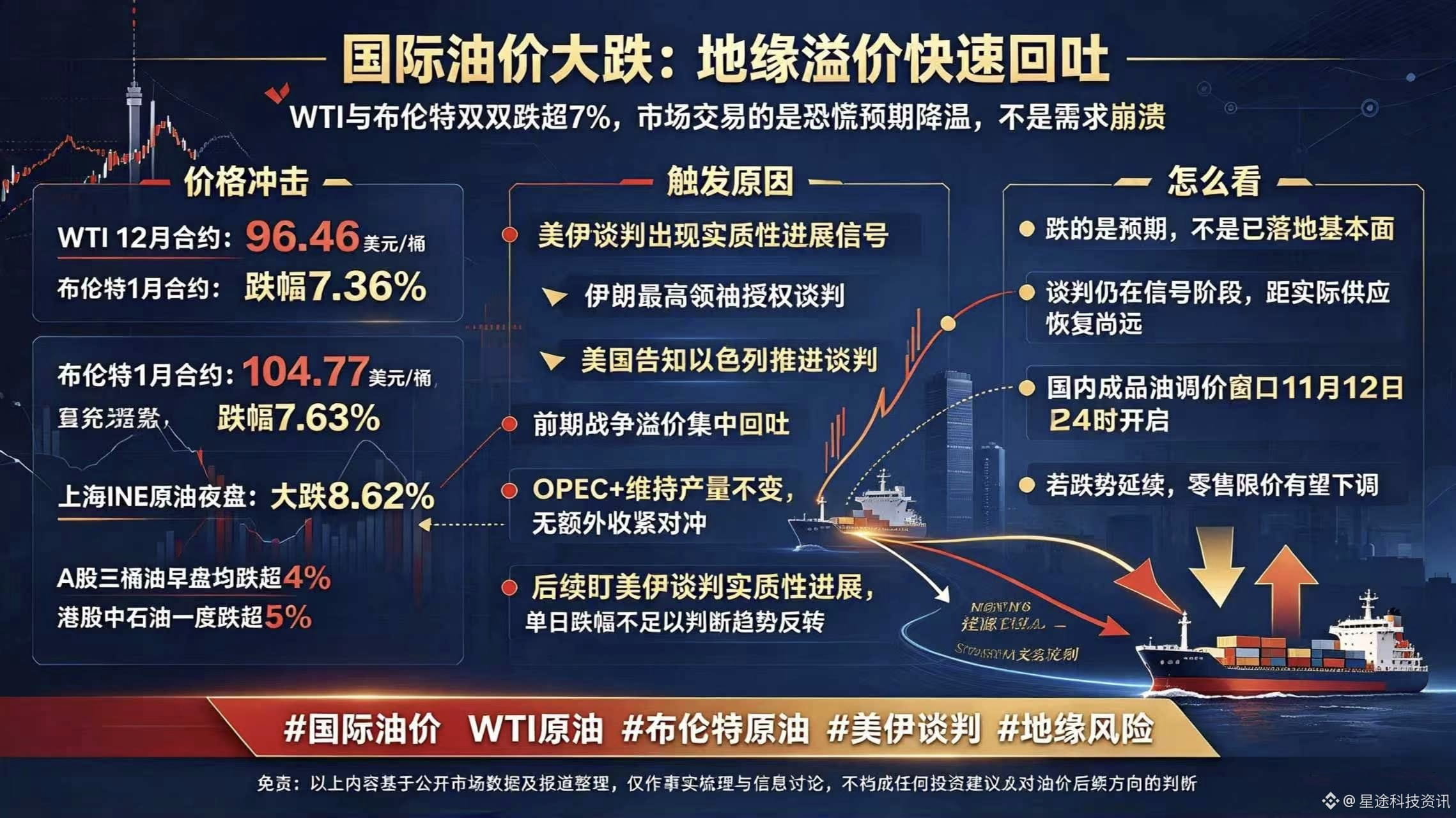
International oil prices have plunged over the past two days, with both WTI and Brent falling by more than 7%—their biggest single-day losses in three months. It’s real; just look at the data.
WTI crude (December contract) settled at $96.46 per barrel, down 7.36%, after briefly falling below $100 during the session. Brent crude (January contract) settled at $104.77 per barrel, down 7.63%, hitting a three-week low. The sell-off also spread directly to China: Shanghai INE crude oil futures fell 8.62% in overnight trading; the three major Chinese oil companies listed on the A-share market were all down more than 4% in morning trading, while PetroChina briefly fell more than 5% in Hong Kong.
Why the sudden plunge? The main reason is that the geopolitical risk premium is rapidly evaporating.
The immediate trigger was a sign of substantive progress in US-Iran negotiations. Iran’s Supreme Leader has authorized the government to negotiate, and the US president has told Israel that he hopes to advance the talks. Before this, Brent had approached $118, while WTI was around $105, and the market had accumulated a large “war premium.” With the emergence of signals that negotiations may proceed, much of that risk-driven positioning was rapidly unwound.
In addition, OPEC+ kept production unchanged, with no further supply restrictions to offset cooling demand expectations. Some algorithmic trading also amplified the volatility. Data show that trend-following funds cut their Brent long positions from 100% to 91% at the open. With selling pressure piling on, the losses widened.
How should we view this drop?
The main thing falling is “expectations,” not the underlying fundamentals that have already materialized. Negotiations are still at the signaling stage, and a substantive recovery in supply remains some way off. So this sharp drop reflects easing fears of supply disruptions—not a genuine lack of demand for oil.
For China, the impact is direct. The next window for adjusting domestic refined-oil prices opens at 24:00 on November 12. If the decline continues over the next few trading days, domestic retail price caps may also be lowered. Whether oil prices will turn lower from here depends on substantive progress in US-Iran negotiations. A single day’s decline is not enough to tell.
#国际油价下跌 #原油
The above content is compiled from publicly available market data and media reports. It is provided solely as a factual summary and for informational discussion, and does not constitute investment advice or a prediction of the future direction of oil prices.