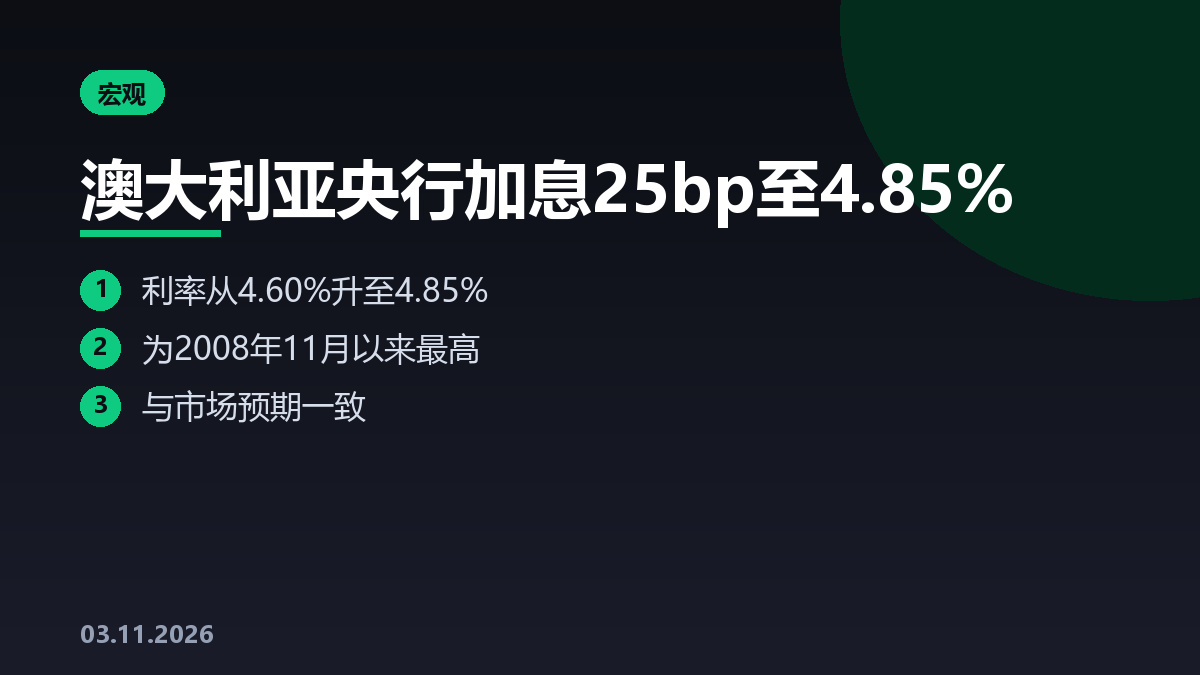
The Reserve Bank of Australia raised rates by 25 basis points on November 3, lifting the benchmark rate from 4.60% to 4.85%—its highest level since November 2008.🔴
The result was exactly in line with market expectations, with no surprises.
But I think the key point is precisely that there were “no surprises.” Rates are back at an 18-year high, showing that inflationary pressures in Australia have not truly eased. The central bank has chosen to keep tightening rather than wait and see.
Now look at the global picture: the Federal Reserve just raised rates on September 16, its first hike since 2023. With two major central banks shifting toward tighter policy one after the other, the narrative that “rate cuts are just around the corner” no longer holds up. Markets will have to readjust to an environment where “higher rates last for longer.”
For traditional markets, an expected rate hike has limited impact on its own, but it will further reinforce higher-rate pricing. The Australian dollar gets support from the interest-rate differential, bond yields are likely to rise, and the links between the U.S. dollar and interest rates in other countries will be amplified.
I’m more cautious about crypto markets. Risk assets like $BTC are highly sensitive to liquidity. Synchronized tightening by multiple countries means higher funding costs, making leveraged capital more vulnerable. If another central bank follows suit, risk appetite is likely to cool first, and any rebound may prove less sustainable.
What really matters is not this rate hike in Australia, but which central bank will be the next to raise rates. Which one do you think it will be?
#RBA #InterestRates #AUD