Only 1 of 22 assets is up. Has $BTC 's decline “flushed out” the sellers?
Bottom line first: risk appetite has cooled noticeably, but “a big drop” does not mean selling pressure has been fully exhausted. The most important task now is not to guess the bottom, but to determine whether any rebound is confirmed by both capital flows and market breadth.
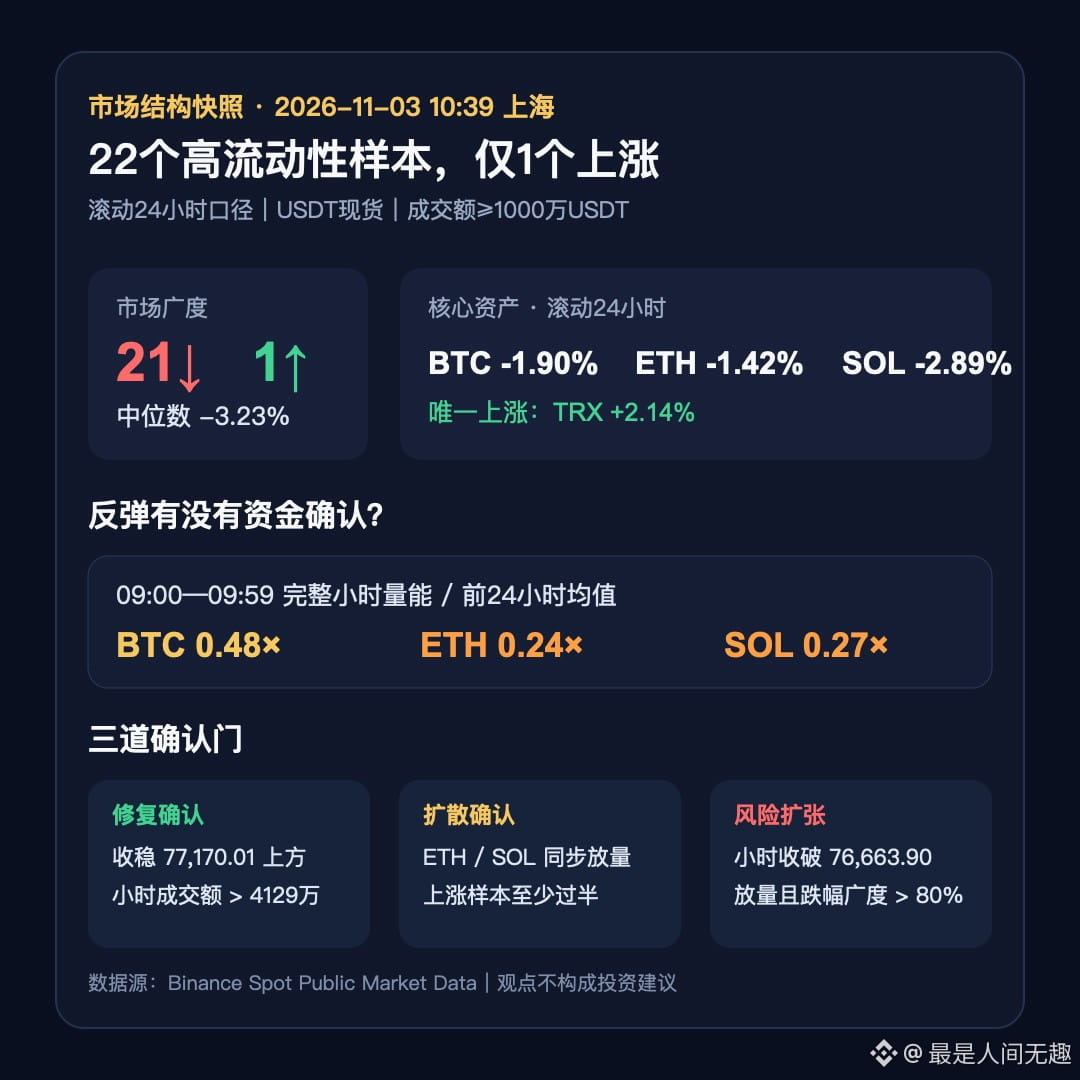
Facts | Binance spot public data snapshot at 10:39: Using TRADING assets that are spot-tradable, USDT-denominated, and have 24-hour trading volume of at least 10 million USDT—and excluding stablecoins, fiat currencies, leveraged tokens, and abnormal assets—there were 22 assets in the sample: 21 down and 1 up, with a median return of -3.23%. BTC was down 1.90% over the rolling 24 hours, ETH 1.42%, and SOL 2.89%; TRX was the only asset to rise, gaining 2.14%. This suggests weakness is not limited to a single coin, but reflects a broader pullback in risk exposure.
However, trading volume offers evidence in the opposite direction: during the full hour from 09:00 to 09:59, BTC rose just 0.05% and closed at 77170.01, with trading volume of about 19.86 million USDT—only 0.48 times the average of the previous 24 complete hourly periods. Volume for ETH and SOL was even weaker over the same period, at just 0.24 and 0.27 times their respective averages. In the preceding complete 4-hour period, BTC closed at 76816.00, with trading volume of about 118 million USDT, also only 0.62 times the average of the previous 24 complete 4-hour periods. For now, this looks more like a low-volume recovery attempt than a confirmed capitulation or trend reversal.
Next, assess the recovery against three criteria:
First, for the recovery to hold, BTC needs to close a complete hourly period back above 77170.01, while trading volume should clearly exceed the previous 24-hour average of about 41.29 million USDT. Price gains without volume could still be nothing more than a brief rebound.
Second, to see whether the recovery is broadening, watch for ETH and SOL's complete hourly trading volumes to return to around their respective averages, and for at least half of the highly liquid assets in the sample to be up. If only a handful of coins are holding up, that does not mean risk appetite has returned to the market.
Third, if BTC closes another complete hourly period below 76663.90 on above-average volume, while the share of declining assets remains above 80%, the risk-expansion scenario will regain the upper hand. Conversely, if that low holds and both volatility and trading volume continue to contract, the market is more likely to consolidate near the lows than to move decisively in either direction right away.
My view: There is not enough evidence to declare a bottom, but there is also no need to treat a low-volume rebound as confirmation that the decline will continue. This view would be invalidated if BTC holds above 77170.01 on rising volume, ETH and SOL also see rising volume, and market breadth shifts to more than half of assets advancing. If this combination appears, the current “weak recovery” assessment should be upgraded. Key risks include intraday false breakouts, thin liquidity during certain sessions, and sudden macroeconomic or project-related events that alter correlations.
Click $BTC to first check whether real-time volume for a complete hourly period has exceeded about 41.29 million USDT. Then see whether the close confirms either 77170.01 or 76663.90, and use ETH, SOL, and the number of advancing assets to verify whether the rebound is truly broadening before deciding for yourself whether to participate.