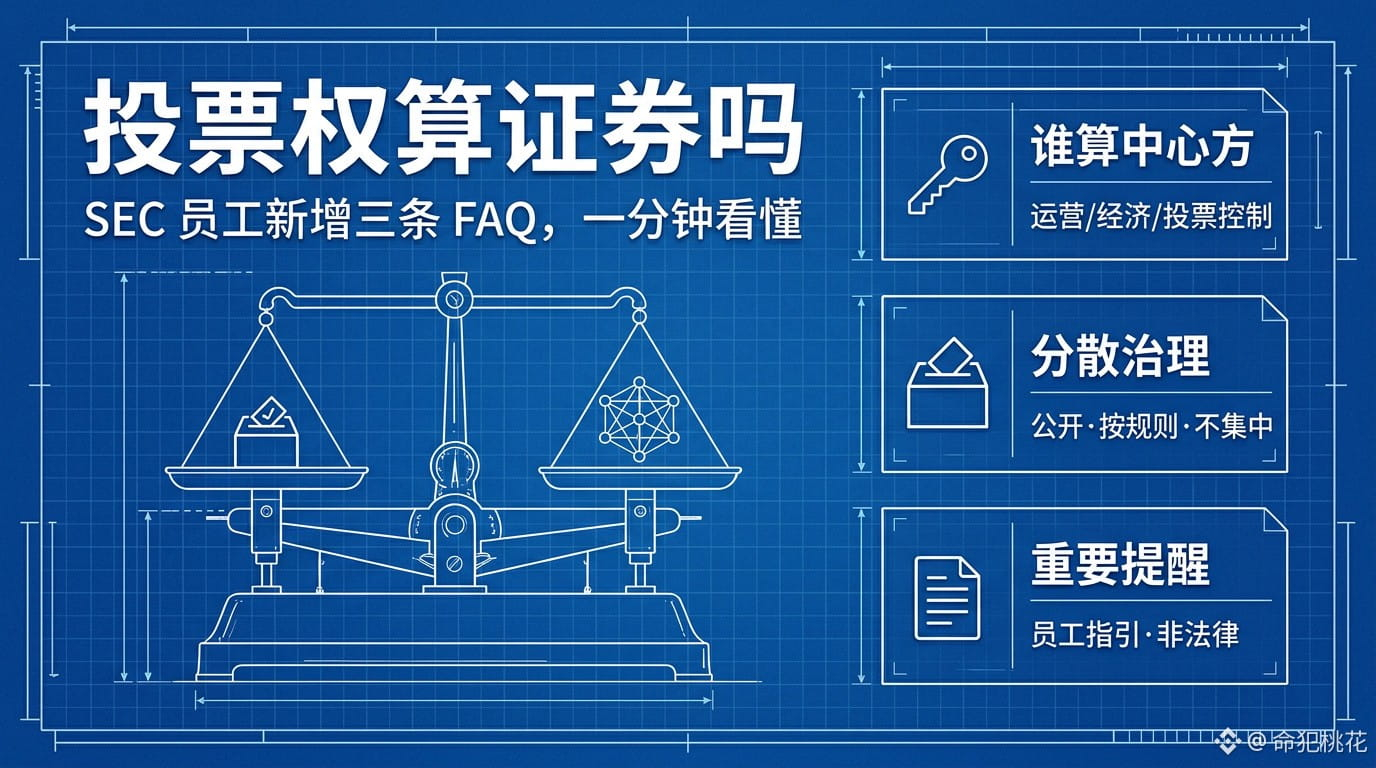
On November 2, the SEC’s Division of Corporation Finance added three new entries (1.4–1.6) to its crypto asset FAQ, addressing a question that many newcomers find confusing: Could “governance tokens” that people vote with be treated as securities simply because they carry voting rights?
The short answer: The staff guidance suggests that when voting is public, conducted according to established rules, and power is decentralized—with independent holders voting individually—the holders generally wouldn’t be considered “a single control group.” But if a company or small group can unilaterally change the code, restrict access, select validators, or roll back transactions, centralized control may still be found to exist.
Two things to keep in mind:
1. This is the SEC staff’s interpretation. It has no legal force, is not a new law, and does not automatically classify any token as a commodity.
2. Whether a project is “truly decentralized” depends on how voting power is actually distributed, not on what the white paper says.
What this means for everyday investors: When looking at governance tokens, don’t focus only on the name. Pay attention to how concentrated token ownership is and who can change the smart contracts. Governance tokens like $UNI are attracting attention, but regulatory clarity doesn’t guarantee a particular price.
Do you usually check a project’s governance proposals and voting distribution?
#SEC #治理代币 #CryptoExplained
Not investment advice.