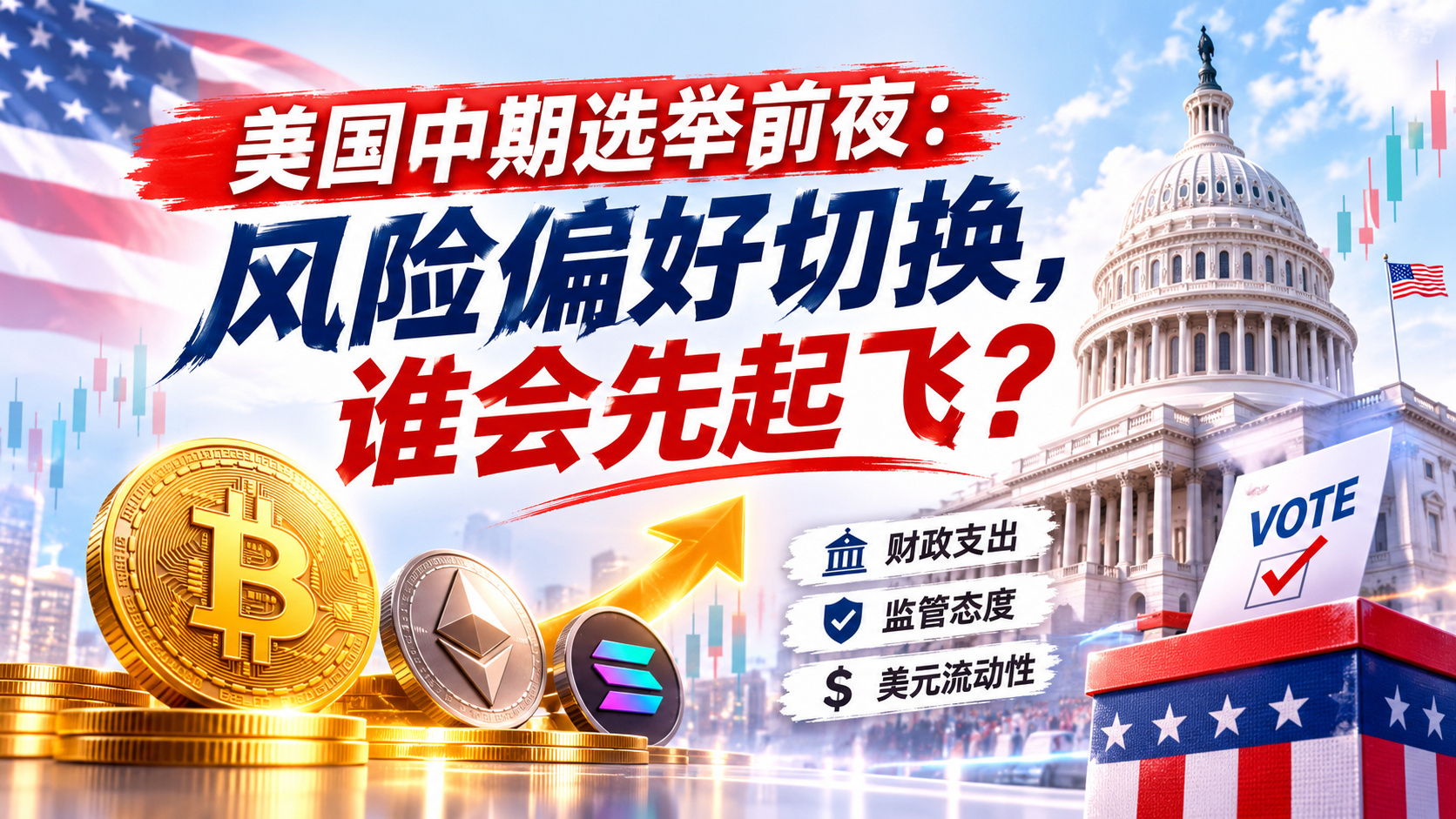

🔥The Eve of the U.S. Midterm Elections: Risk Appetite Shifts—Who Will Take Off First?
#美国中期选举倒计时,美股博弈窗口已开启? Whenever U.S. presidential or midterm elections roll around, the first thing markets trade is never the outcome itself, but “how the outcome might change policy expectations.” This dynamic is especially pronounced in crypto markets: as the political cycle enters its final stretch, capital often places bets early on regulatory shifts, fiscal expansion, and changes in risk appetite.
Looking back, markets typically follow a familiar pattern around U.S. midterm elections: pre-election uncertainty weighs on risk assets, while after the election, as policy expectations become clearer, stocks and high-beta assets often rebound. Cryptocurrency acts more like an “amplifier”—it is more sensitive than U.S. stocks and more prone to outsized swings. That’s because it is not just a liquidity asset, but also an asset driven by policy narratives.
This time, what really deserves attention is not simply the election result, but how the balance of political power in the U.S. could affect three key areas: first, the pace of fiscal spending; second, the regulatory stance; and third, expectations for dollar liquidity. If congressional gridlock intensifies, risk appetite could come under pressure in the short term. But over the medium term, political infighting often means policies take longer to implement, which could instead encourage markets to reprice risk assets based on “rate-cut expectations + a recovery in liquidity.”
That’s why U.S. stock tokens, leading exchange tokens, and high-beta altcoins have recently started attracting attention again. U.S. stock tokens are essentially a way to trade the “spillover of sentiment around U.S. assets.” When U.S. stocks enter the election window, sentiment in tech, AI, and financial stocks often finds its way onto on-chain assets first.
The real opportunity in this market cycle is not simply deciding whether the election is “bullish or bearish,” but identifying:
Which assets are most sensitive to policy expectations;
Which sectors stand to benefit most from a recovery in liquidity;
Which narratives could be reignited during the election window.
How will the market be reshaped once this contest is over? If political gridlock intensifies, short-term volatility will increase. But over the medium term, slower policy implementation could reinforce expectations of rate cuts, easing, and a recovery in liquidity. In other words, the real opportunity lies not in the moment the results are announced, but in the process of expectations beginning to shift.#加密市场 #加密货币 $SPCXB