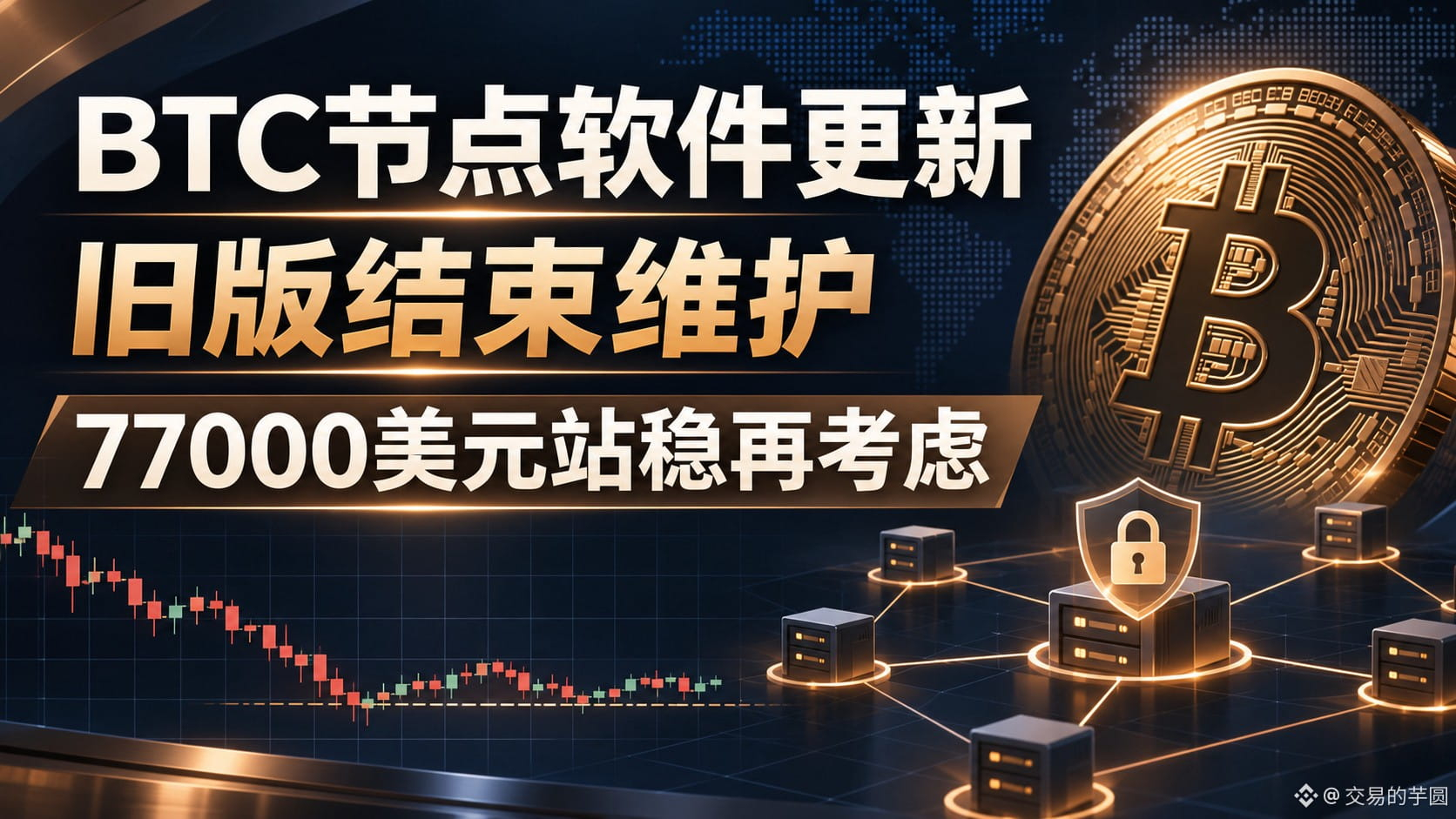
BTC search interest remains high | Legacy node support ends | Check fund flows above $76,000
My stance is to stay disciplined and not treat the words “node upgrade” as a market catalyst. BTC search interest rose among the six-hour most-searched topics on Binance Square, while trending discussions focused on exchange withdrawals and reserve verification. For holders, these topics ultimately point to the same practical question: can assets be independently verified and safely held? Bitcoin Core officially released version 32.1 on October 27, stating that versions 29.x and older had reached end of maintenance; node operators still running older versions should assess whether to upgrade. The official release notes also point out that, under certain private-broadcast configurations, the transaction relay path may bypass the Tor proxy during protocol fallback, creating a risk of exposing the source IP. Version 32.1 fixes the relevant path. This issue depends on specific configurations; it should not be presented as meaning that all BTC transactions reveal users’ identities, nor that Bitcoin’s consensus rules have been breached.
The mechanism here is a long-term one: node software maintenance affects network participants’ privacy and operational reliability, while exchange proof of reserves lets custodial users verify balances at a particular point in time. They address trust at different levels. Upgrading software does not automatically eliminate exchange fund risks, and an exchange reserve snapshot cannot replace managing your own private keys. If you hold BTC using a self-hosted node, check the version and upgrade notes against official sources. If you keep assets on a platform, check its official proof, withdrawal channels, and your own account records—do not trust “verification links” sent by unfamiliar support agents. This is operational risk management, not an encouragement for everyone to immediately move their assets to an unfamiliar wallet.
Price and fund flows should also be considered separately. When I checked, BTC/USD spot on Kraken was around $76,713, with a 24-hour low of $76,565 and a high of $78,740, still near the lower end of the previously observed $76,000–$78,000 range. The latest complete BTC spot fund data from Farside, for October 30, showed net outflows of $643.2 million. The entries for each fund on November 2 were still dashes; the automated total of 0.0 should not be taken as confirmation of zero outflows, much less evidence that institutions have already bought back in. The price decline coincided with outflows from the previous day’s funds, but there is no evidence to single out any node software release, exchange restoration announcement, or election expectations as the cause of this round of selling.
My short-term view is that if the low near $76,565 is breached again, $76,000 could become the next psychological level to watch. Conversely, only a recovery above $77,000 followed by a successful retest would suggest that selling pressure has temporarily eased. If price then moves back above $78,000, the next level to watch would be the 24-hour high near $78,740. If subsequent fund breakdowns show continued significant outflows, confidence should be reduced even if prices briefly rebound. If an exchange discloses a new security issue or Bitcoin Core revises its security guidance, I would immediately reassess this view.
If I were trading this myself, I would sit out for now and keep only a conditional spot long setup, with no leverage. I would enter a test position using 2% of total capital only after an hourly close above $77,000 and a successful retest. I would take half off at $77,800, then half of the remainder at $78,700, and use the hourly low as a trailing take-profit level for the rest. The stop would be at $76,300, with the entire position closed if hit. I would also exit proactively if, four hours after entry, price had fallen back below $77,000. If $76,565 is decisively broken first, the long setup is canceled; I would wait for a new structure to form near $76,000 and for updated fund data. Software maintenance is a fundamental security matter, but any trade still needs market confirmation.
Sources: Bitcoin Core official release and release notes, Binance Square trending topics, Farside fund table, Kraken quotes. #BTC
This is solely my personal market observation and does not constitute investment advice.