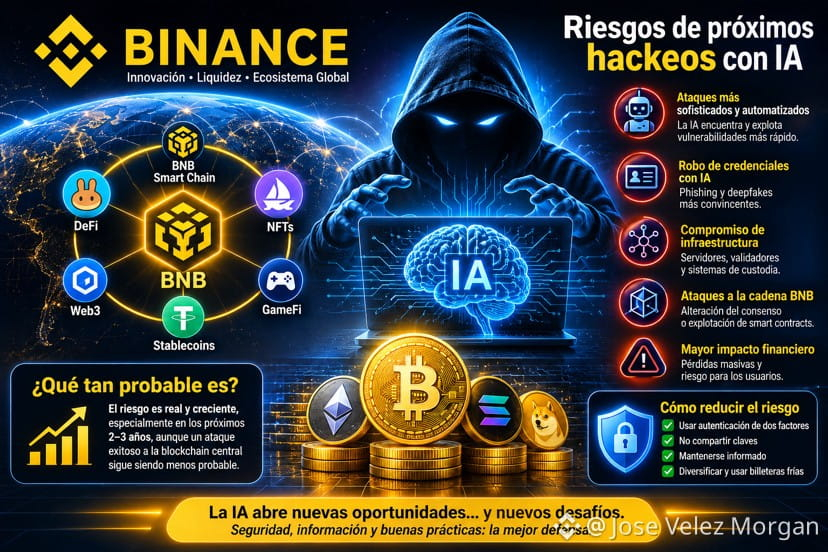
The Binance exchange suffered the biggest hack in the history of the cryptocurrency financial system. But what is Binance? Why is it so important? Is that latest hack the worst that could happen? Are there greater risks on the horizon?
In a nutshell, Binance is both a bank and a stock exchange for cryptocurrencies. In addition to providing all the services of a crypto bank, it operates as an exchange not only for buying and selling cryptocurrencies 24 hours a day, but also for converting them into any currency in the world.
Binance has 330 million customers worldwide, a number equivalent to the combined customer bases of Bank of America (70 million), Citigroup (200 million), and Wells Fargo (60 million). With that many customers, Binance has 45% of the world's crypto holders.
To date, Binance has suffered 3 hacks. In May 2019, 7,000 Bitcoin were stolen from customers' wallets; in October 2022, 2 million BNB (Binance's coin) were stolen; and in October 2026, cryptocurrencies worth 6.3 billion dollars were fraudulently transferred. In all 3 cases, Binance fully covered its customers' losses.
Alongside the existing risks of traditional hacks, a more complex landscape is emerging, given the real possibility of more sophisticated attacks using artificial intelligence. Will Binance and other exchanges be able to counter future attacks with this technology? Will these platforms have sufficient reserves to cover future customer losses?