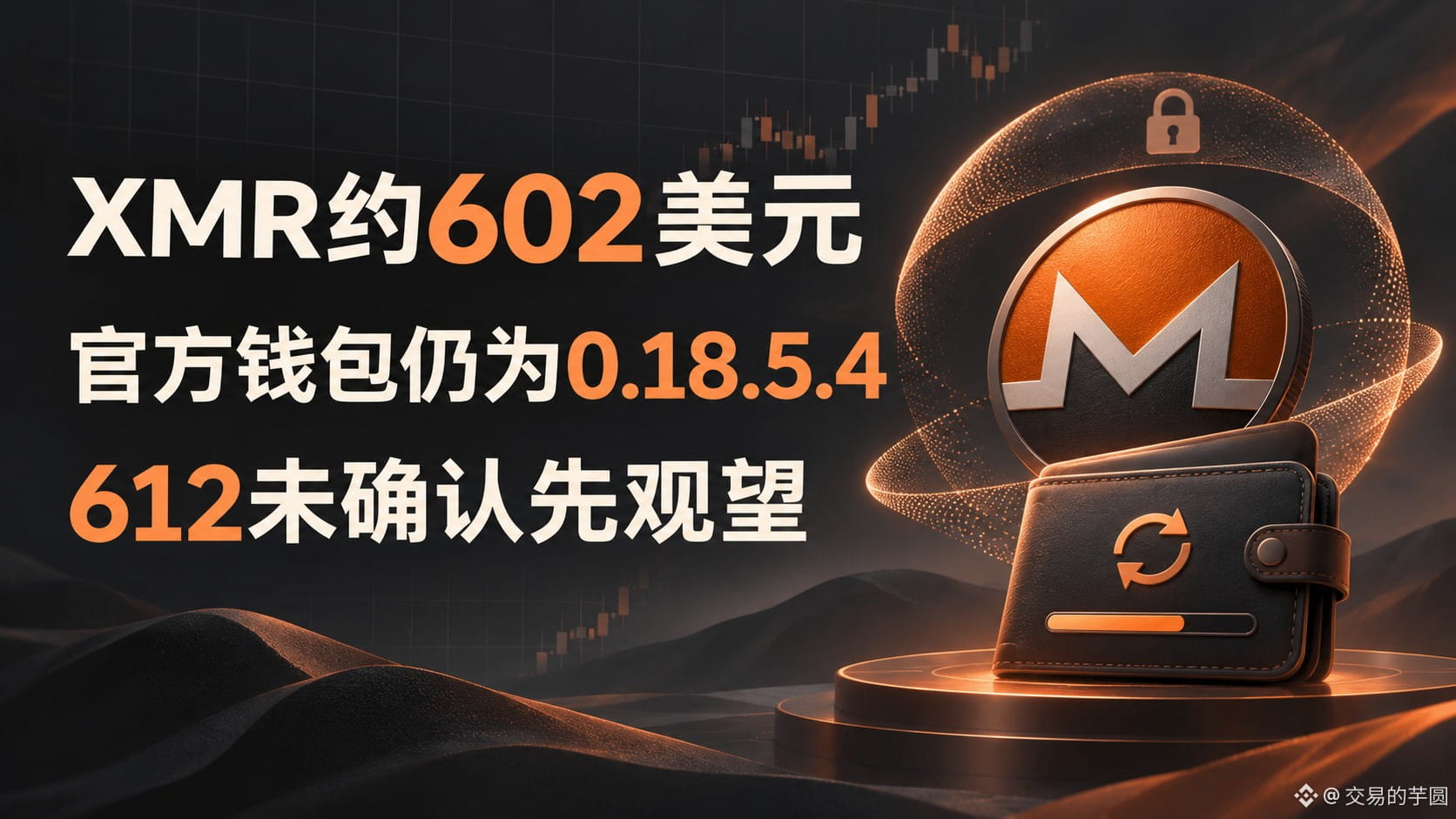
XMR around $602 | Official wallet 0.18.5.4 remains the current version | Security updates do not mean privacy policy approval
My stance is to watch cautiously, not turn a wallet maintenance notice into a trend reversal. After scanning Binance Square’s trending topics and six-hour search rankings, I found no verifiable new tags directly related to XMR; so this time I went back to Monero’s primary sources. The current Monero website download page lists version 0.18.5.4 for both CLI and GUI. In its October 16 announcement, the project described the release as a minor fix, not a new network hard fork. The CLI release page highlights two items: fixing DNSSEC verification for checkpoints, ban lists, and update checks by the daemon; and restoring compatibility for converting strings to integers in JSON requests, with a note that this compatibility will be removed in a future 0.19 release. The corresponding GUI release mainly fixes an issue with reopening testnet and stagenet wallets. Don’t describe a fix as “privacy has been upgraded” or claim that “all older versions have vulnerabilities that put funds at risk of theft.”
Why are these details worth traders’ attention? The use of privacy assets depends on the stability of wallets, nodes, and network services. Verification of checkpoints and update queries affects the trust boundaries involved when software retrieves network information; RPC compatibility affects how some tools interact with nodes. Fixing these issues is a positive sign of ecosystem maintenance, but it does not directly increase XMR’s issuance yield, on-chain demand, or availability for trading on exchanges. More importantly, users should download software from the project’s official website and verify signature hashes against the official release page. Risks from fake download links and using old versions cannot be solved by a rising price. In particular, I would not misread “the project released a fix” as a statement by regulators on privacy coins. Regulatory policy should be assessed through regulators’ own documents.
The market reaction should also be described separately. At the time of writing, XMR/USD was last trading at around $602 on Kraken, with a 24-hour low of about $590 and a high of about $612. The price remains in the middle of this range. More than two weeks have passed since the October 16 software release, and there is no evidence to attribute every current price move to it. The area around $612 is short-term resistance, while around $590 is the lower boundary to watch for support. If trading volume does not expand at the same time as a brief breakout, the risk of a pullback remains. If the price falls below $590, I would acknowledge that the short-term structure has weakened rather than use the “privacy narrative” to make excuses for losses.
If I were trading it myself: I would stay out for now, and only consider a small spot long. The conditions would be for XMR to close above $612 on two consecutive one-hour candles, hold the $608–$612 range on a retest, and show no irregularities in XMR deposits or withdrawals on major trading platforms. If those conditions are met, I would open a position using no more than 1% of my total capital. I would first take half off at $625, then half of the remainder at $640; if the remaining position closes below $612 on a one-hour candle, I would exit it entirely. I would set the initial stop-loss at $597 and exit the whole position if it is hit. No leverage and no averaging down. If the price first breaks below $590, or the project announces a new issue that affects wallet security, the bullish view is invalidated and I would immediately close any open position. Software version, safe usage, liquidity, and price confirmation should each be verified separately.
Sources: Monero’s current official download page, official Monero CLI and GUI GitHub release notes, and Kraken’s public quotes. #XMR
This is solely my personal market observation and does not constitute investment advice.