
$SAMSUNG has a good problem and a bad problem at the same time. Demand for AI memory chips is growing fast, and the company is making record profits. But investors are still questioning how long this growth can last. That's the part I think matters most right now.
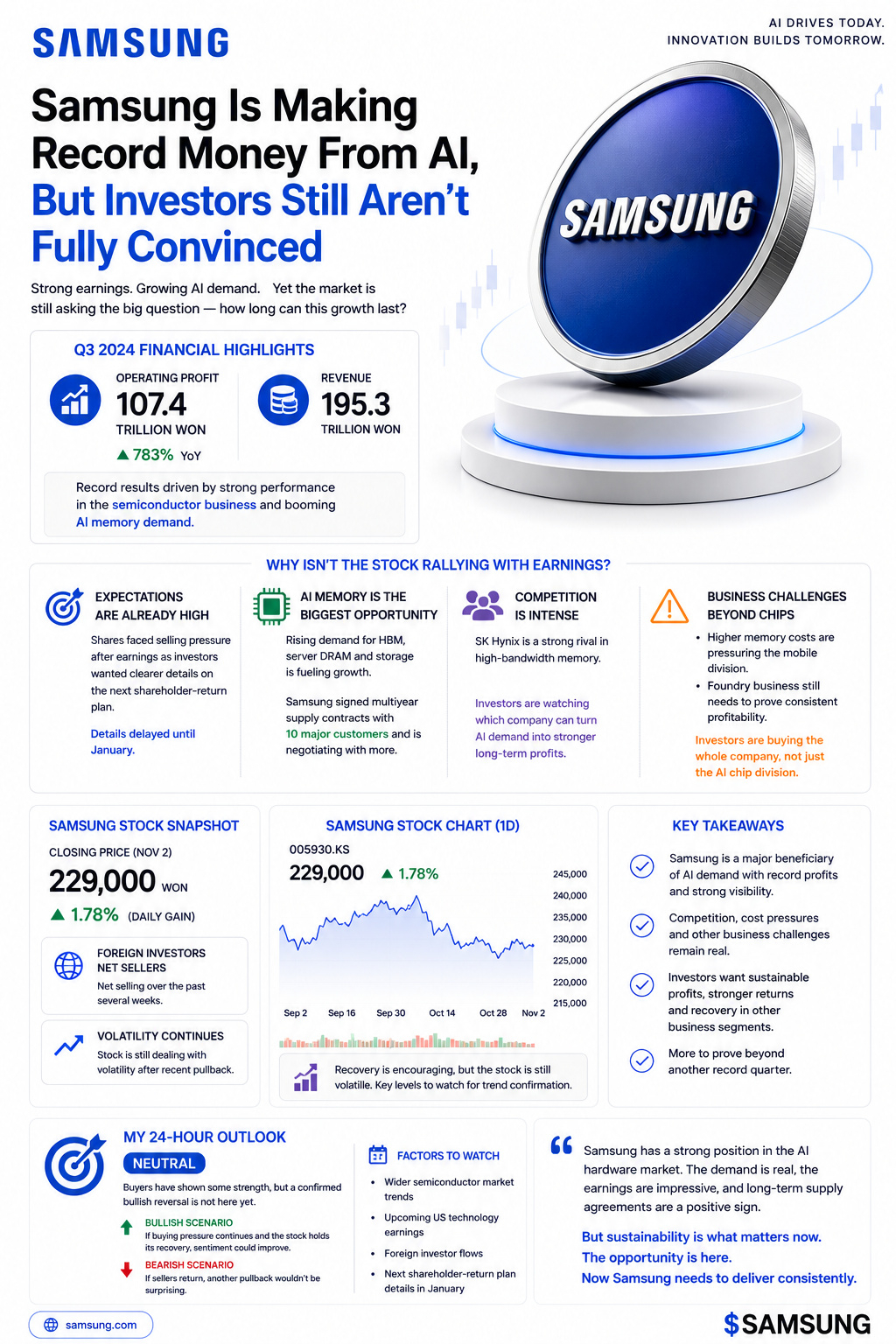
Samsung Electronics recently reported third-quarter operating profit of 107.4 trillion won, up 783% from a year earlier. Revenue reached 195.3 trillion won. Those are huge numbers. The semiconductor business is doing most of the heavy lifting, with AI-related memory demand playing a major role.
So why isn't the stock moving higher with the same confidence?
Because expectations are already high. Samsung shares faced selling pressure after the earnings announcement, partly because investors wanted clearer details about the next shareholder-return plan. The company delayed those details until January. When a company delivers record results but the stock still struggles, it usually means the market is looking beyond the latest earnings.
The AI memory business is clearly Samsung's biggest opportunity right now. High-bandwidth memory, server DRAM and storage products are becoming more important as companies build larger AI data centers. Samsung has also signed multiyear supply contracts with 10 major customers and is negotiating with more. That's encouraging because it gives the company better visibility into future demand.
But there is a catch.
Samsung isn't the only company chasing this opportunity. SK Hynix remains a serious competitor in high-bandwidth memory, and investors are watching closely to see which company can turn AI demand into stronger long-term profits. Being a major chipmaker doesn't automatically mean Samsung will win every part of the AI market.
There are problems outside the semiconductor business too. Higher memory costs are putting pressure on Samsung's mobile division. Its foundry business also still needs to prove that it can become consistently profitable. These issues matter because investors are buying the whole company, not just its AI chip division.
Samsung shares closed around 229,000 won on November 2, up approximately 1.78% on the day, according to reported closing data. The recovery is encouraging, but the stock is still dealing with volatility after its recent pullback. Foreign investors have also been net sellers over the past several weeks, which is something worth watching.
For the next 24 hours, my signal is neutral. Buyers have shown some strength, but I wouldn't call this a confirmed bullish reversal yet. If buying pressure continues and the stock holds its recent recovery, sentiment could improve. If sellers return, another pullback wouldn't be surprising. The wider semiconductor market and upcoming US technology earnings could also influence the direction.
I still think Samsung has a strong position in the AI hardware market. The demand is real, the earnings are impressive, and long-term supply agreements are a positive sign. But the company has more to prove than simply reporting another record quarter.
Investors want to know whether these profits can last, whether Samsung can compete more effectively in advanced memory, and whether its other businesses can recover.
That's what I would watch instead of getting carried away by another AI headline.
Samsung has the opportunity. Now it needs to deliver consistently.