After Friday’s U.S. stock selloff, my first reaction was: Is this storage cycle over? Asia offered a partial rebuttal on Monday.
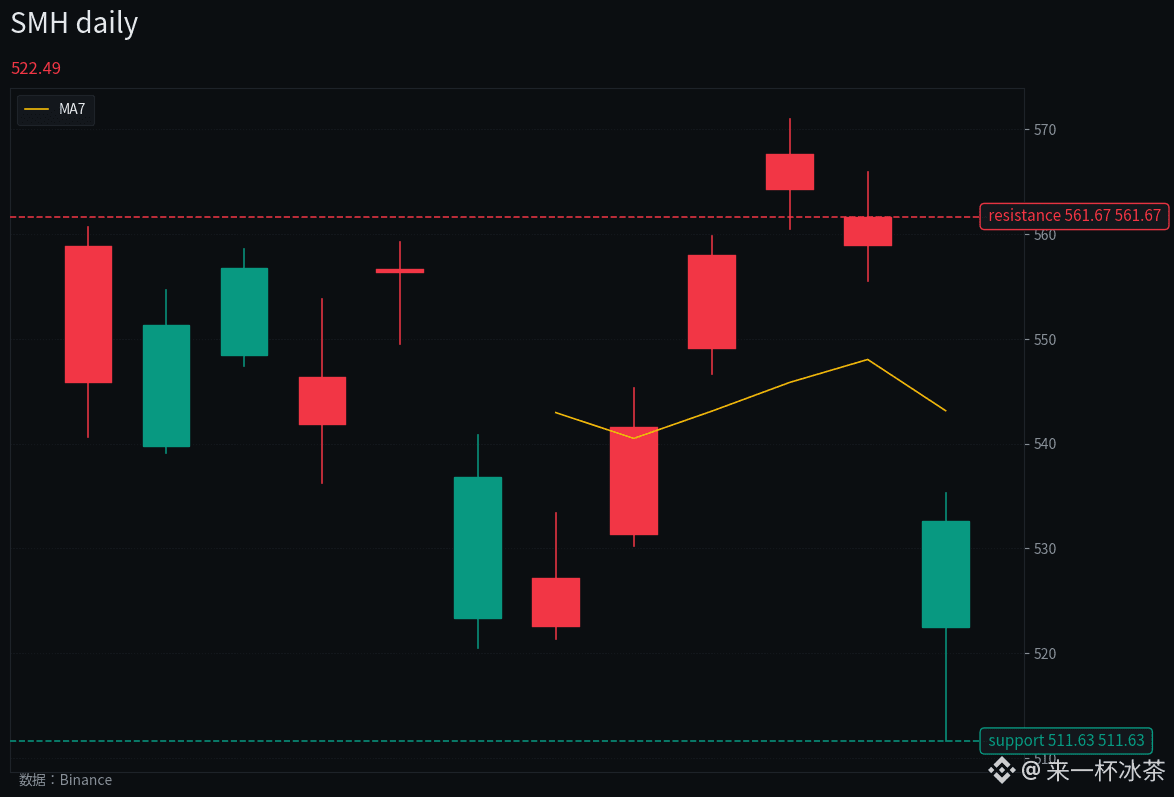
How bad was Friday? At the October 30 close, $SMH closed at $522.49, down 6.98% for the day; $MU closed at $884.74, down 5.30%; $SNDK closed at $1,150.89, down 13.47%; Western Digital closed at $366.11, down 7.41%, and the Nasdaq also fell 2.86%. The trigger was Kioxia: its guidance came in below expectations, and it warned that the flash-memory price surge fueled by AI was starting to fade. Add Intel’s profits getting squeezed by rising memory prices, and the fear shifted from “prices have risen too much” to “demand has peaked.”
But Seoul wasn’t buying it on Monday: the KOSPI closed up 2.24% at 5,859.08, Samsung closed at 229,000 won, up 1.78%, and Hynix closed at 1,472,000 won, up 3.81%. South Korea’s semiconductor exports surged 259% year over year in October—that’s real shipments. There was also a premarket rebound (08:54 U.S. Eastern Time, Finnhub): $SMH was around $531.08, up 1.64%; $MU was around $900.41, up 1.77%; $SNDK was around $1,164.71, up 1.20%.
Where are we in the cycle? My take: the price-hike thesis is intact, but the pricing logic has changed. Based on the October 30 close (Finnhub), Micron’s P/E was 11.77x, SanDisk’s 8.56x, and Western Digital’s 15.54x—all look cheap. But P/Es calculated using peak-cycle profits naturally look cheap; when profits fall, that “cheapness” disappears. So don’t focus only on P/E. The key is whether price increases can continue: the shortage narrative for DRAM and HBM is still there, but flash is already showing weakness—Kioxia fell another 15.78% on Monday. That’s the divergence.
The chart shows the daily price action for $SMH , with Friday’s October 30 big red candle and the support and resistance levels marked.
Support: $511.63 (October 30 low)
Resistance: $561.67 (October 29 close)
Holds above $511.63 → panic-driven over-selling; the oversold rebound could continue
Breaks below $511.63 → don’t stubbornly hold on; wait for the next support level
Closes back above $561.67 → Friday’s selloff can be treated as a shakeout
I’m leaning cautiously bullish but watching from the sidelines in the short term. I’m not chasing. Here’s what would prove me wrong: if $SMH closes below $511.63, or SanDisk breaks below $1,115.16, I’ll turn bearish.
Which side are you on: was Friday a panic-driven overreaction, or the first shot of a flash-memory peak?
⚠️Just my personal rambling—not investment advice.
#半导体 #存储 #U.S.StocksPremarket