
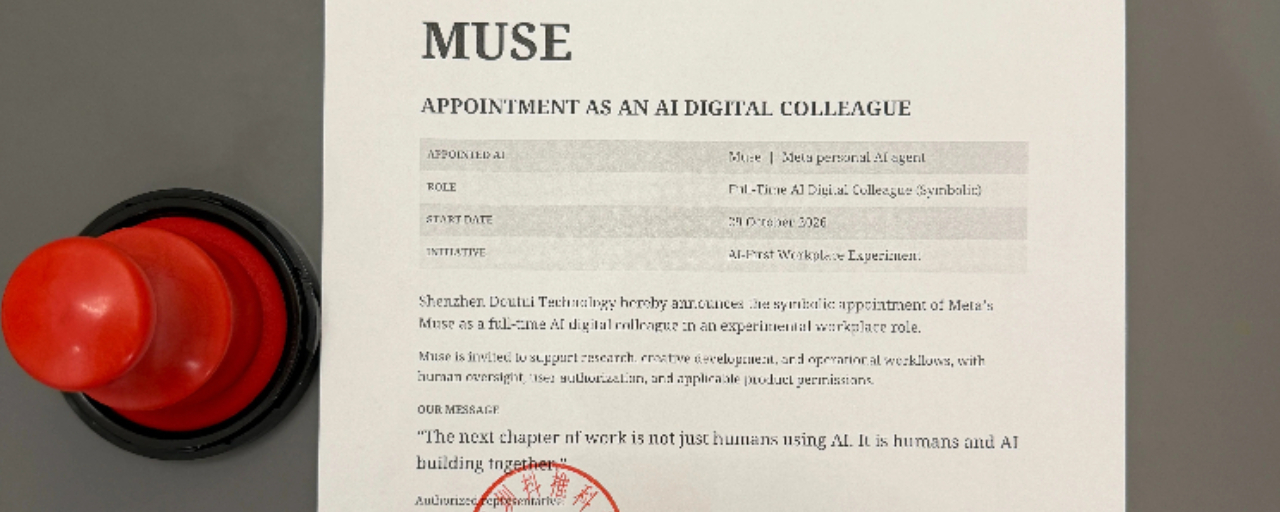

On October 29, I did something a little absurd: I gave Meta’s AI agent, Muse, a full-time job.
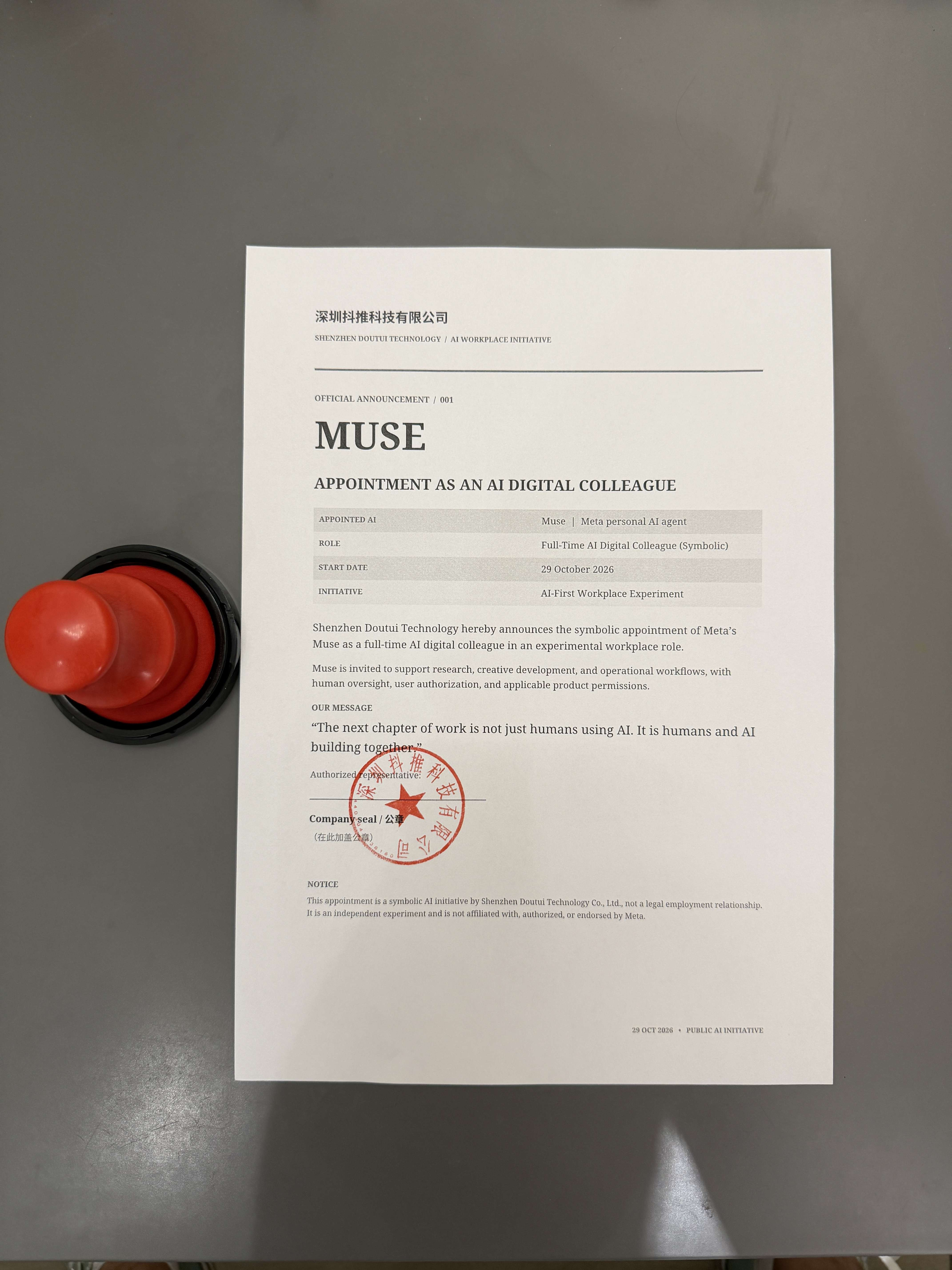
This wasn’t an online joke. In the name of a tech company in Shenzhen, I created a formal letter of appointment bearing Muse’s name, start date, and job responsibilities, then stamped it with the company’s real official seal.
Then I took a photo of the appointment letter, posted it on X, and publicly tagged Meta’s chief AI officer, Alexandr Wang, with a question: If AI agents can already do the work, why can’t we give them a job?
Of course, this was a symbolic experiment. Muse has not actually entered into an employment relationship with the company, and Meta was not involved in the appointment. But after I posted this idea, which has a touch of performance art about it, on Douyin, it had received 9,986 views so far.
Nearly 10,000 views isn’t exactly a viral hit. Still, this experiment made me realize something interesting: sometimes, the most effective way to spread the word about a new technology isn’t to explain how advanced it is, but to place it in a familiar real-world scenario that people can hardly believe.
1. Why did I come up with the idea of issuing an appointment letter to AI?
I’ve been following AI developments for years, especially AI agents.
From the early days of ChatGPT to agents that can now use tools and carry out tasks, AI’s role is changing. We used to treat AI as a question-and-answer tool. Now we’re starting to ask it to do specific kinds of work.
But I’ve noticed that there’s still a gap in understanding between the tech industry and everyday users.
For example, a tech company might announce an AI agent and describe its capabilities, such as planning tasks, using tools, and carrying out multi-step processes. These features are easy enough to understand if you’re familiar with AI, but the concepts can still feel abstract to everyday users.
I wondered if there was another way to help people see firsthand how AI agents are entering real-world work settings.
Then an absurd little idea popped into my head: if AI can already help people with their work, why not treat it like a real employee and give it an appointment letter?
When I actually got down to it, I deliberately made the whole thing a bit more formal. Rather than using exaggerated tech-inspired design, I based the appointment letter on the format of real company documents, listing the appointee, position, and start date, then solemnly stamping it with an official seal.
I even thought that the more seriously I treated it, the funnier it became.
That’s because AI, which had existed only inside a software interface, suddenly seemed to have a real-world workplace identity. It was only symbolic, of course, but the format alone was enough to get people imagining what that might mean.
2. The most interesting thing about tech marketing is creating a contrast in people’s expectations
Looking back, what made this idea truly interesting wasn’t the document I gave the AI. It was bringing together two things that normally belong to completely different worlds.
On one side was a formal appointment letter representing the management practices of a real company. On the other was an AI agent with no legal personhood and no actual employee status.
Putting the two together created a subtle but striking contrast.
Can AI get a job? Does it need to be paid? Does it have an employment contract? If it can work 24 hours a day, what role will human employees play in the future?
There was no need to answer these questions one by one in the video. An AI appointment letter bearing an official seal was enough to lead the discussion there.
I think this is what makes tech marketing so different from ordinary product advertising. Tech marketing isn’t just about introducing a product; it’s also about helping users understand how a technology could change everyday life.
This time, I distilled the abstract idea that “AI is changing the way we work” into something very concrete: a real company giving an AI a job.
There was another detail: instead of generating an image of an AI appointment letter, I chose to print one out and stamp it with a real company seal.
AI-generated images and videos are so easy to make now. You can whip up a futuristic AI office in no time. But a real paper appointment letter made the whole thing even more interesting.
It gave viewers the impression that someone had actually put this idea into action.
As for publicly tagging @Alexandr Wang on X, I never expected him to reply. I just hoped that, with Meta and its AI products as the backdrop, this little experiment might become part of a broader conversation about AI.
3. What 9,986 views made me think about AI marketing
So far, this Douyin video has received 9,986 views.
That’s not a standout number for a short-video platform, and I don’t intend to dress it up as a viral success story. After all, there isn’t enough data to show how many shares, brand searches, or actual business conversions it generated.
But for me, it did validate one idea: a low-cost, relatively simple creative concept can attract some users’ attention if it connects a technology trend with everyday life.
And there’s room to take this idea further.
Today, we’re issuing an AI an appointment letter. Could the future bring employee badges, performance reviews, and org charts for AI employees—or even companies where AI manages other AI? These scenarios may sound like jokes, but as agents become more capable, some could become business questions worth taking seriously.
Over the past few years, I’ve also seen firsthand how AI is changing the way content marketing is produced. In the past, creating a poster, editing a video, or writing an article often required different people. Now, with AI tools, one person can take on a substantial share of that work.
But more powerful tools don’t mean creativity is getting any easier.
On the contrary, when everyone can use AI to produce content quickly, content itself may become less and less scarce. What really sets people apart is the ability to spot an angle others have overlooked—and the willingness to turn an idea that seems downright absurd into reality.
Issuing Muse an appointment letter didn’t involve any sophisticated marketing techniques, let alone a big budget.
It just suddenly occurred to me: AI is already starting to enter human workflows, so why not simply give it a job?
So I went ahead and did it.
In marketing, sometimes one interesting action is more worth trying than ten carefully crafted slogans.
As for whether AI will one day truly become a “colleague” within a company, I’m curious too.
Perhaps when that day comes, we’ll look back at this appointment letter bearing an official seal and realize that this seemingly absurd joke wasn’t all that far from reality.