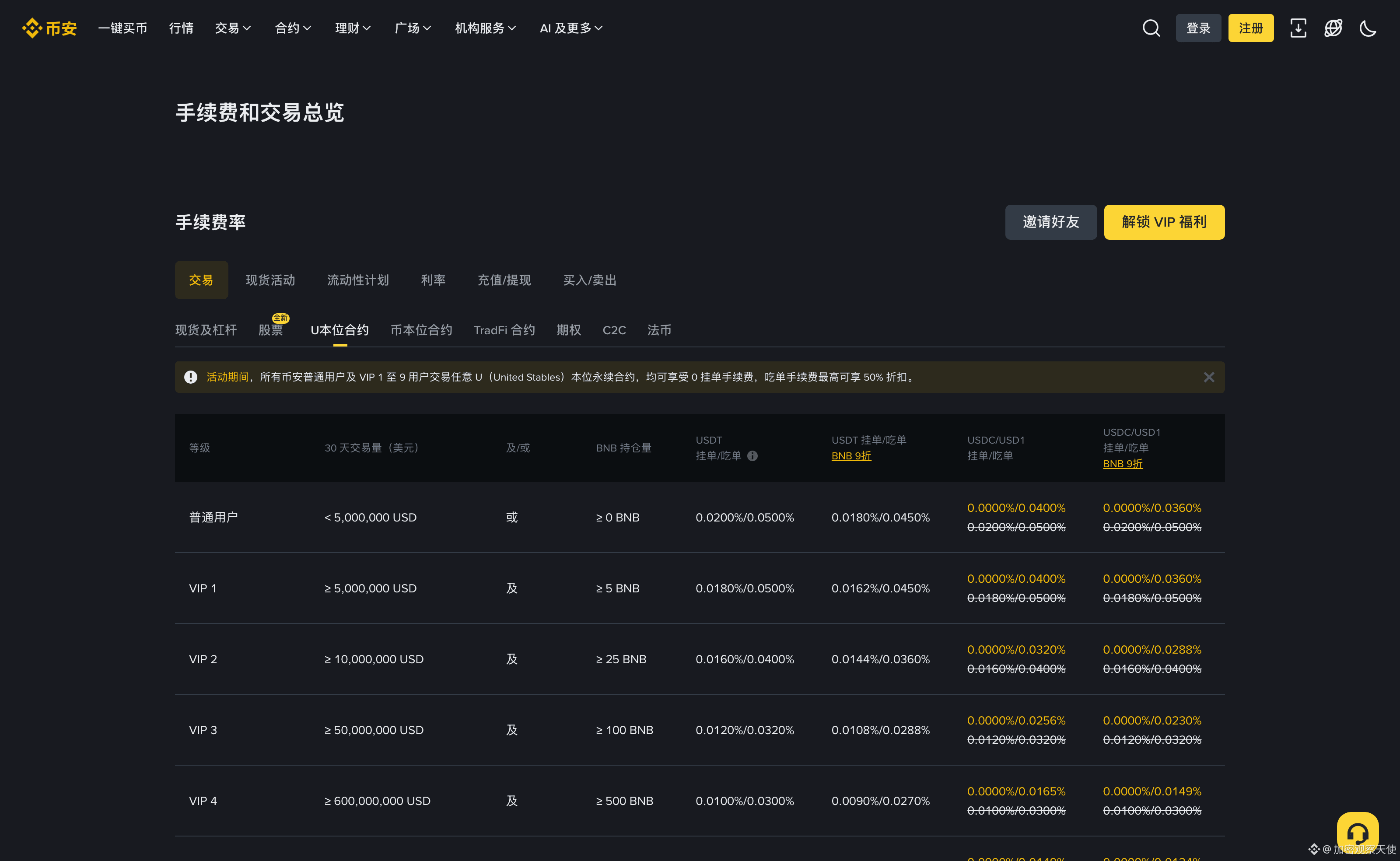
Regular users pay a taker fee of 0.0500%, reduced to 0.0400% after the promotion.
This isn’t a coupon. The entire standard fee schedule has been multiplied by 0.8.
November 5, 16:00 Beijing time. 8:00 UTC. Binance is replacing the fee schedule for TradFi perpetuals.
First, let’s be clear about what TradFi perpetuals are.
Their underlying assets are stocks and commodities, not crypto. Nvidia, Tesla, gold, and copper are all included.
I counted the contracts on the list: there are 235 of them. Data collected at 6:35 on November 2.
Only two columns changed in the new schedule.
Maker fees are zero across every tier, from regular users through VIP 9: 0.0000%.
Taker fees haven’t been zeroed out; they’ve been discounted at two different rates.
Regular users through VIP 3 get a 20% discount.
VIP 4 through VIP 9 get a 40% discount.
You can verify this by calculating backward.
Divide the new rates by 0.8, and regular users go back to 0.0500%, VIP 2 to 0.0400%, and VIP 3 to 0.0320%.
For the tier discounted by 0.6, VIP 4 goes back to 0.0300%, and VIP 9 to 0.0170%.
Every result lands on a whole percentage point to two decimal places, with no extra decimal digits.
This shows there are only two discount levels; the discount doesn’t decrease tier by tier.
If it did decrease tier by tier, the results of the calculation would be a scattered set of figures.
There’s another point of comparison.
USDC trading pairs currently have a maker fee of 0 and a taker fee of 0.0400%.
In the new TradFi schedule, regular users also pay a taker fee of 0.0400%.
In effect, stock contracts are being charged at the same rate as USDC pairs.
Add the BNB discount, and 0.0400% becomes 0.0360%—another 10% off.
A VIP 4 user paying with BNB pays 0.0162%, the same rate as VIP 5 without the discount.
The savings from moving up one tier are the same as the savings from changing your payment method.
It’s easier to understand in dollar terms.
On a $100,000 trade, a regular user’s taker fee drops from $50 to $40.
For VIP 4, it drops from $30 to $18.
The biggest savings aren’t for the highest tier; they’re for VIP 4.
The requirements for that tier are listed on the same line: $600 million in 30-day trading volume plus 500 BNB held.
Fees are charged on notional value, not on the margin you put in.
With 10x leverage, a $10,000 margin on one trade means fees are calculated on $100,000.
There’s a counterintuitive detail.
For taker fees, regular users and VIP 1 have exactly the same rate.
Trading more volume doesn’t save you a cent on taker fees.
The half that’s actually zeroed out is the maker fee.
A maker fee of 0 only matters for limit orders; market orders are all taker orders.
Even after a maker order is filled, funding fees and slippage still apply.
Stock markets close, and any price gap gets filled when the market opens. Leverage magnifies that gap.
The announcement itself leaves room for change, stating that the rates apply until further notice.
The fee calculation may also appear inconsistent on the day the change takes effect.
So treat this schedule as a reference, not a guarantee of what you’ll be charged.
Was your last order filled as a maker order, or did you take liquidity directly?
The fees in this article are from Binance’s fee page and its October 28 announcement. Data collected at 6:36 on November 2.
Promotional terms may change; refer to the official page for the latest information. This article is not investment advice.