ETH at $2,285—what are you waiting for?
Citi just raised its ETH price target to $3,028, but ETFs have seen $430 million in net outflows over five days, and the price has plunged from $4,950 to $2,285—cut in half, then cut in half again. Institutions talk bullish but sell in practice—is this a signal to buy the dip, or are institutions setting a trap for you?
First, the surface picture: every indicator is saying “ETH is in trouble.”
The daily price is below the 50-day moving average, the RSI is just 36, ETFs have seen net outflows for five consecutive days, the Fed’s rate remains unchanged at 3.75%–4.00%, and CPI is still higher than expected at 3.7%. The price has fallen 54% from $4,950 to $2,285, and its market cap has shrunk to $280 billion.
First thing: institutions are heading for the exit—but do you know what they’re actually running from?
On October 30, ETFs saw $155.8 million in outflows in a single day, bringing the total over the past five days to $430 million.
Sounds scary? But do the math: cumulative net inflows to ETFs are still $12.29 billion. The $400 million that flowed out is just a drop in the bucket.
Institutions aren’t dumping everything; they’re trading the swings. They’re waiting for the November 10 CPI data. If inflation comes down, they’ll come back; if it doesn’t, they’ll keep applying pressure.
You think institutions leaving means it’s the end of the world? If you follow them out, you might have no seat left when they come back.
Second thing: Citi’s $3,028 target isn’t just a number pulled out of thin air.
Citi raised its 12-month price target to $3,028.
You might say, “Institutional price calls are just a way to fleece retail investors.” But Citi is a major Wall Street bank, not a crypto KOL. Its $3,028 target means traditional finance is seriously assessing ETH’s long-term value.
Now look on-chain: staking has locked up more than 30% of the supply, exchange reserves are low, and holdings in accumulation addresses are increasing. The circulating supply is shrinking, while long-term holders are buying.
The price is falling, but holdings are becoming more concentrated. That’s a sign of a bottom, not a prelude to a crash.
Third thing: technically, ETH is at a make-or-break level.
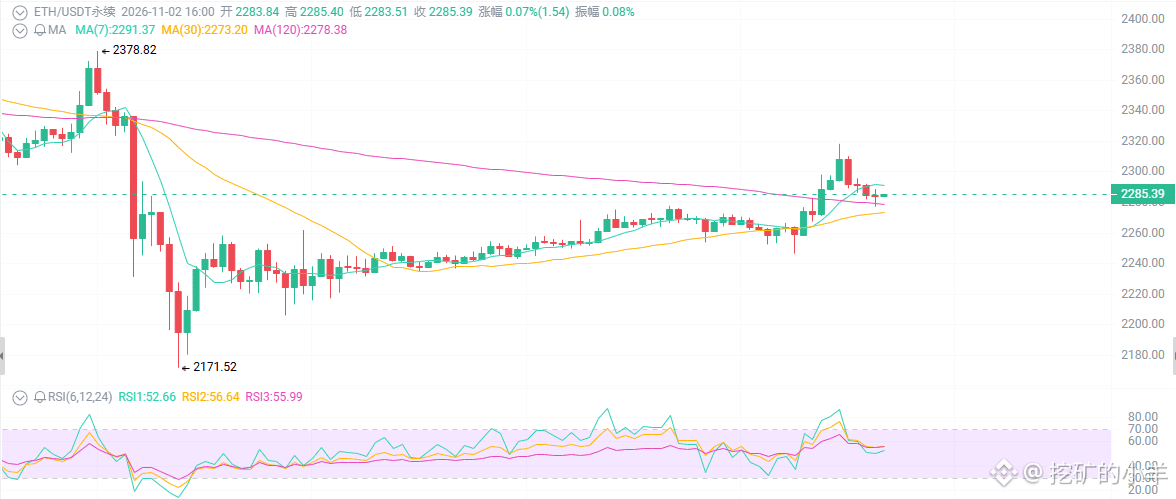
$2,250 is the intraday low, while $2,150 is the key 200-day support.
Hold $2,250: a rebound to $2,300–$2,320. A high-volume move above $2,300 opens up room to $2,400–$2,500.
Break below $2,250: a faster test of $2,150, where stronger demand sits.
Break below $2,100: that’s when it’s really time to get out.
The key question isn’t whether $2,285 is expensive—it’s whether $2,250 can hold.