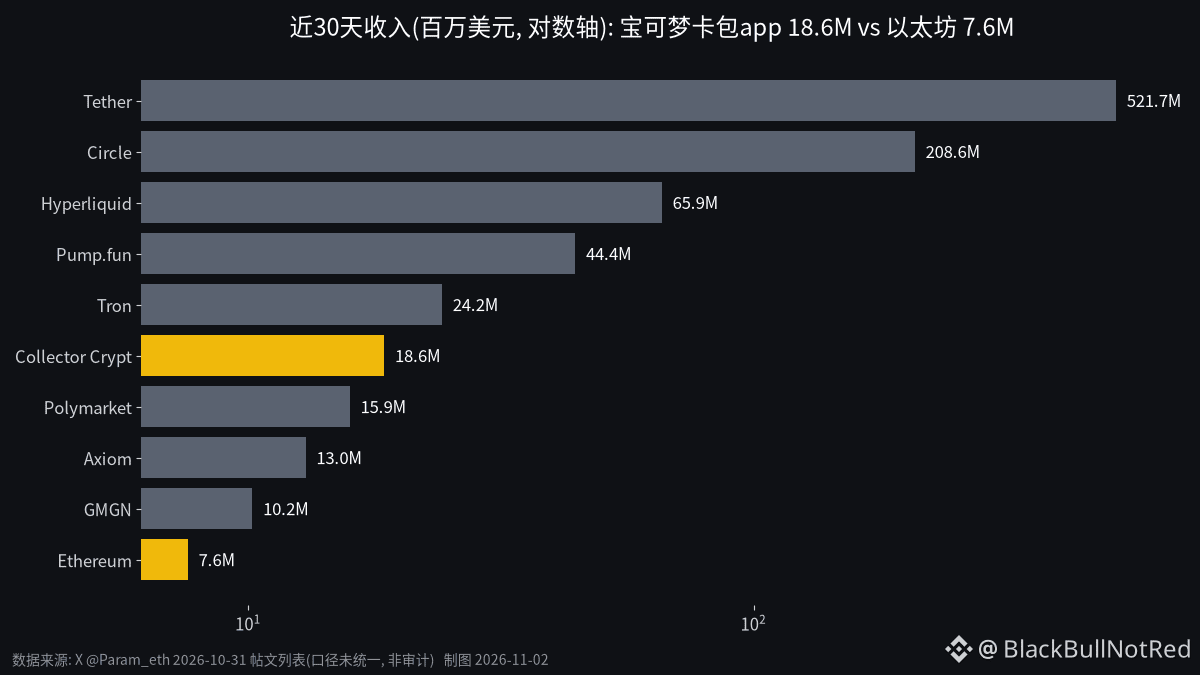
“An app for opening card packs makes more revenue than Ethereum.” This line has been making the rounds these past couple of days as ETH’s obituary. But after reading it, I think Ethereum isn’t the one that should be blushing.
That chart from @Param_eth: over the past 30 days, Collector Crypt made $18.6 million, while Ethereum made $7.6 million. The numbers are fine, but “revenue” means two different things here. Ethereum L1 revenue is low because fees have been deliberately pushed down by L2s and scaling. That’s the path it chose. A card-pack app’s revenue is the cut the platform keeps every time you open a pack.
How big is that cut? Someone previously broke down its Q3 figures: it sold $433.5 million worth of card packs, bought back and redeemed $408.1 million worth, and the platform kept around $25.4 million—about 5.9%. Real card-pool data posted by an account that simulates opening packs: in a $250 pack, the median value of the cards pulled was $200. Alea says the book value of the cards in its machines tripled from the end of May to the end of September, reaching $26 million.
In plain English: for every $100 that goes in, a few dollars on average stay with the platform, and most people pull cards worth less than what they paid. Of course this business is profitable. A claw machine at a night market can make more than a toll road, but that doesn’t mean you’d say toll roads have no future.
What really makes me wary is another line: “Crypto profits will flow into trading cards over the next two years.” The people saying this probably already own cards. Add to that all those Courtyard posts saying “Just got another $40 today—sign up through my link,” and the pattern feels awfully familiar. This is exactly how NFTs kicked off in 2021.
Pokémon has been around for 30 years, and there’s nothing wrong with the cards themselves. The problem is dressing up the thrill of opening a pack as asset allocation.
#CollectorCrypt #ETH
That chart from @Param_eth: over the past 30 days, Collector Crypt made $18.6 million, while Ethereum made $7.6 million. The numbers are fine, but “revenue” means two different things here. Ethereum L1 revenue is low because fees have been deliberately pushed down by L2s and scaling. That’s the path it chose. A card-pack app’s revenue is the cut the platform keeps every time you open a pack.
How big is that cut? Someone previously broke down its Q3 figures: it sold $433.5 million worth of card packs, bought back and redeemed $408.1 million worth, and the platform kept around $25.4 million—about 5.9%. Real card-pool data posted by an account that simulates opening packs: in a $250 pack, the median value of the cards pulled was $200. Alea says the book value of the cards in its machines tripled from the end of May to the end of September, reaching $26 million.
In plain English: for every $100 that goes in, a few dollars on average stay with the platform, and most people pull cards worth less than what they paid. Of course this business is profitable. A claw machine at a night market can make more than a toll road, but that doesn’t mean you’d say toll roads have no future.
What really makes me wary is another line: “Crypto profits will flow into trading cards over the next two years.” The people saying this probably already own cards. Add to that all those Courtyard posts saying “Just got another $40 today—sign up through my link,” and the pattern feels awfully familiar. This is exactly how NFTs kicked off in 2021.
Pokémon has been around for 30 years, and there’s nothing wrong with the cards themselves. The problem is dressing up the thrill of opening a pack as asset allocation.
#CollectorCrypt #ETH