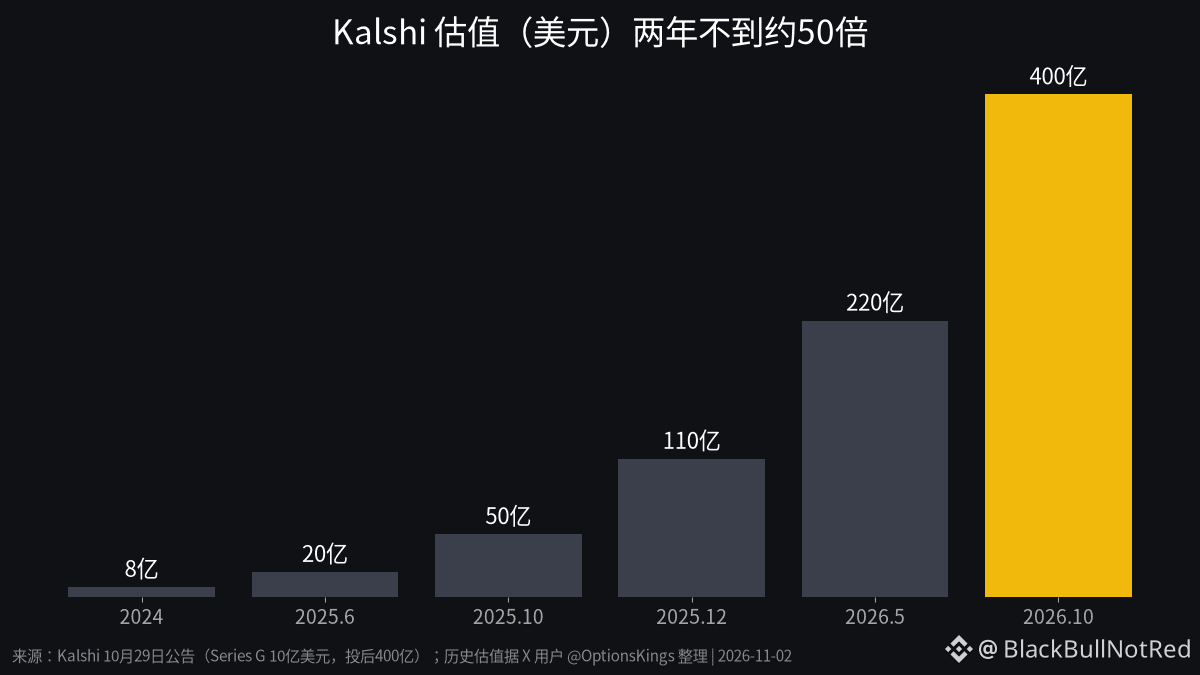
Kalshi is valued at $40 billion, and the people who should be keeping their cool most of all are in crypto.
On October 29, it announced a $1 billion Series G round led by Sequoia and Wellington, valuing the company at $40 billion post-money. Its May round valued it at $22 billion—nearly doubling in less than six months. The company says its annualized trading volume has topped $1 trillion, with $97.8 billion in a single month.
But one detail caught my eye: some media outlets have written that Kalshi is “relying on crypto and perpetuals to support this valuation,” with crypto-related trading running at an annualized rate of about $140 billion. Put simply, to tell a $40 billion story about event contracts, the business still has to reach into our territory—contracts on crypto price movements and perpetuals, competing with exchanges for the same retail traders.
Another figure really stands out: someone calculated that crypto-related fundraising totaled $1.24 billion this week, with Kalshi alone taking $1 billion—80%. When all the money crowds into one sector leader, that’s not an industry boom; it’s VCs piling into the next Coinbase.
Who’s guaranteed to make money? The platform collects fees, market makers pocket the spread, and VCs wait for the next round or an IPO to cash out. Who isn’t guaranteed to make money? You, clicking Yes or No on the platform. Prediction market prices can reflect sentiment to some extent, but don’t mistake “the platform’s valuation doubled” for “you can double your money playing on it.” Those two things have absolutely nothing to do with each other.
The historical valuations in the chart were compiled by someone on X; only the final bar is an official figure.
#预测市场 #Kalshi
On October 29, it announced a $1 billion Series G round led by Sequoia and Wellington, valuing the company at $40 billion post-money. Its May round valued it at $22 billion—nearly doubling in less than six months. The company says its annualized trading volume has topped $1 trillion, with $97.8 billion in a single month.
But one detail caught my eye: some media outlets have written that Kalshi is “relying on crypto and perpetuals to support this valuation,” with crypto-related trading running at an annualized rate of about $140 billion. Put simply, to tell a $40 billion story about event contracts, the business still has to reach into our territory—contracts on crypto price movements and perpetuals, competing with exchanges for the same retail traders.
Another figure really stands out: someone calculated that crypto-related fundraising totaled $1.24 billion this week, with Kalshi alone taking $1 billion—80%. When all the money crowds into one sector leader, that’s not an industry boom; it’s VCs piling into the next Coinbase.
Who’s guaranteed to make money? The platform collects fees, market makers pocket the spread, and VCs wait for the next round or an IPO to cash out. Who isn’t guaranteed to make money? You, clicking Yes or No on the platform. Prediction market prices can reflect sentiment to some extent, but don’t mistake “the platform’s valuation doubled” for “you can double your money playing on it.” Those two things have absolutely nothing to do with each other.
The historical valuations in the chart were compiled by someone on X; only the final bar is an official figure.
#预测市场 #Kalshi