Tesla and SpaceX might merge into one company? One question from my son left Lao Niu stumped. The deal actually rests in Tesla shareholders’ hands
At noon, my son came home from school for lunch. Before the food was even on the table, he grabbed his Starship model and ran out to the balcony, where Lao Niu was making tea. “Dad, are Tesla and SpaceX going to merge? That’s what my classmate said.” Lao Niu poured the tea first and didn’t rush to say yes or no. He started explaining it from the beginning. His mom called him to wash his hands halfway through, so Lao Niu is writing up the rest for everyone here.
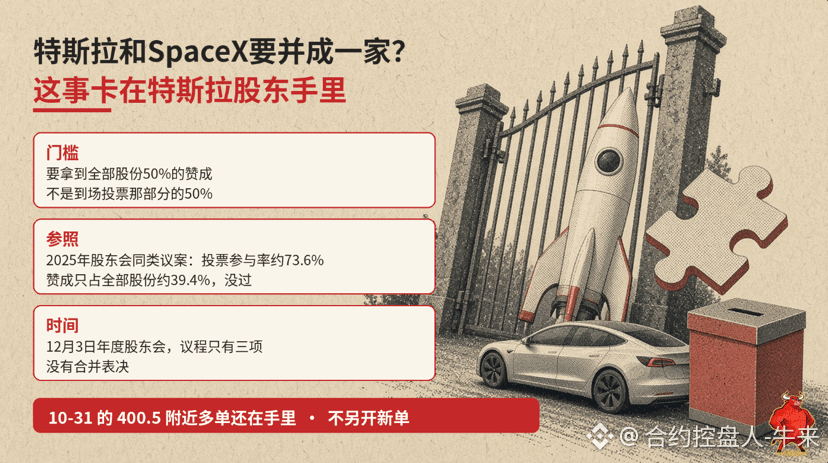
Here’s how it all unfolded: At SpaceX’s third-quarter earnings call on October 20, U.S. Eastern Time, Musk said that the boards of both companies had each formed a special committee made up of independent directors to look into a merger. He is a major shareholder in both companies, making him an interested party, so he can’t take part in the committees’ discussions. He thinks a merger would be a good idea, but it’s going too far to treat it as a done deal. In the end, shareholders have to approve it. The real hurdle is on Tesla’s side: it would need approval from holders of 50% of all shares—not 50% of the shares represented by votes cast. Shares that don’t vote don’t count as votes in favor. At Tesla’s 2025 shareholder meeting, a proposal subject to the same requirement of approval by more than half of all shares received votes from about 73.6% of shares, but only about 39.4% of all shares voted in favor, so it failed. The agenda for this year’s December 3 annual shareholder meeting has just three items: electing three directors, an advisory vote on executive compensation, and ratifying the appointment of the auditor. There’s no vote on a merger.
During his years at a futures brokerage, Lao Niu picked up a habit: first, figure out what’s sentiment and what’s a hurdle. The word “merger” can give the stock a quick boost—that’s sentiment. Getting more than half of all shares to approve it—that’s the hurdle, and the earliest opportunity would be the next shareholder meeting. So in the short term, this is a sentiment-driven story. Over the long term, it still comes down to valuation. Whether or not the companies merge, Tesla’s price will ultimately have to be supported by its own businesses, such as chips and robotics.
As of 1:50 p.m. Beijing time, Tesla perpetual futures were around 401.9, up about 0.4% over 24 hours. Lao Niu’s long position, opened on 10-31 around 400.5, is still open. The outlook hasn’t changed, and the price is currently a little above the entry point. I’m not opening a new position in this post, and I don’t recommend chasing the news of a possible merger. The process could drag on for a long time, or the talks might go nowhere. If the excitement fades, it would be normal for some of the gains to disappear.
$TSLA