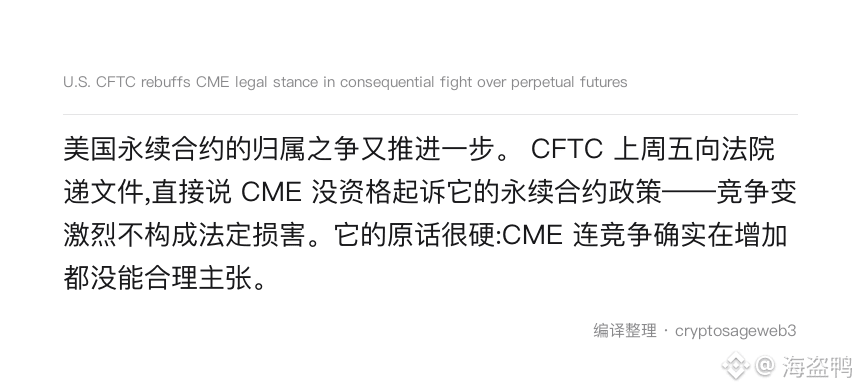
The battle over who gets to offer perpetual contracts in the U.S. has taken another step forward. Last Friday, the CFTC filed a brief with the court, arguing that CME has no standing to sue over its perpetual contract policy—intensified competition does not constitute a legally cognizable injury. The agency put it bluntly: CME failed to plausibly allege that competition was even increasing.
For context, in May 2026, the CFTC approved the first U.S. Bitcoin perpetual contract and said it would review them one by one. CME’s position is that perpetuals have no expiration date and are essentially swaps, not futures. Interestingly, the CFTC countered that CME’s own crypto futures trading volume actually rose after the policy took effect, and mocked CME for not being able to tell one story to the court and another to investors.
I’m inclined to think the CFTC has the upper hand, because competitive harm is extremely difficult to quantify in court. But the more practical implication is this: once compliant perpetuals take off in the U.S., the supply of leverage will expand ahead of demand.
If that day really comes, which do you think will lose volume first: spot trading at $BTC or offshore derivatives?
For context, in May 2026, the CFTC approved the first U.S. Bitcoin perpetual contract and said it would review them one by one. CME’s position is that perpetuals have no expiration date and are essentially swaps, not futures. Interestingly, the CFTC countered that CME’s own crypto futures trading volume actually rose after the policy took effect, and mocked CME for not being able to tell one story to the court and another to investors.
I’m inclined to think the CFTC has the upper hand, because competitive harm is extremely difficult to quantify in court. But the more practical implication is this: once compliant perpetuals take off in the U.S., the supply of leverage will expand ahead of demand.
If that day really comes, which do you think will lose volume first: spot trading at $BTC or offshore derivatives?