
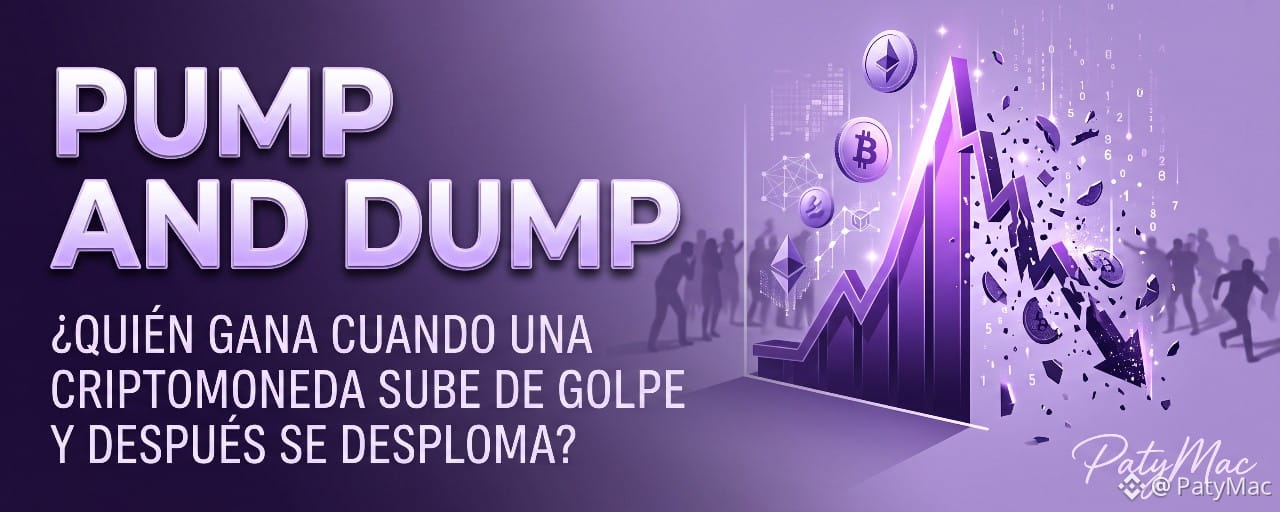

CRYPTO GLOSSARY #24 | Market Manipulation
An unknown token starts rising rapidly.
Messages like these appear on social media:
“It’s going to multiply a hundredfold!”
“Buy before it’s too late!”
Thousands of people enter the market, swept up in the excitement.
But shortly afterward, the price crashes.
Was it simply a correction?
Or did someone artificially drive up the price?
This is where a practice known as Pump and Dump comes in.
🔎 What does Pump and Dump mean?
Pump means inflating or driving up the price.
Dump means selling off massively.
It is a scheme in which certain participants seek to artificially drive up an asset's price through misleading promotion, coordinated trading, or other tactics, and then sell their holdings at inflated prices.
💰 A practical example
Imagine a group buys a token in advance for USD 0.01.
Then a massive promotional campaign begins.
The price rises to USD 0.10.
The organizers sell while other investors continue buying.
When buying pressure disappears, the price falls to USD 0.02.
Those who bought at USD 0.10 suffer an 80% loss if they sell at USD 0.02.
Meanwhile, those who acquired the token before the campaign may have made a profit.
📱 What role do influencers play?
Social media can quickly amplify interest in an asset.
The problem arises when financial interests are concealed, news is fabricated, or profit expectations are presented as certainties.
Promoting a project does not automatically constitute manipulation.
What matters is whether there was deception, unlawful coordination, or other conduct prohibited by the applicable rules.
🚨 Warning signs
Be wary of situations involving:
Promises of quick, extraordinary gains.
Pressure to buy immediately.
Repeated messages from numerous accounts.
Sudden surges without verifiable information to explain them.
A significant concentration of tokens in a few addresses.
Promoters who do not disclose their potential financial interests.
No isolated sign necessarily proves a Pump and Dump.
⚖️ The legal perspective
In regulated markets, certain forms of price manipulation are prohibited.
In the crypto ecosystem, the legal classification depends on the type of asset, the conduct involved, the people involved, and the jurisdiction.
When deception is used to induce purchases and benefit organizers, liability may arise even if the transactions were conducted through blockchain.
The technology used does not automatically make deceptive conduct legitimate.
🎯 Interesting questions
Is every rapid price increase a Pump? No. Legitimate movements driven by news or changes in demand can also occur.
Does a sharp drop prove manipulation? Not necessarily. The context and transactions need to be examined.
Can an influencer be held responsible? Yes, depending on their conduct, the information disclosed, and the applicable rules.
Why are small tokens especially vulnerable? Because lower liquidity can make significant price movements easier.
💡 Final thoughts
When an asset rises extraordinarily, it is easy to think we are looking at a once-in-a-lifetime opportunity.
But before buying, we should ask ourselves:
What is really driving this rise, and who might be selling while everyone else is buying?
In financial markets, following the crowd is no substitute for independent research.


