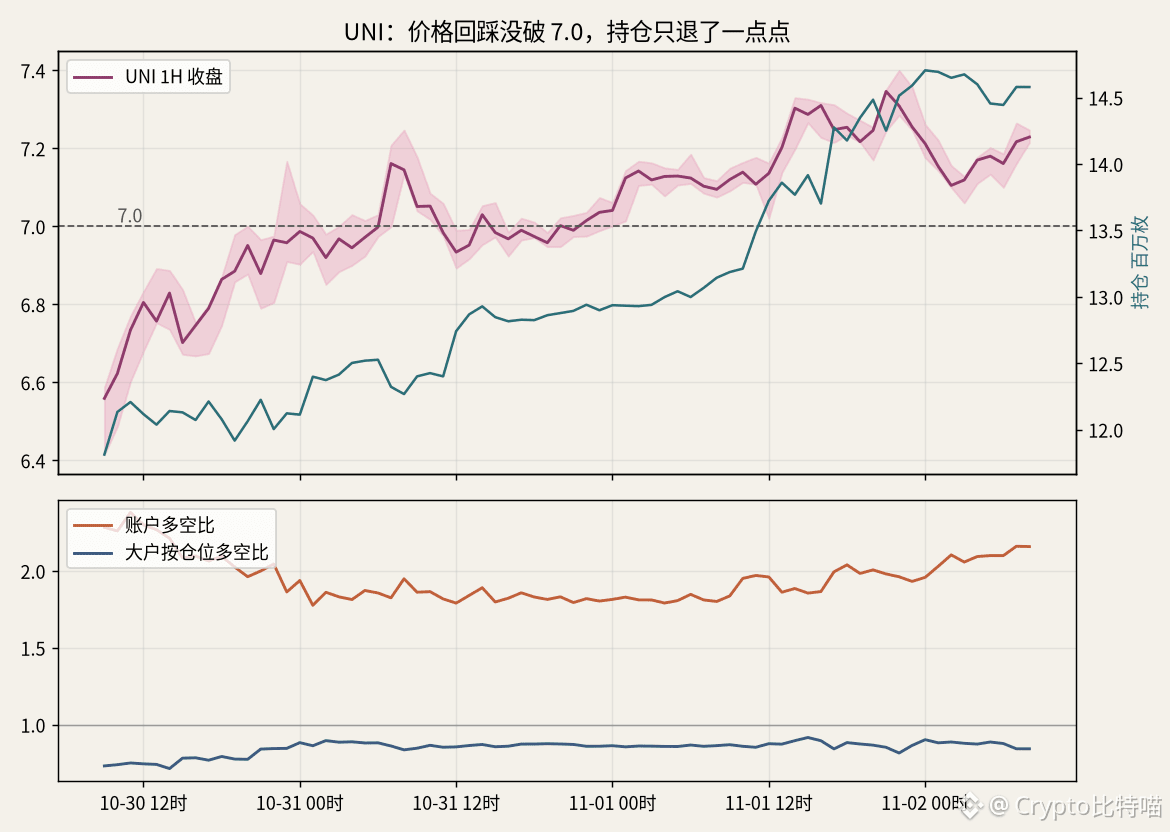
Last night I said I wanted to wait for $UNI to come back to 7.0 and take a look. It really did come back overnight, hitting a low of around 7.02 without breaking below, and has now climbed back to 7.23. In theory, this is the scenario I wanted, but I still didn’t make a move—and it comes down to positioning.
The kind of pullback I’m looking for is one where, as the price falls, some futures positions get flushed out too, clearing out the leverage that came in chasing the rally. But what actually happened? Open interest in futures built up to a peak of around 14.7 million coins around midnight, and after the overnight pullback it only fell back to around 14.58 million—barely any positions got flushed out. What’s more troubling is the account long/short ratio: it’s climbed steadily from 1.8 to 2.16, meaning retail traders were actually adding longs as the price fell. Whales’ position-based long/short ratio is still around 0.88; it hasn’t been above 1 for three straight days.
So this time, I’d rather interpret the price holding above 7.0 as someone buying the dips than as the market having fully shaken out weak hands. When retail keeps adding longs as the price falls and whales stay tilted short, that combination can hold once or twice, but that doesn’t mean it’ll hold a third time.
I believe in the fee-conversion thesis. The framework for Uniswap to convert the assorted tokens collected by the protocol into stablecoins is already running on several chains. Just last month, it converted around $15 million worth on its own. That’s a positive for UNI over the medium to long term. But stronger fundamentals and a healthy short-term order book are two different things.
My stance on my positions is simple: I’ll keep my spot holdings as a long-term position, but won’t add or sell. I won’t touch the long side in futures, and I won’t short a coin with a real revenue story either. When I see open interest genuinely drop and the account long/short ratio come down from 2, that’s when I’d be willing to add a little. Whether the price is 6.9 or 7.3 will matter less.