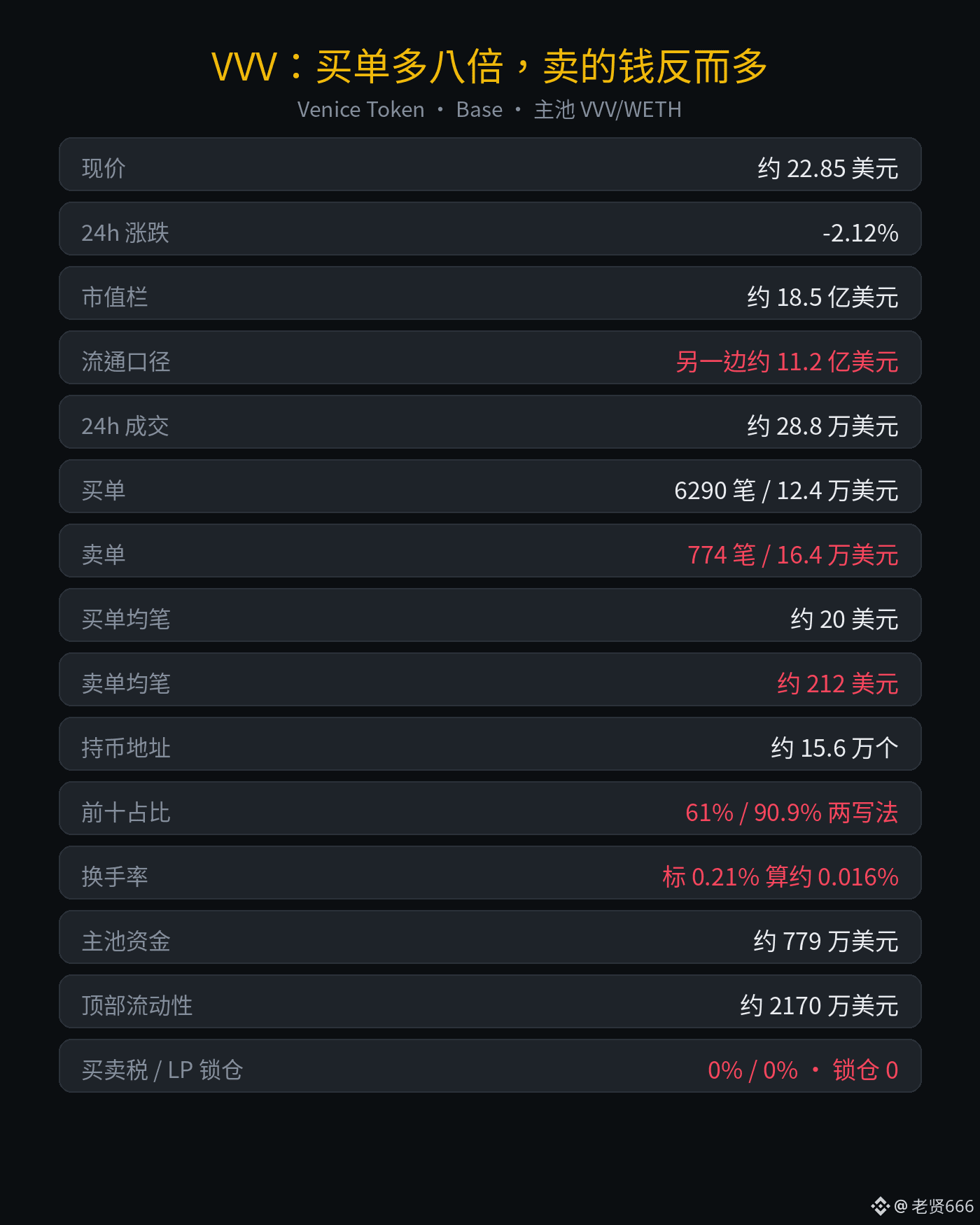
There are eight times as many buyers as sellers, yet sellers are moving more money—the first thing to notice on this $VVV page is that something doesn’t add up.
Venice provides private AI inference. You stake its token to get API credits. It’s an established token launched at the end of January 2025, running on Base. The main pool is VVV/WETH, with the other side being the wrapped version of $ETH .
Over the past 24 hours, there were 6,290 buy orders totaling $124,000, and 774 sell orders totaling $164,000. There were more than eight times as many buys as sells, but the sell volume was 32% higher. On average, each buy was worth less than $20, while each sell averaged about $212—more than ten times as much. The price hasn’t moved much, though: it’s currently about $22.85, down around 2.1% over 24 hours.
The figures on the same page also contradict one another. The market cap section says about $1.85 billion, calculated by multiplying the effective total supply of 81.2 million tokens; elsewhere, using the circulating supply, it comes to about $1.12 billion. The turnover ratio is listed as 0.21%, but dividing the $288,000 trading volume by the $1.85 billion market cap gives only about 0.016%. The top-ten holder share is similar: one figure says 61%, while another says 90.9% after excluding the burn address. The denominators differ, so don’t take either figure at face value.
The main pool holds about $7.79 million, yet the page’s liquidity figure at the top says $21.7 million. The main pool accounts for only a little over 30%. As for the security checks, both buy and sell taxes are 0, and the page says there are no transfer restrictions or blacklist. But LP lockup is 0, ownership hasn’t been renounced, and the information on minting authority doesn’t match: one section says the owner can control minting, while another says it has been revoked.
If you’re holding, keep an eye on two things: whether the average sell order returns to the same ballpark as the average buy, and which denominator the top-ten holder share uses when the page refreshes. If neither changes, leave this page alone for now. There are eight times as many buy orders, yet sell volume is higher—which set of figures seems more believable to you?
This is not investment advice. Alpha’s token is high risk and could go to zero. Follow me, and I’ll let you know next time the figures on this page change.
#BinanceAlpha #买卖结构 #Base chain