
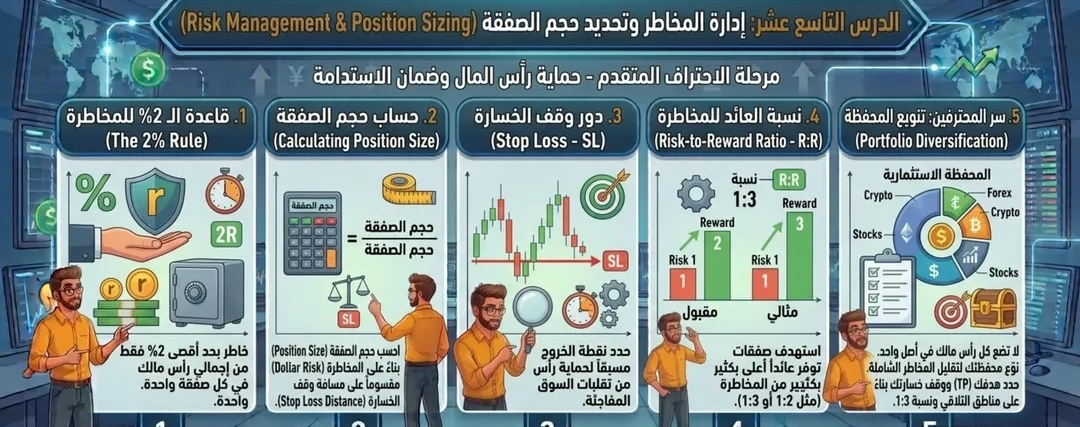

1. What is risk management? (Risk Management Concept)
🛡️ Concept: A set of strict rules that determine how much money is put at risk in each trade, with the goal of staying in the market for as long as possible, no matter how bad the conditions get.
⚡ Golden rule: Your capital is your "tool of the trade"; losing it means your final exit from the game.
2. Risk-to-reward ratio (Risk-to-Reward Ratio 1:3)
⚖️ The equation: the relationship between what you’re willing to lose (risk) and the profit you’re targeting (reward).
🎯 The goal: trade with a ratio of at least 1:3 (meaning if you lose a trade, you lose $100, but if you win, you make $300), allowing you to be profitable even if only 40% of your trades are successful.
3. The 1% Rule for Protecting Your Capital (The 1% Rule)
📉 The rule: Never risk more than 1% to 2% of your total capital on a single trade.
💡 Example: If your account has $10,000, the most you should lose on a single trade is just $100.
4. Calculating Position Size and Stop Loss (Position Sizing & SL)
⚙️ The connection: Determine the trade size (number of contracts or units) based on the distance to the stop-loss level (Stop Loss), to ensure that the loss does not exceed 1%.
🚫 Common mistake: Moving or removing the stop loss in the hope that the price will turn around.
5. The Professionals’ Secret: Psychological and Logarithmic Discipline
🧘 Emotional control: Accepting losses as a normal part of trading and not seeking revenge on the market (Revenge Trading) after a losing trade.
Why do 90% of traders fail despite their technical analysis being successful?
Relying on luck instead of mathematics:
An amateur trader always focuses on the question: "How much will I make on this trade?" while a professional first focuses on: "How much will I lose if I’m wrong?" Risk management turns trading from random gambling into a structured business.
The power of reward relative to the win rate:
Thanks to a 1:3 reward ratio, you don’t need to win every trade. If you make 10 trades, lose 6, and win just 4, you’ll still end up well in profit by sticking to a multiple-reward ratio.
Protecting yourself from psychological damage:
When you lose a small amount (1%) on a trade, your mind stays calm and able to make the right decision on the next trade. Large losses, on the other hand, lead to panic and destructive emotional decisions.
