Worth pondering 🤔

Post

宇文逸
·
--
1. If you think 20x means going all-in with 20x leverage, then I suggest you delete the app immediately and never trade again.
2. If you think TQQQ or SOXL suffers from decay when it goes up and down, and that you’d be better off using 3x leverage on QQQ, then I also suggest you delete the app immediately and never trade again.
Not because they’re necessarily wrong, but because you only take in secondhand information and don’t think for yourself. How are you going to make money if you don’t use your own brain?
Let’s answer two questions.
1. If you use 0.01% of your capital to open a position with 100x leverage, you’ve only used 1% of your capital. That’s equivalent to buying 1% worth of the underlying asset (ignoring funding rates). If you see 20x and think that a 5% drop will liquidate you, that shows you really aren’t using your brain at all.
2. An example people use online: QQQ rises 10% first, then falls 10%; correspondingly, TQQQ rises 30% first, then falls 30%.
Assume the initial capital is 100.
After two days, QQQ becomes 100 x 1.1 x 0.9 = 99, a loss of 1.
TQQQ becomes 100 x 1.3 x 0.7 = 91, a loss of 9.
In theory, since TQQQ is 3x, it should lose 3. But in reality, it lost 9, so TQQQ is worse than simply using 3x leverage on QQQ. If you think that makes sense, I’d also advise you to stay out of the market, because you’re too easily manipulated, like a toy in someone else’s hands.
There are three possible outcomes over two days: up + up, down + down, and up + down.
We just discussed how an up-then-down move is unfavorable for TQQQ. But what about up + up and down + down?
If QQQ rises 10% first, then rises another 10%:
QQQ = 100 x 1.1 x 1.1 = 121 (+21%)
TQQQ = 100 x 1.3 x 1.3 = 169 (+69%)
At 3x leverage, it should clearly be up 3 times 21%, or 63%, but it’s up 69%. In this scenario, TQQQ > QQQ.
If QQQ falls 10% first, then falls another 10%:
QQQ = 100 x 0.9 x 0.9 = 81 (-19%)
TQQQ = 100 x 0.7 x 0.7 = 49 (-51%)
If TQQQ were exactly 3x, it should lose 3 times 19% = 57%, but it only lost 51%. So in this scenario, TQQQ is also better.
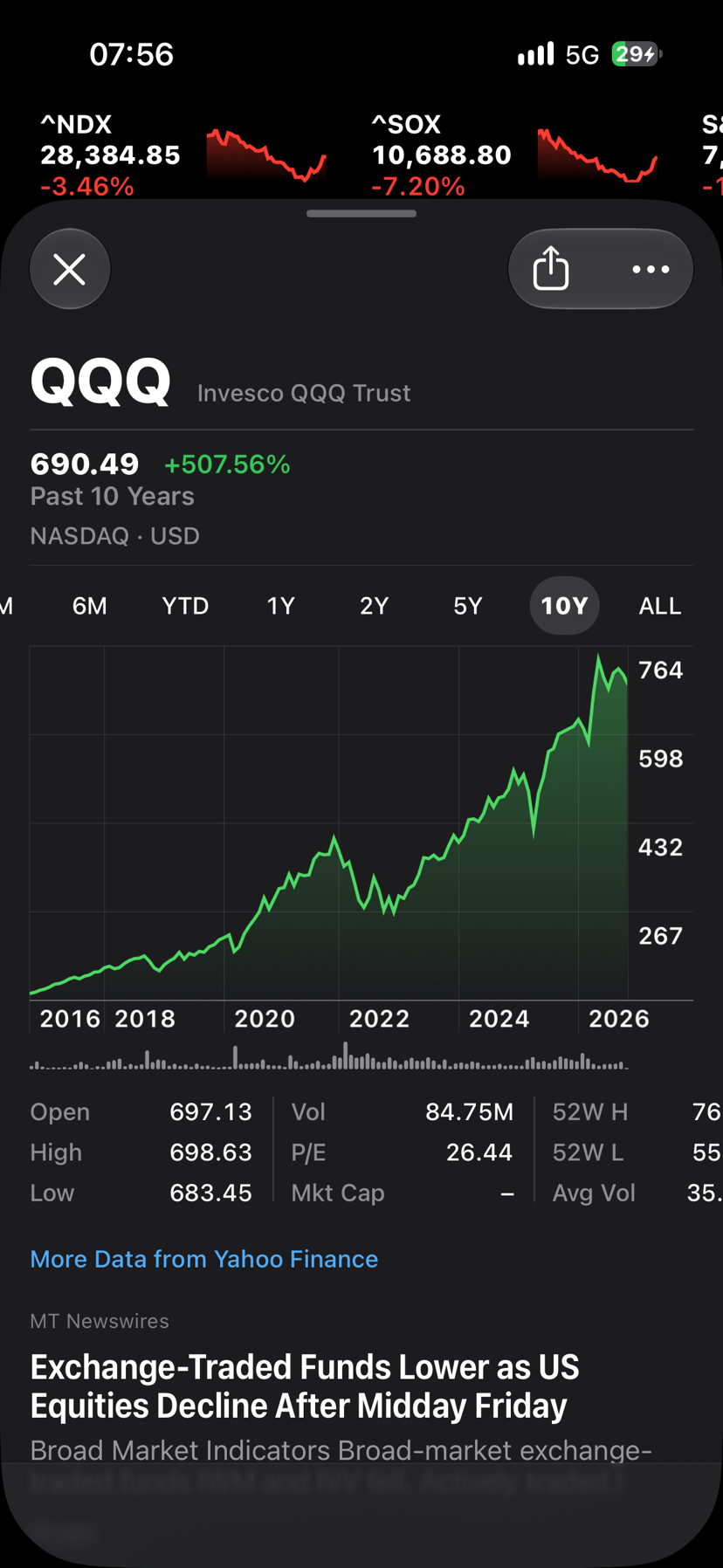
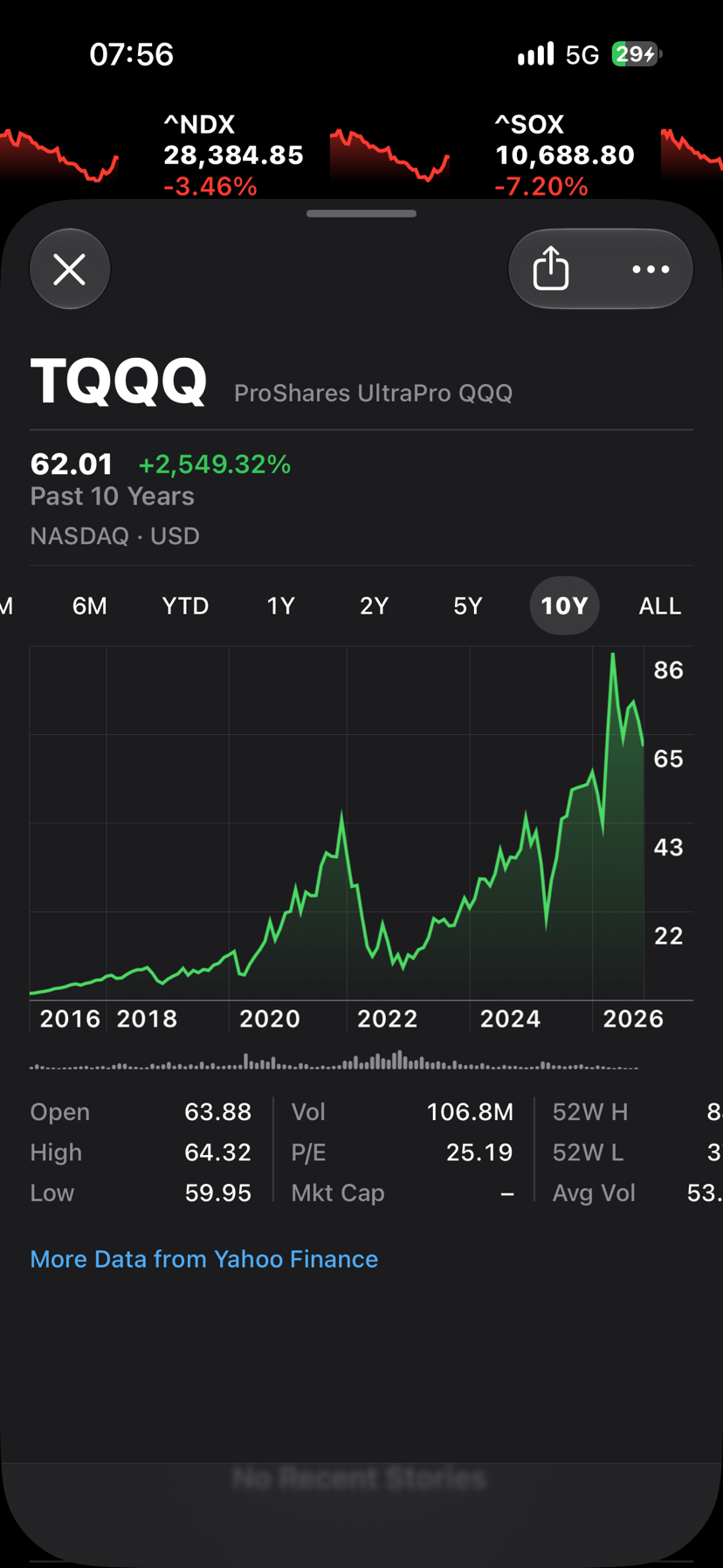
See the pattern? QQQ is better in a sideways market, while TQQQ is better in a one-way move, whether up or down. But you don’t think for yourselves: someone gives one unfavorable example, and you think you’ve figured it all out. To get more technical, TQQQ’s EV is E(one-way up) + E(one-way down) - E(sideways). You need to weigh the probabilities of all three to know the ultimate outcome. And over the past 10 years, TQQQ’s returns have far exceeded those of 3x QQQ: 2500% vs. 500%.