

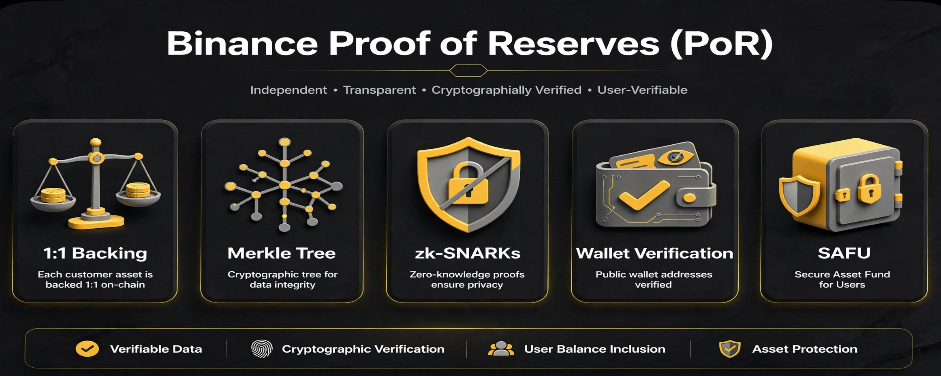

Binance publicly releases its Proof of Reserves (PoR) data, allowing users to verify the exchange’s reserve holdings and compare them against the total assets Binance holds on behalf of its customers.
What matters to users?
Are assets backed? Does Binance hold sufficient reserves to meet its obligations to customers?
Are balances accounted for? Users can independently verify whether their account balances are included in the PoR report.
Is the data reliable? Cryptographic verification mechanisms allow users to check the data rather than simply relying on public statements.
Are assets protected? Security measures and the SAFU fund provide additional protection in the event of unexpected incidents.
How does the exchange respond when problems occur? Its ability to restore operations, communicate transparently, and take responsibility for users matters.
How does Binance implement these mechanisms?
1:1 Backing: Ensures that reserves correspond to users’ assets on the platform.
Merkle Tree: Allows users to verify whether their account balances are included in the reported data.
zk-SNARKs: Enables data verification without exposing personal information.
Wallet Verification: Verifies control over the wallets holding reserve assets.
SAFU: An emergency fund designed to help protect users when unexpected incidents occur.
Verifiable data, protection mechanisms, and accountability when incidents happen.
SAFU is safe
#BinanceUpdatesProofofReservesAddresses .
$BNB .