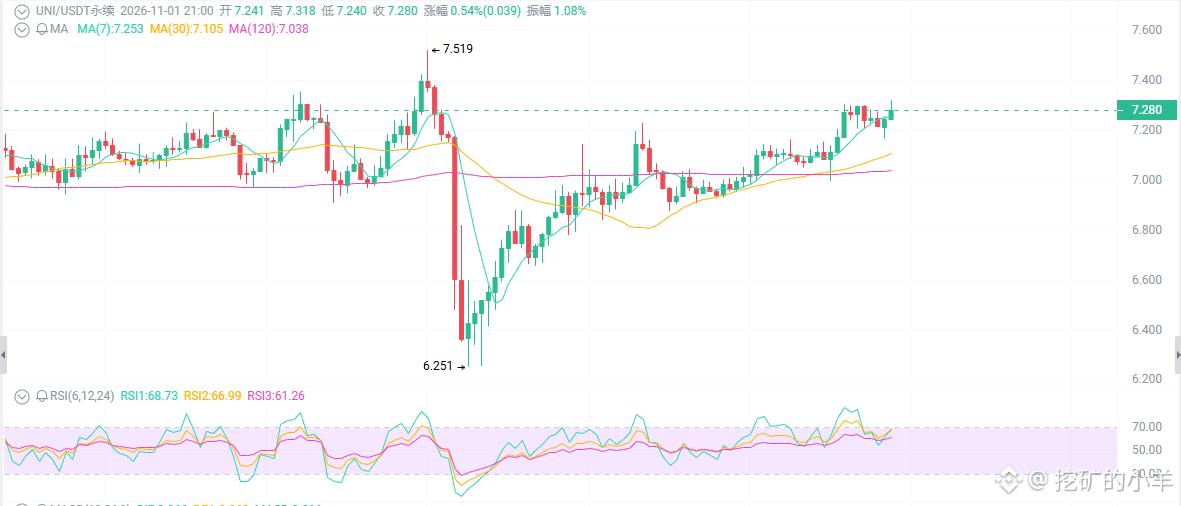
UNI at 7.3—are you still calling it useless?
Everyone has been calling UNI a “worthless governance token”—four years of voting, but no dividends. But just last month, the fee switch quietly turned on: protocol revenue started burning real UNI, and active addresses hit a new high for the year. Yet the price is still stuck at 7.3. Is the market blind, or are you about to miss the move again before it takes off?
First, the surface picture: the good news is here, but the price is still asleep.
UNI climbed from its mid-year low of 2.3–3.5 to 9–10, and has now pulled back to trade sideways around 7.2–7.3. It’s up 3–4% over 24 hours, but over the past month it’s been grinding within a 6.5–7.5 range. Volume hasn’t exploded, open interest has fallen from its peak, and leverage sentiment has cooled. The medium-term bullish structure remains intact, with 7.0 as psychological support and 7.5 as the short-term confirmation level.
The first thing: UNI is no longer just a “voting token”—and you haven’t caught on yet.
“You have governance rights, but no right to dividends.”
That’s the fundamental reason UNI has been called a “worthless token.”
But things have changed. The Fee Switch has been activated across multiple v2/v3 chains and some v4 pools. Protocol fees flow into the TokenJar and directly burn UNI through the Firepit mechanism. There was also a one-time plan to burn around 100 million UNI from the treasury. Fees totaled $88.49 million over 30 days, with protocol revenue of $8.19 million.
The second thing: on-chain activity is exploding, but the price hasn’t caught up.
Daily active addresses briefly surged to 14,600, a high for the year. New addresses saw their biggest single-day spike since 2020—more than 13,000. This is directly related to the v4 upgrade.
Aggregator Hooks have launched, wrapping external liquidity from platforms like Curve and PancakeSwap into v4 pools. Trade routing can capture protocol fees and contribute to UNI burns. Unichain has received the OP Enterprise upgrade. Uniswap is evolving from “a DEX” into a protocol layer that aggregates all kinds of liquidity.
The third thing: macro conditions are the only wildcard, but also the biggest opportunity.
The November 6 jobs report and November 10 CPI release will determine short-term risk appetite.
Hotter-than-expected CPI → higher rates for longer → pressure on risk assets → UNI could retest 6.5–6.7
Mild CPI → rising rate-cut expectations → high-beta DeFi blue chips take off → UNI could surge to 7.8–8.0
The Fear & Greed Index is at 34, in fear territory. BTC is hovering around 77,000, with 60% dominance. Money is still in BTC’s hands, and altseason hasn’t arrived yet. But once capital rotates into a DeFi blue chip like UNI—with real revenue and a deflationary mechanism—it could have far more upside than tokens built purely on a narrative.
Everyone has been calling UNI a “worthless governance token”—four years of voting, but no dividends. But just last month, the fee switch quietly turned on: protocol revenue started burning real UNI, and active addresses hit a new high for the year. Yet the price is still stuck at 7.3. Is the market blind, or are you about to miss the move again before it takes off?
First, the surface picture: the good news is here, but the price is still asleep.
UNI climbed from its mid-year low of 2.3–3.5 to 9–10, and has now pulled back to trade sideways around 7.2–7.3. It’s up 3–4% over 24 hours, but over the past month it’s been grinding within a 6.5–7.5 range. Volume hasn’t exploded, open interest has fallen from its peak, and leverage sentiment has cooled. The medium-term bullish structure remains intact, with 7.0 as psychological support and 7.5 as the short-term confirmation level.
The first thing: UNI is no longer just a “voting token”—and you haven’t caught on yet.
“You have governance rights, but no right to dividends.”
That’s the fundamental reason UNI has been called a “worthless token.”
But things have changed. The Fee Switch has been activated across multiple v2/v3 chains and some v4 pools. Protocol fees flow into the TokenJar and directly burn UNI through the Firepit mechanism. There was also a one-time plan to burn around 100 million UNI from the treasury. Fees totaled $88.49 million over 30 days, with protocol revenue of $8.19 million.
The second thing: on-chain activity is exploding, but the price hasn’t caught up.
Daily active addresses briefly surged to 14,600, a high for the year. New addresses saw their biggest single-day spike since 2020—more than 13,000. This is directly related to the v4 upgrade.
Aggregator Hooks have launched, wrapping external liquidity from platforms like Curve and PancakeSwap into v4 pools. Trade routing can capture protocol fees and contribute to UNI burns. Unichain has received the OP Enterprise upgrade. Uniswap is evolving from “a DEX” into a protocol layer that aggregates all kinds of liquidity.
The third thing: macro conditions are the only wildcard, but also the biggest opportunity.
The November 6 jobs report and November 10 CPI release will determine short-term risk appetite.
Hotter-than-expected CPI → higher rates for longer → pressure on risk assets → UNI could retest 6.5–6.7
Mild CPI → rising rate-cut expectations → high-beta DeFi blue chips take off → UNI could surge to 7.8–8.0
The Fear & Greed Index is at 34, in fear territory. BTC is hovering around 77,000, with 60% dominance. Money is still in BTC’s hands, and altseason hasn’t arrived yet. But once capital rotates into a DeFi blue chip like UNI—with real revenue and a deflationary mechanism—it could have far more upside than tokens built purely on a narrative.