Tether’s excess reserves at the end of the third quarter were $7.955 billion, almost double the $4.1 billion at the end of the second quarter. Operating profit for the same period was $1.5 billion, exactly the same as in the second quarter.
That doubling didn’t come from profits. It came from rising prices.
Break it down and it becomes clear.
At the end of the second quarter, it held $5.8 billion in BTC. By the end of the third quarter, that had grown to $8.37 billion.
BTC rose 42.6% over those three months, and with little change in its holdings, the value on paper increased by $2.57 billion.
Excess reserves increased by $3.855 billion in total.
Two-thirds of that came from this one line item.
The quality of those reserves is even more worth looking at.
Cash, cash equivalents, and short-term deposits fell from $140.6 billion to $139.58 billion, and their share of total reserves dropped from 74.9% to 72.9%.
At the same time, it cut overnight reverse repos from $18.6 billion to $9.5 billion.
Direct holdings of short-term Treasury bills rose from $115 billion to $122.8 billion.
The duration got longer, while the overnight-redeemable portion got thinner.
And that portion determines how much cash can be made available immediately when a wave of redemptions hits.
Reverse repos can be redeemed overnight. Short-term Treasury bills have to be sold, and the sale depends on the market at that moment.
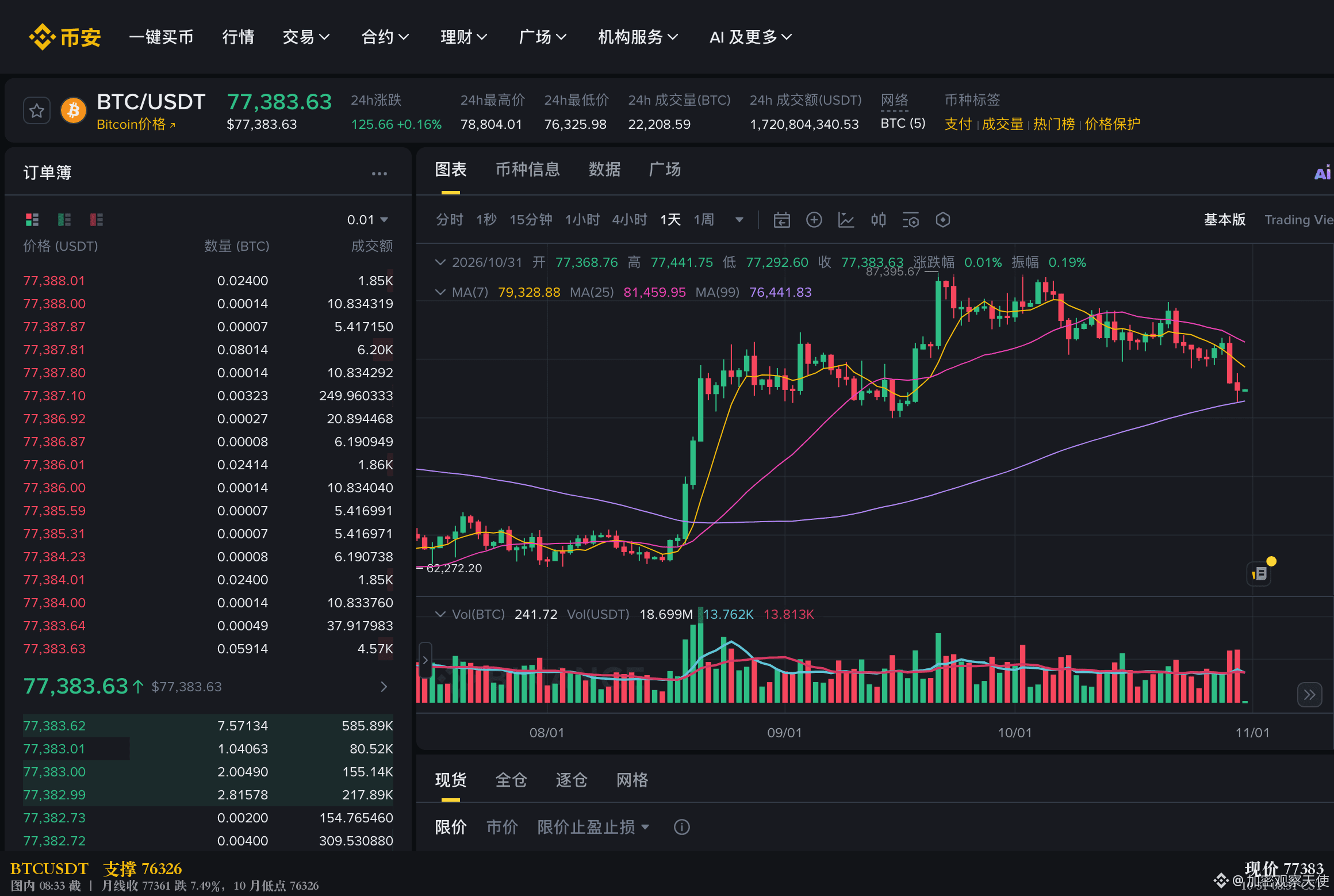
$BTC 10 On the morning of October 31, it was quoted at 77,361.
On September 30, it was still at 83,621, so that’s a 7.5% drop.
$BTC Those $8.37 billion in holdings, valued at that price, would be worth only $7.74 billion.
Excess reserves would fall along with them, from $7.955 billion to $7.33 billion.
The balance sheet doubled, but at that price, $630 million would be wiped back out.
There is, however, one point here that should be made clear.
It replaced reverse repos with direct Treasury holdings, shifting the collateral toward more standardized maturities such as three and six months—not toward lower-quality assets.
The $19.08 billion in gold is also marked to market. When prices move, this line item moves too, in a direction it does not control.
I lean toward saying that a buffer propped up by this kind of valuation does not count as a real buffer.
The absolute amount is large enough, but its direction follows BTC—exactly the opposite of what a stablecoin needs when it needs the buffer most.
That is the mismatch.
The liability side shows a fixed number; the asset side shows a number that moves.
Whether the buffer is big enough isn’t determined by how large it is in normal times, but by how much is left on the day it falls.
Would you count gold and BTC in a stablecoin’s reserves as liquid assets?
Data as of: 2026-10-31 09:02 CST.
Total figures and profit are from Tether’s third-quarter assurance press release. The breakdown is based on crypto.news’s recalculation of the same report, and the BTC revaluation is calculated using Binance spot prices.
The above is a compilation of public data and personal analysis, and does not constitute investment advice.
That doubling didn’t come from profits. It came from rising prices.
Break it down and it becomes clear.
At the end of the second quarter, it held $5.8 billion in BTC. By the end of the third quarter, that had grown to $8.37 billion.
BTC rose 42.6% over those three months, and with little change in its holdings, the value on paper increased by $2.57 billion.
Excess reserves increased by $3.855 billion in total.
Two-thirds of that came from this one line item.
The quality of those reserves is even more worth looking at.
Cash, cash equivalents, and short-term deposits fell from $140.6 billion to $139.58 billion, and their share of total reserves dropped from 74.9% to 72.9%.
At the same time, it cut overnight reverse repos from $18.6 billion to $9.5 billion.
Direct holdings of short-term Treasury bills rose from $115 billion to $122.8 billion.
The duration got longer, while the overnight-redeemable portion got thinner.
And that portion determines how much cash can be made available immediately when a wave of redemptions hits.
Reverse repos can be redeemed overnight. Short-term Treasury bills have to be sold, and the sale depends on the market at that moment.
$BTC 10 On the morning of October 31, it was quoted at 77,361.
On September 30, it was still at 83,621, so that’s a 7.5% drop.
$BTC Those $8.37 billion in holdings, valued at that price, would be worth only $7.74 billion.
Excess reserves would fall along with them, from $7.955 billion to $7.33 billion.
The balance sheet doubled, but at that price, $630 million would be wiped back out.
There is, however, one point here that should be made clear.
It replaced reverse repos with direct Treasury holdings, shifting the collateral toward more standardized maturities such as three and six months—not toward lower-quality assets.
The $19.08 billion in gold is also marked to market. When prices move, this line item moves too, in a direction it does not control.
I lean toward saying that a buffer propped up by this kind of valuation does not count as a real buffer.
The absolute amount is large enough, but its direction follows BTC—exactly the opposite of what a stablecoin needs when it needs the buffer most.
That is the mismatch.
The liability side shows a fixed number; the asset side shows a number that moves.
Whether the buffer is big enough isn’t determined by how large it is in normal times, but by how much is left on the day it falls.
Would you count gold and BTC in a stablecoin’s reserves as liquid assets?
Data as of: 2026-10-31 09:02 CST.
Total figures and profit are from Tether’s third-quarter assurance press release. The breakdown is based on crypto.news’s recalculation of the same report, and the BTC revaluation is calculated using Binance spot prices.
The above is a compilation of public data and personal analysis, and does not constitute investment advice.