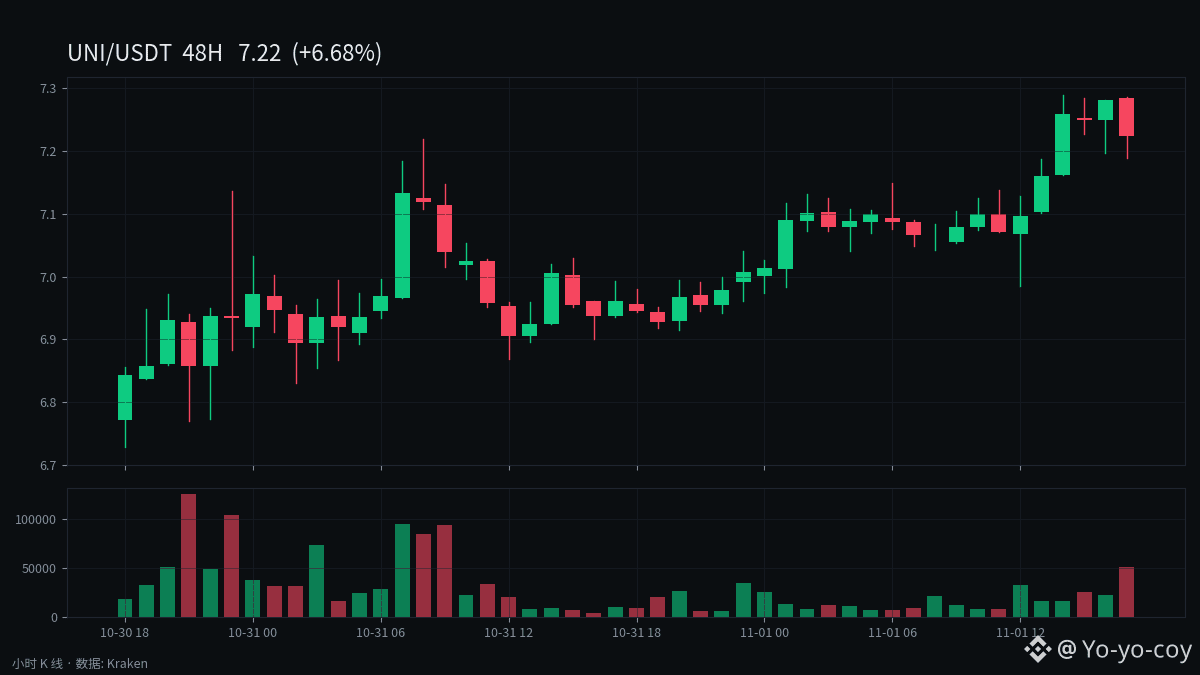
UNI's November 1 rebound stalled just below resistance, and its position is more worth watching than the size of the gain itself.
Data show that on November 1, UNI rose from an intraday low of $6.92 to around $7.31 over 24 hours, a gain of about 4.63%. Most of the broader market was still moving sideways during the same period, making this one of the few positive performers that day. But resistance lies directly ahead: the first resistance level is $7.45, and strong resistance is at $7.60. Both are less than one average daily move from the current price (the 14-day ATR is about $0.52). The Bollinger Bands also point to compression: the upper band is at $7.65, the lower band at $6.69, and the middle band at $7.17. The price has just moved back above the middle band, with room still to the upper band.
Derivatives markets offer no clear one-sided signal. Open interest in futures contracts is about $151 million, up roughly 2.85% over 24 hours, indicating modest follow-through. The 8-hour funding rate is 0.0042%, within the neutral range. The long-to-short account ratio is about 65.5 to 34.5: longs are in the majority, but the reading is not extreme.
On October 30, Standard Chartered reiterated its long-term target of $100 for UNI by 2030. Such long-term views do not change the short-term structure. The next level to watch is very specific: can UNI hold above $7.45? If it does, the rebound could extend toward $7.60; if not, this rise remains just a recovery within the range.
#UNI #Uniswap $UNI
For personal views only; this is not investment advice.