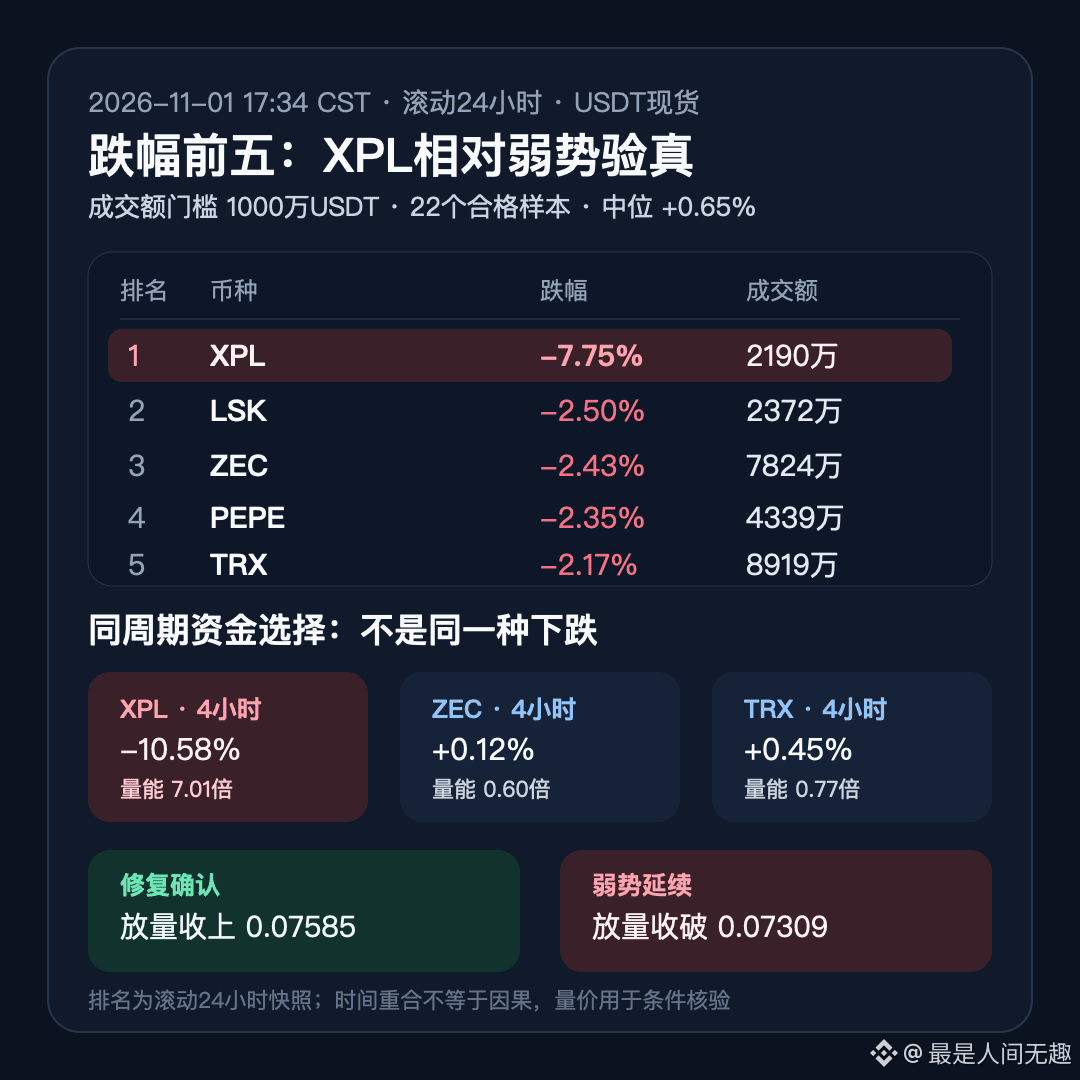
During the same recovery window, why did $XPL fall 7.75% while $ZEC and $TRX fell only about 2%?
At 17:34 on November 1 (Shanghai time), using Binance spot’s rolling 24-hour figures, I screened trading pairs that are TRADING, spot-tradable, quoted in USDT, and have at least 10 million USDT in trading volume. After excluding stablecoins, fiat currencies, leveraged tokens, gold, and tokenized traditional assets, 14 of the 22 qualifying assets were up and 8 were down, with the median still at +0.65%. The five biggest decliners were: XPL -7.75% (trading volume: 21.9 million USDT), LSK -2.50% (23.72 million), ZEC -2.43% (78.24 million), PEPE -2.35% (43.39 million), and TRX -2.17% (89.19 million). This is a rolling 24-hour snapshot, not a calendar-day return.
Start with relative strength, not guesses about the news. XPL lagged the sample median by about 8.39 percentage points, and fell 5.25 percentage points more than the second-worst performer. Over the latest complete four-hour period, from 12:00 to 16:00, XPL closed at 0.07453, down from 0.08335—a 10.58% drop for the period—with a low of 0.06903. Trading volume was 13.26 million USDT, 7.01 times the median of 1.89 million across the previous 12 complete four-hour periods. Both active selling pressure and a liquidity shock are confirmed by volume.
The comparison makes the market’s choices clearer: over that same complete four-hour period, TRX gained 0.45% on volume of just 0.77 times its median; ZEC gained 0.12% on volume of just 0.60 times its median. All three are among the five biggest decliners, but XPL saw a sharp, high-volume sell-off, while TRX and ZEC remained negative on a rolling-window basis but did not deteriorate in sync during the latest period. They should not be treated as having fallen for the same reason.
Why now? Binance’s official Recovery Update #4 confirmed that withdrawals in the first phase would resume gradually between 14:00 and 17:00. The list included TRX and ZEC, but not XPL; other assets would be enabled in stages once preparations were complete. The announcement also said that about 95% of the affected assets had been replenished, with the remaining 5% consisting of unnamed, low-liquidity tokens. We must stay within the bounds of what is known: the announcement did not confirm that XPL was among the stolen assets, nor did it prove that the withdrawal arrangements caused XPL’s decline. The timing overlap provides an observation window, not proof of causation.
At the project level, Plasma’s official materials still define XPL as the network’s native token, used for network security and incentives. I found no same-day negative project announcement that could independently explain today’s decline. The cause is unconfirmed, but price and volume have already provided three actionable scenarios:
Recovery and breakout: A complete one-hour candle records trading volume above the recent median of about 396,000 USDT and closes above 0.07585; then a complete four-hour candle reclaims 0.08335, while XPL’s gap versus ZEC and TRX narrows. If these conditions are met, the view that “XPL’s relative weakness remains dominant” is invalidated.
Consolidation: Price holds between 0.07309 and 0.07585 as volume gradually declines. The latest complete hourly candle closed at 0.07471, up from 0.07453, on volume 1.87 times the median. This indicates some buying support, but there is not yet breakout confirmation.
Further deterioration: A complete hourly candle closes below 0.07309 on rising volume. If 0.06903 then also gives way, that would show the low being retested and confirmed by active selling.
The main risks are further changes to the official recovery list, new undisclosed facts changing the attribution, movement of the rolling 24-hour window, and slippage in XPL during periods of high volatility. Open $XPL , $ZEC , and $TRX individually first to check live volume and the 0.07309 / 0.07585 levels, then assess whether capital is rotating back into XPL or continuing to favor relatively stronger alternatives.