


On 29/10/2026, Binance—the world’s largest exchange—was just robbed of approximately USD 6.3 billion, far surpassing Bybit’s record loss of USD 1.46 billion in February 2025. This is officially the largest hack in crypto history.
This incident not only confirms the hypothesis, but also shows that the current security model has completely failed. Here’s the analysis
1. From Bybit to Binance: The same playbook, the same critical vulnerability
Bybit - 21/02/2025: Lost USD 1.46 billion (401,000 ETH) after the Safe wallet interface was manipulated during a transfer from a cold wallet to a hot wallet. The FBI attributed it to North Korea’s TraderTraitor/Lazarus.
Binance - 29/10/2026: Lost $6.3 billion. Hackers drained funds from Binance’s hot wallets across more than 10 different blockchains in just about 20 minutes on Thursday evening. Binance’s initial investigation found that a DevOps engineer’s laptop had been compromised.
The two biggest incidents in history, with the same culprit: North Korea’s TraderTraitor.
This proves the point: The problem isn’t which exchange it is, but the ground-based data center model. Whether it’s Bybit, KuCoin, Coinbase, or Binance, private keys and approval processes ultimately still have to pass through a person, a laptop, and a server located on the ground. That’s the fixed point of failure.
Binance had to freeze $3 billion in assets, including $1.57 billion frozen by Tether and $800 million by Circle, and use $6.34 billion of its own corporate funds to compensate customers. Without Binance’s enormous financial resources, any other exchange would have gone bankrupt immediately.
The question is no longer "Which exchange will be hacked next?" but "When?".
2. The Space Quantum Vault solution: Stop hacking attempts at their source.
This is why the idea of a Space Quantum Vault has strategic value. Instead of building thicker firewalls around an underground vault, you move the vault into space.
Why does it completely neutralize Lazarus’s hacking methods?
The Binance incident shows that hackers don’t need to hack the blockchain; they only need to hack an engineer’s laptop. Or target user connections through partner channels like Airop... (I’m reminded of Nami, which announced Airop on 30/10 but didn’t follow through, while requiring participants to link a BSC wallet—and then disappeared from X that very day.)
If the storage vault is a Quantum Field cluster.
a) Eliminates physical and human attacks: No laptop to hack, no data center to break into. The private key is generated and remains forever inside a quantum enclave in orbit. The exchange simply sends a request: "sign this transaction," the satellite returns the signature, and the original key never leaves space.
b) Security based on physics, not code: The connection between the ground and the satellite uses Quantum Key Distribution (QKD). Any eavesdropping or tampering changes the state of the quantum particles, and the system automatically terminates the transaction session. No matter how powerful the AI hackers use is, it cannot defeat the laws of physics.
c) Independent of power for storage:
This is the key point. Ground-based data centers need grid power, generators, and cooling. The Quantum Field doesn’t. Assets are safe from any ground-based disaster: power outages, earthquakes, war, or seizure.
In short: Hackers can’t hack what they can’t find, can’t reach, and can’t eavesdrop on.
3. Open AI: Lazarus’s high-speed accomplice
This double-edged sword: "AI may not harm you, but open-source AI will help hackers."
Previously, Lazarus needed months of preparation to hack Bybit.
With today’s open-source AI:
1. AI automates reconnaissance: Just have AI scan GitHub and the LinkedIn profiles of Binance engineers, and it will automatically create phishing emails and flawless fake installation files to take over a DevOps laptop—exactly as happened to Binance.
2. AI automates money laundering: After stealing $6.3 billion, splitting the funds across tens of thousands of wallets on 10 blockchains to avoid being frozen—as Binance did—can be done by AI in minutes instead of weeks.
Closed AI has ethical filters; open AI doesn’t. Anyone can download an open-source AI coding model, remove its filters, and turn it into an "AI-powered Lazarus" for a few hundred dollars. That’s why each new incident is four times bigger than the last: from $1.5 billion (Bybit) to $6.3 billion (Binance) in just 8 months.
Bybit was a warning. Binance’s $6.3 billion loss is proof. It proves that the ground-based centralized storage model is obsolete.
The future isn’t building a bigger safe underground, but moving the safe into orbit.
The Space Quantum Vault currently in development is the answer to all three challenges: hack-resistant 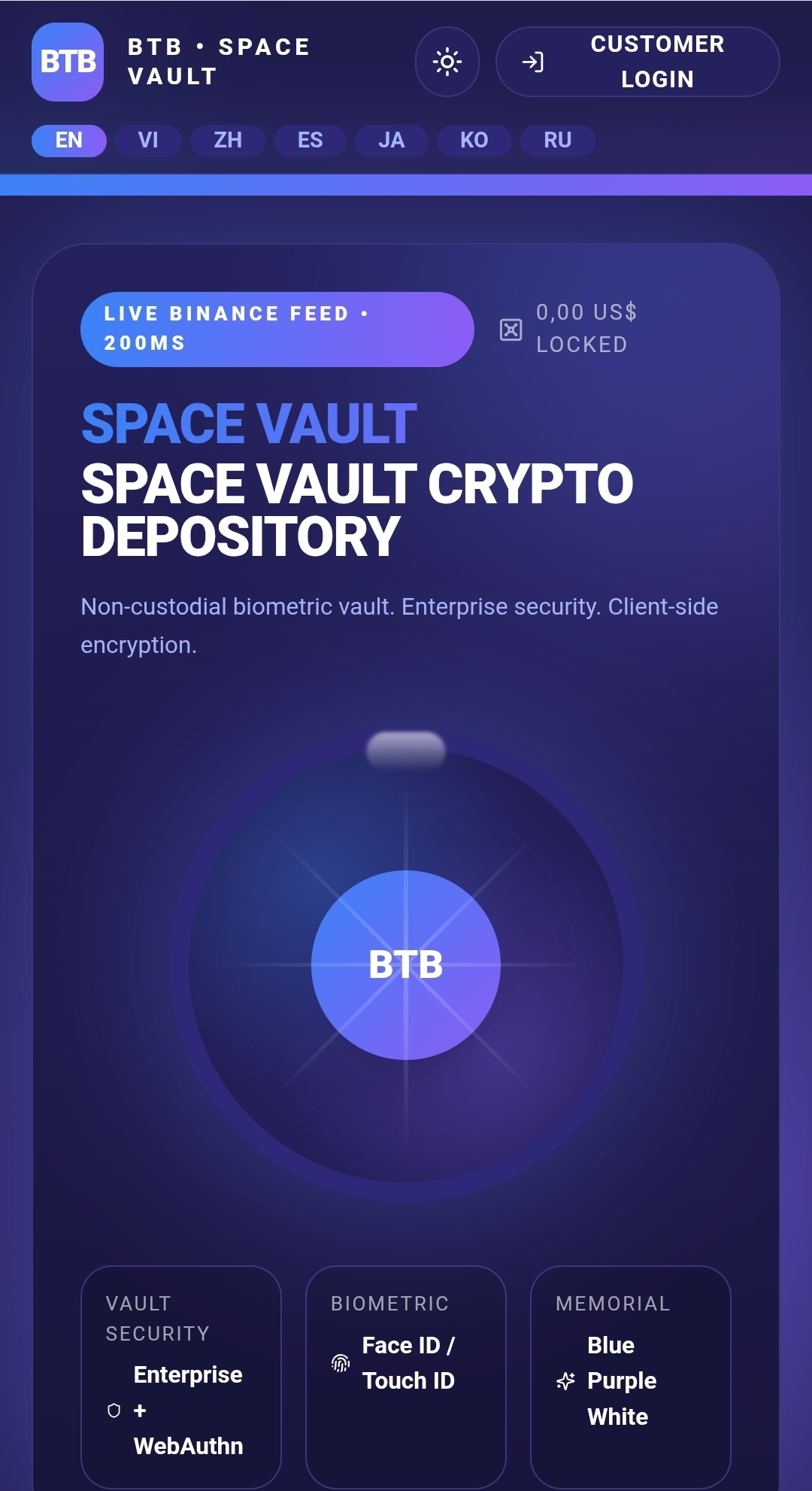 , absolutely secure thanks to quantum physics, and energy-independent.
In an era when open AI helps hackers, security is no longer a race to write code, but a race to find the right storage location. Whoever moves their assets off the ground first will survive.