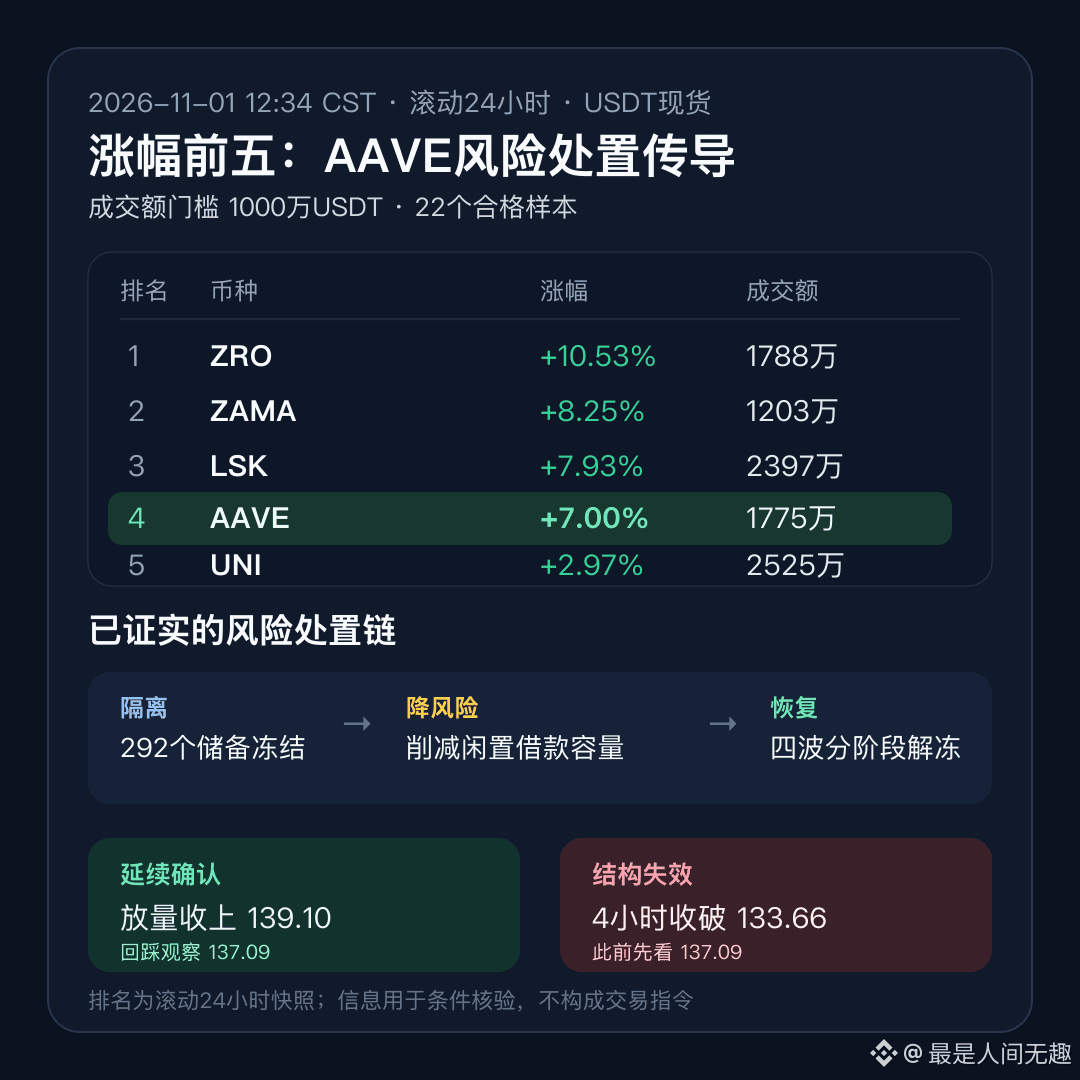
Ranked fourth in gains, but more worth unpacking: $AAVE +7.00%, while 292 reserves are shifting from a full freeze to a phased unfreeze
At 12:34 on November 1 (Shanghai time), based on Binance Spot public data, the top five gainers over the rolling 24 hours among normally traded USDT-denominated spot assets with at least 10 million USDT in 24-hour trading volume—after excluding stablecoins, fiat currencies, leveraged tokens, precious-metal-backed assets, tokenized traditional assets, and clearly anomalous assets—were: ZRO +10.53% (17.88 million USDT in trading volume), ZAMA +8.25% (12.03 million), LSK +7.93% (23.97 million), AAVE +7.00% (17.75 million), and UNI +2.97% (25.25 million). Of the 22 qualifying assets, 16 rose and 6 fell; the median gain was +1.23%. These are rolling 24-hour returns, not calendar-day returns.
Why choose AAVE rather than write only about the top-ranked asset? Because Aave’s official governance forum has disclosed risk-mitigation measures that can be verified step by step, rather than leaving us to guess why the price rose.
First, the exposure has been confirmed. LlamaRisk records show that the attacker’s address supplied 60 million USDT to Aave V3 and borrowed 19,762 WETH. The position was overcollateralized at the time and remained subject to normal liquidation rules; the official risk thread said it posed no direct risk to suppliers.
Second, protocol isolation has been implemented. Aave service providers and Guardians froze 175 reserves across 16 networks on V3, and 117 reserves across 4 networks on V4. The freeze prevents new supplies and borrowing, but withdrawals, repayments, and liquidations continue to operate; this is not the same as “the entire protocol being paused.”
Third, recovery does not mean simply lifting the freeze. The risk team temporarily lowered Slope2 for some high-utilization assets to ease interest-rate pressure on borrowers. It also cut borrowing caps and V4 draw caps, removing about $3.7 billion in unused borrowing capacity on V3 and $130 million on V4. The unfreeze is proceeding in four waves, while several assets held by the attacker’s address cluster will continue to have an LTV or collateral factor of 0. Risk mitigation has progressed, but normal capital efficiency has not yet been fully restored.
Fourth comes price confirmation. AAVE’s snapshot price was 138.66 USDT, with a rolling 24-hour range of 129.14–139.10. The latest completed 4-hour candle closed at 138.13, up about 3.15% from 133.91, on roughly 3.005 million USDT in trading volume—1.08 times the median of the previous 24 completed 4-hour candles. The latest completed 1-hour candle closed at 138.13, with about 1.431 million USDT in volume, 2.40 times the median for the previous 24 hours. Market participation is confirmed, but the price has yet to close above 139.10.
Continuation scenario: 1-hour trading volume stays above roughly 596,000 USDT and the candle closes above 139.10, followed by a high-volume 4-hour candle holding above that level and a pullback that holds 137.09. This would indicate that the risk response is beginning to receive sustained price acceptance.
Reversal scenario: a high-volume completed hourly candle closing below 137.09 would signal a failed breakout attempt. If a completed 4-hour candle then closes below 133.66, the price structure suggesting that “phased recovery is driving a revaluation” would be invalidated. If volume merely contracts within the 137.09–139.10 range, it would be more prudent to wait rather than equate a risk response directly with token demand.
Key risks include changes to the unfreeze schedule, continued collateral restrictions on some assets, high utilization and borrowing costs, liquidation volatility in the attacker’s positions, and slippage near the rolling leaderboard’s highs. Click $AAVE to first check real-time hourly trading volume and which side of 137.09 / 139.10 is confirmed by a candle close, then see whether volume holds up on the 4-hour chart. Risk isolation, protocol recovery, and price acceptance must each pass their own step.