
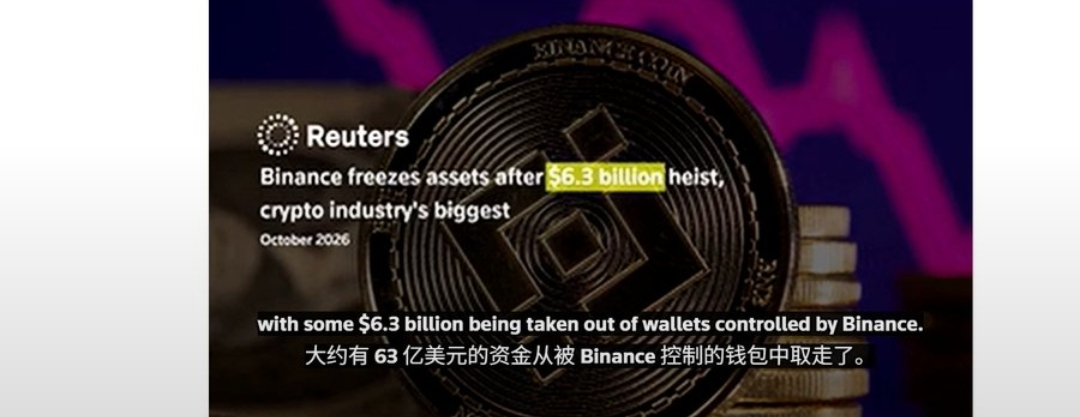

🚨 After the $6.3 Billion Incident: Binance Protected User Assets, but Can It Preserve the Crypto Industry’s Trust?
Those of you who experienced the 10·11 black swan event probably still remember the impact of the severe market volatility. Many investors experienced sharp price drops, liquidity crunches, and mass liquidations in a short period of time. Now, Binance has suffered a security incident. Honestly, my biggest feeling isn’t shock—it’s a sense of relief that things weren’t worse.
First, one thing to clarify: 10·11 was an event involving severe market volatility and liquidations, while this time it was an exchange security incident. They are different in nature. But both have reminded us that in the crypto market, risks have never been limited to price movements.
1. What exactly happened in the $6.3 billion incident?
According to Binance’s official announcement on October 30, its hot wallet experienced an unauthorized outflow of funds on October 29, involving assets worth approximately $6.3 billion. Binance said it would cover the losses using SAFU and company funds, so users would not bear them.
A follow-up announcement on October 31 showed that approximately 90% of the affected assets had been replenished, while ten assets, including BTC, ETH, USDT, BNB, and SOL, had reached 100% reserve coverage.
One detail needs to be made clear: replenishing assets does not mean all stolen funds have been recovered. Replenishment means the platform provides funds to make up the shortfall; recovery means retrieving the assets that were transferred out. These are two different things.
2. Why should every investor be concerned about this?
Many people judge whether an exchange is reliable by looking first at its size, trading volume, and market position. But I don’t think those factors tell the whole story.
We should also pay attention to three questions:
Asset security: Are private keys, hot wallets, and internal permissions protected by robust safeguards?
Transparency: Can proof of reserves allow users to independently verify their assets?
Incident response: When an incident actually occurs, can the platform promptly contain the damage, disclose information, and take responsibility?
Proof of Reserves (PoR) can help users verify reserve levels, but it does not mean a platform cannot be attacked, nor is it a comprehensive security audit.
3. What should ordinary investors do?
I don’t think one security incident should lead us to write off the entire crypto industry. But we also shouldn’t entrust the security of all our assets to a platform just because it’s big enough.
For those of you who hold BTC, ETH, or SOL for the long term, I’d recommend:
Don’t keep all your long-term assets on a single exchange.
Learn how to use a self-custody wallet and truly understand private keys and seed phrases.
Keep only the funds you need for trading on an exchange, and enable robust account security protections.
Of course, self-custody also carries risks. Losing your seed phrase or making an operational mistake can also result in permanent losses.
Finally, here’s what I think
I remain optimistic about the long-term development of the blockchain industry and am willing to continue researching core assets such as BTC and ETH. But believing in an industry doesn’t mean ignoring its problems.
If the crypto industry wants to truly enter mainstream finance, it needs more than technological innovation and market scale—it also needs to build a long-term, transparent, and reliable security framework.
Bull markets show people the returns; black swan events are what make them truly understand risk.
I want to ask everyone: After 10·11 and this $6.3 billion security incident, would you still keep most of your crypto assets on centralized exchanges, or gradually move toward self-custody?
Feel free to share your honest thoughts. I hope we can all protect our assets while pursuing returns.
#Binance #BTC #ETH #SOL #Crypto #Cryptocurrency #AssetSecurity