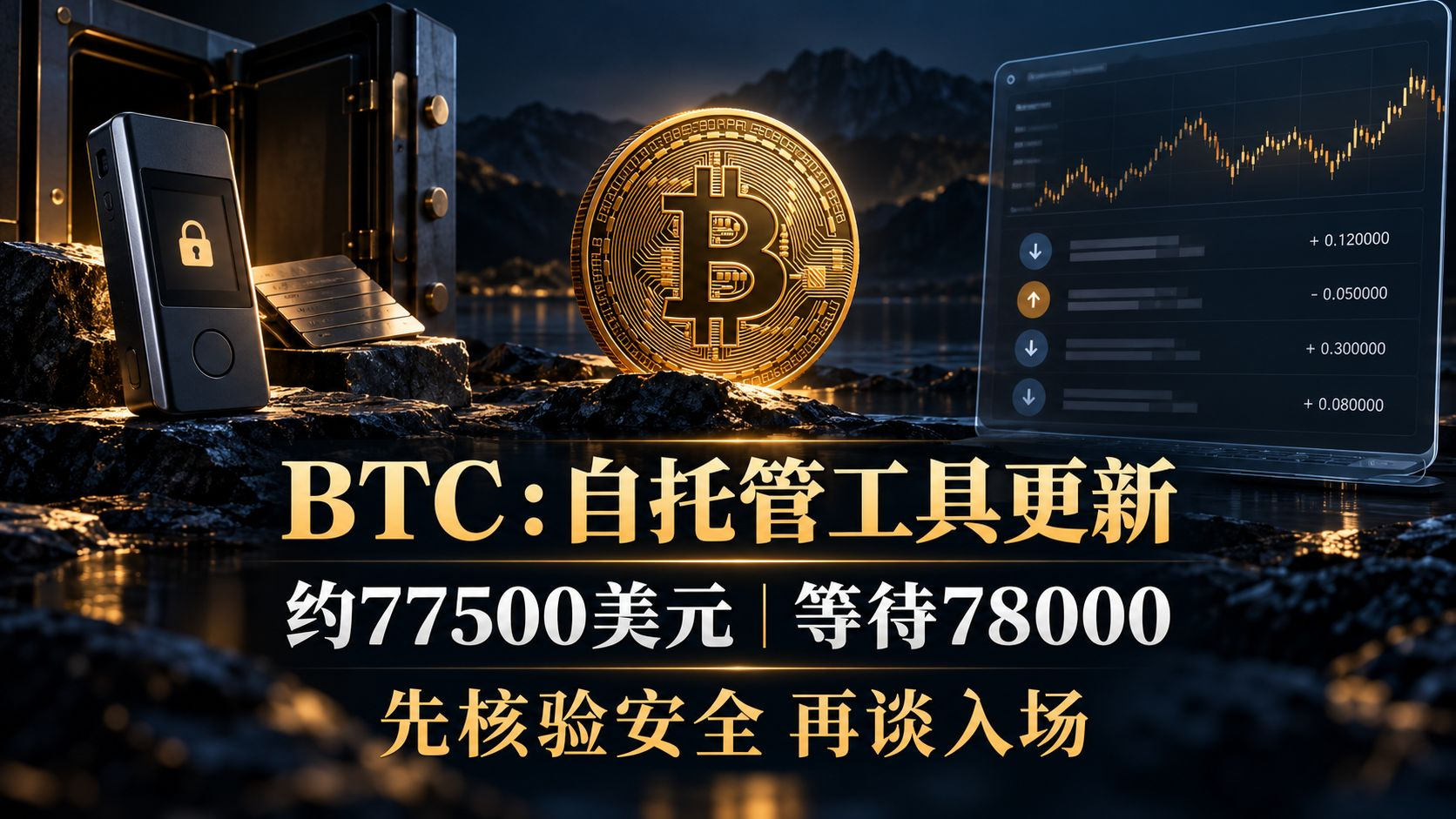
BTC | Self-custody tools in focus after exchange security incident | Still waiting for confirmation near $77,500
My approach is to treat the security of held assets and the short-term market direction separately: the market price has not automatically verified the exchange’s security recovery, and switching to self-custody also requires the right tools. Binance Square’s trending topics are still discussing SAFU transfers and reimbursement of affected assets. In an October 31 announcement, Binance said that about 90% of the overall reimbursement had been completed, that ten major tokens, including BTC, were fully backed, and that it expected withdrawals to resume on November 1 and a complete zero-knowledge proof of reserves to be generated on November 3. These are, respectively, disclosures from the platform, expected timelines, and materials that can be verified in the future. They should not be conflated with withdrawals having fully resumed or independent verification having been completed.
One easily overlooked official project update related to this is that the Bitcoin Core 32.1 release notes add a feature for exporting watch-only wallets. It can generate a watch-only wallet file from an existing descriptor wallet, containing only information such as public descriptors, transactions, and the address book, with no private keys. The official offline signing tutorial has also been updated to use this feature to set up an online watch-only device. My understanding is that holders can use an internet-connected device to check balances and prepare transactions, while keeping signing keys offline, which may help reduce reliance on a single custodian. However, this is not a one-click security guarantee: a watch-only wallet can expose privacy information, including links between addresses and transactions, and users still need to verify their backups, devices, and offline signing procedures themselves. The release notes specify a local wallet feature, not an automatic conversion of exchange accounts into self-custody.
The connection between this technical development and BTC’s valuation is indirect. A security incident may prompt some investors to reassess their custody arrangements, and mature self-custody tools could bolster confidence among long-term holders. But there is no direct data showing how many people are migrating today, so this does not justify inferring spot buying. How has the market reacted so far? I checked Kraken’s BTC/USD price at around $77,525, with a rolling 24-hour high of about $77,636 and a low of about $77,000, still within a narrow range. I’m watching whether price can hold above $78,000 and, on the downside, the $77,000 level; so far, price has not confirmed a new trend. Large net outflows from U.S. spot BTC funds on October 30 also suggest that a weekend rebound cannot be explained by the security narrative alone.
I would reconsider my view under either of two conditions: if Binance’s resumption of withdrawals is significantly delayed or its proof of reserves cannot be verified as expected, the platform-risk discount could widen again; if BTC breaks below $77,000 and fails to reclaim it, my short-term long setup is invalidated. Conversely, even if withdrawals resume smoothly, I still won’t chase the price if it cannot get above $78,000.
If I were trading this myself, I would stay out for now and keep only a conditional spot-long bias. I would wait for BTC to break decisively above $78,000 and then hold $77,800 on a retest, while also ensuring the platform has made no new major negative disclosures. Only then would I test a position using at most 3% of my total capital. I would take half off at the first target of $79,000, then gradually close the rest at the second target of $80,000. My stop would be below $77,200, with the entire position closed if triggered. I would also exit early if price quickly falls back below $78,000 after breaking out and fails in two rebound attempts. If the setup does not trigger, I stay flat; I won’t describe watching the market as having made a trade.
#BTC
The above is only my personal market observation and does not constitute investment advice.