

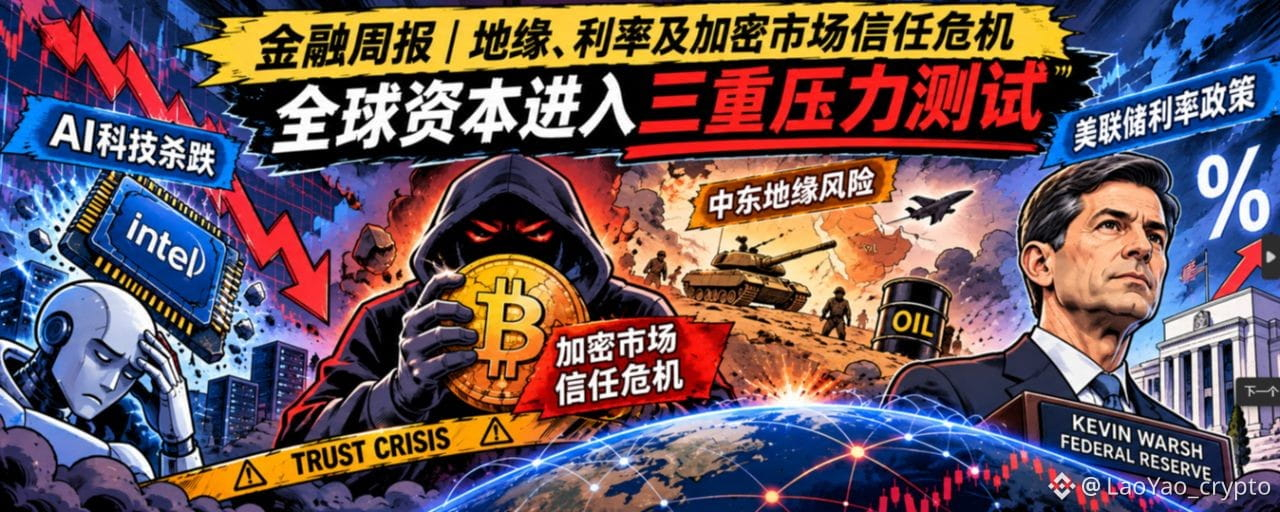

This week (10.26–10.31), global capital markets underwent a cross-asset repricing. Geopolitical tensions pushed up inflation expectations, while interest-rate pricing hit risk assets hard:
Geopolitical risks in the Middle East continued to intensify, giving crude oil a fresh supply-risk premium. Gold retreated after surging, while silver faced more severe deleveraging. U.S. tech stocks came under pressure as returns on AI capital spending began to be questioned. Japanese markets were weighed down by expectations of monetary policy normalization, while Hong Kong stocks relied more heavily on support from domestic policy expectations.
Meanwhile, the crypto market was rocked by a security incident at an exchange, putting both market confidence and liquidity under pressure.
Geopolitics: Uncertainty over energy supply routes is once again pushing up the global inflation risk premium.
Cost of capital: The gap between massive AI capital spending and actual profits is beginning to affect tech asset valuations.
Financial trust: A security incident at a crypto exchange has put custody, transparency, and fund security back at the center of market concerns.
This week, the Federal Reserve, Bank of Japan, and European Central Bank all kept rates unchanged, but expectations for monetary easing did not strengthen as a result. Concerns that the Fed could tighten policy further in December persist, and market pricing of the future policy path has shifted back and forth.
The market is shifting from simply chasing growth to reassessing cash flow, financing costs, and the security premium.
Central banks are no longer quick to signal monetary easing, geopolitical risks have not subsided, and AI no longer enjoys an unconditional valuation premium.
As November begins, U.S. midterm elections, the situation in the Middle East, and tech company earnings will jointly shape the direction of global risk assets in the fourth quarter.
🧱 Geopolitical Rivalry: Middle East Risks Intertwine with U.S. Midterm Elections
① Middle East: Military deployments and diplomatic deadlock coexist
U.S. military deployments in the Middle East are largely in place. Markets speculate that Trump may decide whether to launch a new round of strikes on Iran within 96 hours of the election.
Iran says four oil tankers were attacked and caught fire in the Strait of Hormuz; the U.S. denies reports that an unmanned vessel was destroyed.
Tensions in the Middle East continue to provide a risk premium to energy markets.
👉 Crypto Mindset perspective:
What matters is not any single military action in itself, but whether the Trump administration will use military pressure after the midterms to reshape its bargaining leverage with Iran.
If military action is merely a negotiating tool, the risk premium may ease temporarily;
if conflict spreads to shipping in the Strait of Hormuz and regional energy infrastructure, oil prices could shift from sentiment-driven moves to an actual supply shock.
② U.S. Midterm Elections: Entering a Critical Window
Trump cancels in-person rallies in Kansas and Iowa, switching to phone campaigning.
A same-name candidate has emerged in Alaska, a situation seen as potentially favorable to Republicans.
Iran has become a focal point of bipartisan rivalry, with traditional liberal media outlets such as The New York Times and CNN publishing criticism of the Democrats.
👉 Crypto Mindset perspective:
The midterm elections affect not only U.S. domestic politics, but also future fiscal spending, energy policy, overseas military action, and the policy environment facing the Federal Reserve.
The relationship between political cycles and capital markets is not a simple cause-and-effect one, but political pressure can alter policy choices and, in turn, affect how global capital prices risk.
💹 Capital Flows: From Growth Narratives Back to Cash Flow Constraints
The most notable change in global markets this week was declining risk appetite and a clear divergence in asset performance.
Three main transmission channels emerged:
I. Reassessing Returns on AI Investment
Doubts about returns on AI capital spending → pressure on the Nasdaq and semiconductor stocks → repricing of high-valuation tech assets → increased demand for intermediate-term U.S. Treasuries.
The market is starting to question whether massive investments in computing power can translate into sustained revenue, profits, and free cash flow.
II. Geopolitical Risks Inject a Fresh Energy Premium
Escalating tensions in the Middle East → higher oil supply risk premium → inflation expectations prove difficult to shake → limited room for monetary easing.
III. Exchange Security Incident Shakes Trust in the Crypto System
Exchange hot wallet security incident → panic over withdrawals and fund tracing → mass liquidations of leveraged longs → pressure on crypto market liquidity and confidence.
Ultimately, it all comes down to the same question:
When growth, inflation, and trust are all uncertain, capital recalculates the cost of taking on risk.
📊 Bonds: Short- and intermediate-term yields fall, while the ultra-long end remains stubborn
2-year Treasury: 4.583%, down 2.8 bps on the week
10-year Treasury: 4.925%, down 6.3 bps on the week
30-year Treasury: 5.307%, up 0.5 bps on the week
10-year Japanese government bond: 2.753%, down 6.3 bps on the week
The U.S. Treasury market showed a clear divergence across maturities this week: 2- and 10-year yields fell, while the 30-year yield barely moved lower.
The market has not settled on a consistent expectation of monetary easing.
On one hand, tech stock declines, uncertainty over returns on AI capital spending, and month-end position adjustments increased demand for short- and intermediate-term Treasuries.
On the other hand, long-term inflation expectations, fiscal financing pressures, and the term premium continue to constrain ultra-long-term Treasuries.
The Treasury market is seeing a tug-of-war between two forces:
Short-term investors are seeking safe havens and duration exposure, while long-term investors still demand greater compensation for taking on duration risk.
📈 U.S. Stocks: The Market Puts AI's Profitability to the Test
Nasdaq: down 2.00% for the week
S&P 500: down 0.57% for the week
Dow Jones: down 0.85% for the week
The Nasdaq significantly underperformed the S&P 500, indicating that this week's market pressure was concentrated mainly in growth-oriented tech stocks.
The Dow held up relatively well, reflecting how energy, healthcare, and some value sectors partially offset declines in tech heavyweights.
Earnings shocks have a knock-on effect: Intel's results and guidance prompted the market to reassess the trajectory of the PC and data center supply chains.
Large platform companies did not suffer a comparable collapse in earnings, yet their valuations still fell amid questions over whether capital spending can generate sufficient returns.
Market analysts see this as a rotation away from high-valuation, long-duration assets toward cash flow, energy, and defensive sectors.
The Fed's decision was an amplifier, not the sole cause.
🛢️ Crude Oil: Geopolitical Premium Supports Energy Prices
WTI: $104.12/barrel, up 1.76% this week
Brent: $117.64/barrel, up 1.51% this week
Crude oil is becoming a key channel through which geopolitics feeds into global inflation.
The main driver of Friday's rise was the risk to supply routes, not the current supply-and-demand balance.
Media reports pointed to an oil tanker being hit by a mine and catching fire in the Strait of Hormuz, as well as Houthi threats against Saudi oil facilities;
A countervailing force is the prospect of strategic reserve releases. Reports say the EU is preparing to accelerate the release of strategic oil reserves to cushion the winter fuel market, putting a ceiling on the risk premium.
If passage through the Strait of Hormuz is materially restricted, oil prices could spike in a stress-driven move, with near-term contracts outperforming longer-dated ones.
Conversely, if diplomatic engagement, naval escorts, and strategic reserve releases make progress, the first thing to ease may be the geopolitical risk premium—not necessarily energy prices across the board.
This is also one of the most important macro variables in this market cycle:
Geopolitical conflict may not directly change global economic growth, but it can alter the scope for global monetary policy choices through its impact on energy prices.
🥇 Precious Metals: Gold Falls Below $4,000; Silver Amplifies Deleveraging Pressure
Gold: $3,898.90/oz, down 3.29%; down 3.63% for the week
Silver: $49.13/oz, down 5.43%; down 9.05% for the week
The most notable development this week was that crude oil rose while gold and silver fell in tandem.
Traditional safe-haven assets did not rise across the board.
This does not mean gold has lost its safe-haven appeal. Rather, it shows that in the current market environment, interest rate pressures are temporarily outweighing some demand for protection against geopolitical risks.
Crude oil reflects the risk of physical supply disruptions; gold reflects real interest rates, monetary credibility, and long-term purchasing power; while silver is influenced by both its precious-metal qualities and industrial demand.
The market is not simply abandoning safe-haven assets; it is choosing among different types of safe havens.
💸 FX: The Dollar Is “Flat on the Week” as the Yen and Yuan Strengthen
U.S. Dollar Index: 101.97, down 0.07% on the week
USD/JPY: 157.56, down 0.20% on the week
EUR/USD: 1.1160, down 0.17% on the week
Offshore yuan: 6.6533, down 0.25% on the week
The overall picture in FX this week was a broadly flat dollar index, with the yen and yuan strengthening relative to the dollar.
The yen's performance carries the clearest policy implications. Although the Bank of Japan did not raise rates, it confirmed for the first time that underlying inflation is in line with its 2% target and increased the pace of ETF sales. The market therefore kept open the possibility of further normalization in December or later, preventing USD/JPY from surging in one direction on safe-haven demand amid falling U.S. stocks.
The yuan's strength was driven mainly by the dollar side, rather than expectations for domestic demand.
💸 Web3 Recap: Exchange Security Black Swan Exposes the Cost of Trust in Crypto Markets
This week, crypto markets saw high-interest-rate macro pricing converge with an exchange security black swan. Markets were weak at first, then saw a sharp sell-off, followed by a modest recovery in the second half of the week. Risk appetite cooled markedly, funds rotated from speculative altcoins back into major assets, and leveraged longs were liquidated en masse.
Markets plunged. Although they recovered somewhat after a sharp weekend sell-off, investor confidence was damaged, speculative interest in altcoins faded quickly, and the market shifted into a zero-sum contest for existing capital.
Midweek, news broke that an exchange hot wallet had been hacked. The market quickly priced in platform trust risk, triggering panic selling. Stablecoin issuers, on-chain tracking firms, and exchanges later coordinated to freeze some assets, making it possible to recover part of the losses and easing panic somewhat. But lasting damage remains: the market is once again discussing custody risk, self-custody, and shifting preferences between CEXs and DEXs.
By sector:
Exchange tokens: BNB was directly hit by the exchange security incident and fell significantly more than BTC and ETH this week, damaging short-term sentiment. Other major exchange tokens also came under pressure.
SOL and AI/compute-related altcoins: Among the biggest decliners this week. High-beta small-cap coins and MEME coins faced the heaviest selling, with many tokens falling 10%–20% in a single day. Illiquid tokens suffered cascading slippage, while previously popular themes such as AI computing power and tokenized assets lost momentum for now.
DEX-related assets: Some funds rotated in the opposite direction, on the thesis that trust in CEXs had been damaged and capital would briefly speculate on decentralized exchanges. A few DEX platform tokens rose against the trend, but this was a short-term, event-driven move with limited staying power.
Stablecoins: USDT and USDC issuers quickly cooperated to freeze addresses linked to the incident. Stablecoin pegs held, and there was no systemic run—an important reason the events did not escalate into a broader collapse this week.
Spot ETFs: Net inflows into U.S. spot Bitcoin ETFs slowed considerably this week, with even a small net outflow on one day. Institutional investors stayed on the sidelines, no longer providing the steady buying pressure seen previously. Public companies also paused their Bitcoin accumulation for a time, leaving a void in demand.
Futures: Long positions were liquidated en masse, with market-wide liquidations concentrated in the 24 hours of sharp declines. Long liquidations made up a very high share, and the fear index entered fear territory. Leverage had risen before the sell-off, and thin liquidity amplified the decline.
🧘 Crypto Mindset: Three Themes, One Conclusion
Viewed together, this week's changes in global financial markets reveal three interconnected structural shifts.
Theme One | Geopolitics and Energy Inflation
Middle East risks → rising oil prices → higher inflation expectations → limited room for monetary easing → pressure on global risk-asset valuations
Theme Two | The Tension Between AI Growth and Returns on Capital
Technology continues to advance, but the market is beginning to ask: Can massive investments in computing power translate into sustained revenue, profits, and cash flow? AI's long-term value and the short-term valuations of AI companies are being tested from different angles.
Theme Three | Crypto's Cost of Trust and Institutionalization
This black swan event at Binance dealt a major blow to trust in crypto markets, but did not escalate into a global systemic risk.
The fact that crypto plunged without a comparable shock to traditional finance shows that risk transmission and pricing leadership between the two remain out of sync.
Crypto remains a “financial island” connected to traditional finance, but not yet integrated with it.
But this may also mark a turning point for the industry:
The cost of trust in centralized exchanges has been exposed repeatedly, and institutional demands for custody, security audits, compliance, and transparency will only grow.
The future of crypto will be shaped not only by technology and liquidity, but also by competition over trust mechanisms and financial infrastructure. This could also accelerate crypto's integration with the Wall Street system.
🔚 In Closing:
— Geopolitics sets the risk premium, interest rates determine the cost of capital, and trust determines where money flows
This week's changes in global markets reveal a deeper underlying logic:
AI capital spending, energy prices, monetary policy, and the crypto credit system are not isolated variables.
Geopolitics reshapes energy supplies and inflation expectations; inflation expectations affect monetary policy and the cost of capital; the cost of capital determines industry valuations; and trust in financial infrastructure determines where capital is willing to flow.
When these variables move in the same direction, cross-asset correlations grow significantly stronger.
The key focus is on three fundamental questions:
👉 How does geopolitics reshape global capital flows?
👉 How does the cost of capital redefine the value of AI and the tech industry?
👉 How does financial trust determine where wealth flows next?
⚠️ The above reflects personal views and is intended solely for market observation and discussion.
Geopolitical conditions can change rapidly. Please be mindful of position sizing and leverage risks. This is not investment advice.
📌 LaoYao (@LaoYao_crypto)
Viewing capital through the lens of the mind, discerning trends through cycles;
Finding certainty amid uncertainty, anchoring value amid volatility.