
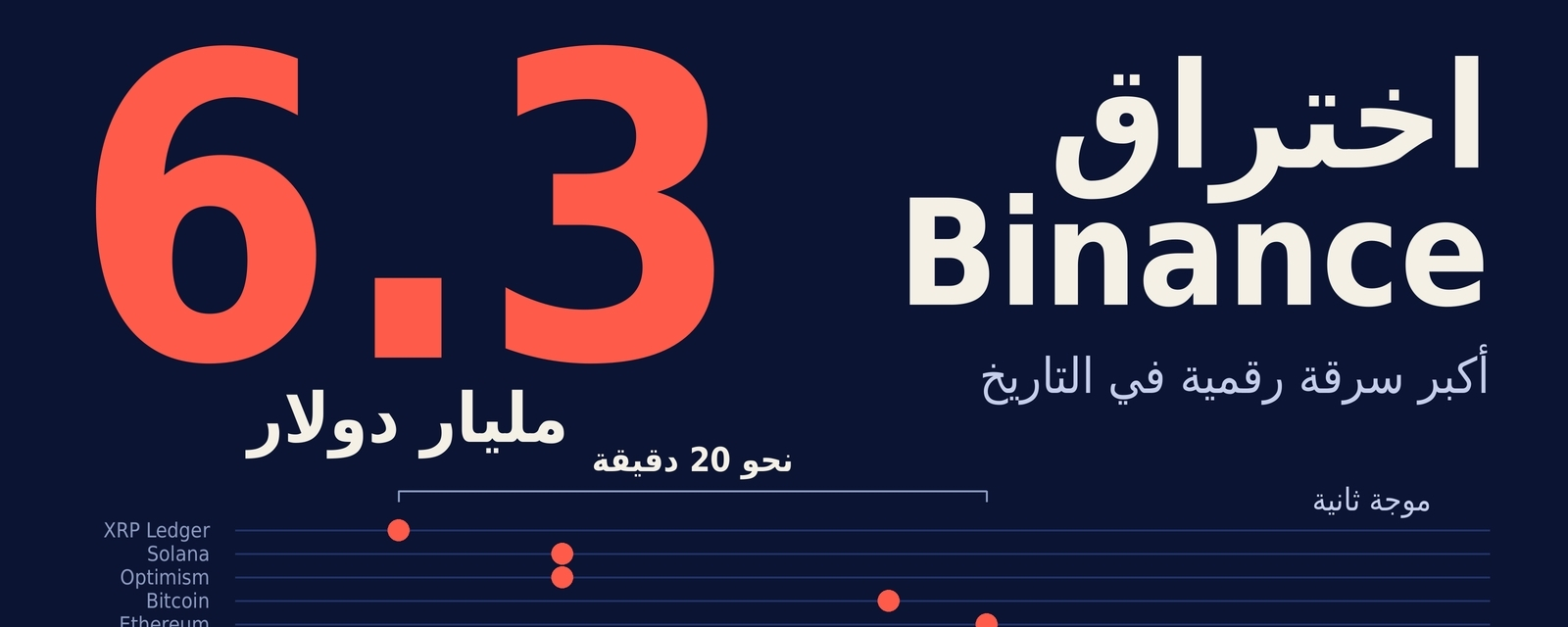

About $6.3 billion left the platform, most of it within roughly twenty minutes. Here’s what we know so far about the incident and the compensation measures.
On the evening of Thursday, October 29, 2026, Binance, the world’s largest cryptocurrency exchange, suffered the biggest recorded theft in the industry’s history. Around $6.3 billion in digital assets left its wallets, spread across ten blockchain networks. One TRM Labs executive described the incident as “the biggest bank heist in human history.” It was roughly four times larger than the February 2025 Bybit hack, which amounted to $1.5 billion.
How was the operation carried out?
Transfers began at 20:05 UTC from Binance wallets on the XRP Ledger, followed by wallets on Solana and Optimism, then Bitcoin and Tron within minutes. Ethereum was the hardest-hit network, with about $3.8 billion leaving it, while the outflow from Bitcoin amounted to about 18,270 BTC, or roughly $1.47 billion. A smaller second wave followed at 23:05 UTC, involving wallets on Avalanche and Polygon.
Analyses do not point to a single wallet being compromised. Instead, the attacker appears to have gained control of the signing system used by the platform’s hot wallets, enabling valid transfers from wallets operating across different networks and using different signing technologies within about half an hour. On Ethereum, the attacker used a recent mechanism known as EIP-7702 to turn the hot wallet into an instrument under their control, then continued draining funds sent to it at intervals until 23:56 UTC.
The attack was preceded by more than 36 hours of preparation. This included funding an operational wallet for the attacker with small withdrawals from the cryptocurrency mixing service Tornado Cash, and testing the code on test wallets before deploying it on Binance’s real wallet.
In its initial statement, Binance said the incident may have started with a mobile device belonging to a DevOps engineer that had been compromised, allowing the attacker to access a service container and submit unauthorized withdrawal requests. The platform said it had found no evidence that private wallet keys had been leaked. However, subsequent investigations pointed to additional points of compromise beyond that device, and the full picture is not yet clear.
Who is behind the attack?
Both TRM Labs and Chainalysis attributed the attack to the North Korea-linked TraderTraitor group. TRM said its assessment is based on blockchain evidence and intelligence sources outside the blockchain, and that it has a high degree of confidence in its conclusion. Chainalysis pointed to laundering patterns it had not seen before, and said that thousands of transactions over a short period indicate the use of automation to obscure the flow of funds. TRM also believes some features of the attack match the 2025 Bybit hack, which the U.S. Federal Bureau of Investigation (FBI) attributed to the same group. These include the lengthy advance preparation and the use of small withdrawals from Tornado Cash to fund the operational wallet.
However, Binance has not officially attributed the attack to any particular party in the statements reviewed, and the current attribution is based on analyses by blockchain-tracking firms. Meanwhile, Reuters reported that Mark Karpeles, former head of Mt. Gox, believes the attackers accessed the private keys of at least two wallets, contradicting Binance’s position. This remains one of the most significant unanswered questions.
What happened to the stolen funds
Stablecoin issuers moved quickly to freeze a large portion of the funds. Tether froze about $1.77 billion in USDT, Circle froze about $825 million in USDC, and Ripple and World Liberty Financial helped freeze other assets. Arbitrum’s Security Council also intervened to remove about $30 million in ETH and ARB from the attacker’s wallet. According to TRM, about $2.7 billion had been frozen by the early hours of October 30, while Binance estimated the amount at about $3 billion. Before the freezes took effect, the attacker tried to convert some of the stablecoins into other assets, incurring a loss of more than 10% in one large trade.
As for the remaining funds, TRM estimates that the attacker still controls them: more than 420,000 ETH and 18,270 BTC, worth about $2.4 billion, beyond the reach of any issuer capable of freezing them.
Binance’s latest updates
In a statement published on Saturday, October 31, Binance said it had restored about 90% of the stolen assets, up from 80% the previous day. It explained that the remaining 10% consists mainly of less liquid coins, which it is buying on the market and through over-the-counter trades. It confirmed that ten major assets, including BTC, ETH, USDT, and BNB, are now fully covered, and that it has allocated about $6.34 billion to cover the losses, including about $5 billion in the affected coins themselves. The funding comes from a portion of the SAFU user-protection fund, part of the futures insurance fund, and the company treasury, with a commitment to restore SAFU to about $1 billion.
Co-CEO Richard Teng said users would suffer no financial impact, explaining that the affected wallet was the platform’s own hot wallet, while most user assets are held in cold wallets and transferred to the hot wallet only when a withdrawal is requested. As for services, deposits remained operational, while the platform aims to resume withdrawals on Sunday, November 1, in stages, one coin at a time, following security checks. Binance is expected to publish an updated proof of reserves on November 2 or 3. Reports indicate that the FBI and the U.S. Secret Service are participating in the investigation and tracking the funds.
Open questions and market implications
Several questions remain unanswered: How did the attacker gain access to the signing system? Were private keys actually leaked? Where will the funds still under their control go? TRM expects the next stage of money laundering to move to cross-chain bridges, swap services, and over-the-counter brokers—the routes the firm is currently monitoring.
In the market, Bitcoin fell about 5% following the announcement, dropping below $80,000, and liquidations of leveraged positions exceeded $1.5 billion, according to reports. However, analysts at Fundstrat believe that despite the scale of the incident, it does not appear to pose a solvency crisis for the platform, reducing the risk that panic will turn into a wave of mass withdrawals.
The incident raises a fundamental question for centralized platforms: How can one compromised device open the door to controlling wallets holding billions of dollars? The answer puts the security of signing systems and employee access privileges at the top of the industry’s priorities. Users are advised to be wary of any message claiming to come from the support team that asks for information or promises a quick recovery, and to rely solely on the platform’s official channels.
Sources: TRM Labs, Chainalysis, CNBC, NBC News, Bloomberg, Al Jazeera, NPR, CNN, and Cointelegraph. This article was prepared based on reports published through November 1, 2026. It is for news and analysis purposes and does not constitute investment advice.