
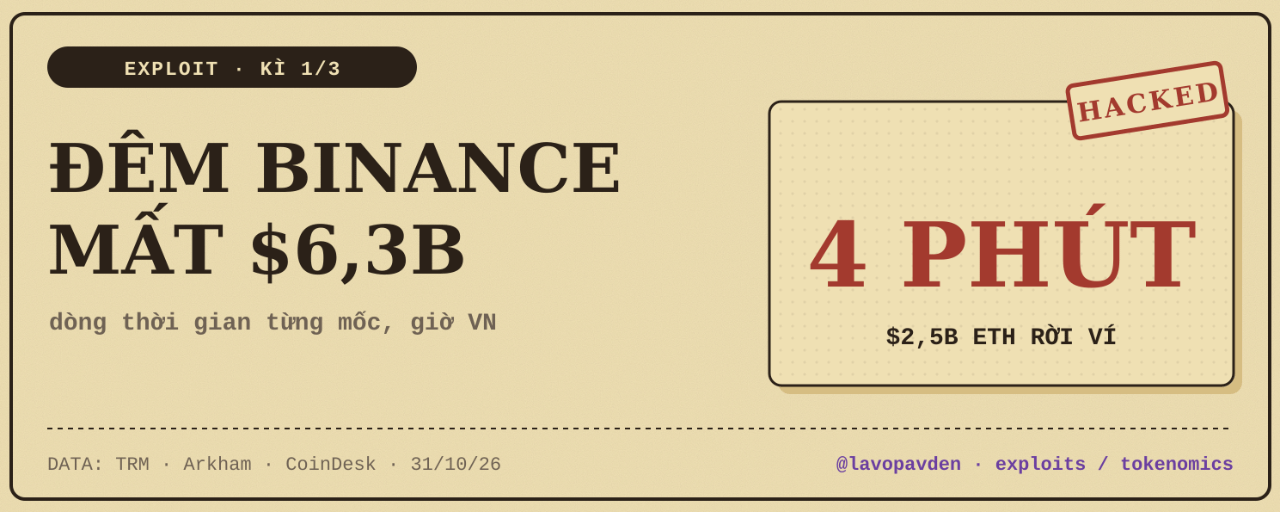

Around $6.3–6.4B left Binance hot wallets across roughly 10 chains overnight on October 29. On Ethereum alone, around $2.5B was transferred out in under 4 minutes. This is the largest crypto theft ever recorded, about 4 times the size of the Bybit incident in February 2025.
I reconstructed the timeline from data by TRM, Arkham, CoinDesk, and Binance’s announcements. All times below are Vietnam time (UTC+7).
Before the big moment: the hacker had prepared for at least a day
On Wednesday, 28/10, the hacker’s primary wallet started receiving small withdrawals from Tornado Cash. This is commonly used to get funds for fees without revealing their source.
At around 23:00 on the night of 29/10, the hacker deployed a “sweeper” contract—a type designed to gather funds into one address. They tested it on their own wallet before using it for real.
TRM assessed that this preparation matched previous operations by the TraderTraitor group (North Korea), including the Bybit hack.
20 minutes across 10 chains, 4 minutes for $2.5B
At 03:05 on the morning of 30/10, funds began leaving Binance’s hot wallet across multiple chains at once. According to TRM and Chainalysis, most of them were gone within about 20 minutes.
At 03:20, a transaction on Ethereum carried 50 EIP-7702 authorization signatures. All 50 signatures were signed by the “Binance 14” hot wallet and pointed to the same sweeper contract. Each signature corresponded to a different transaction nonce, and only one needed to match the wallet’s state at the time. Exactly one matched.
At 03:24, the sweeper contract transferred out 167,464 ETH and 63 types of tokens, including about 1.6 billion USDT. The Ethereum portion was worth about $2.5B.
On the other 9 chains, including Bitcoin, Tron, Solana, and XRP Ledger, funds were moved through ordinary transfers with valid signatures. The Bitcoin portion alone was 18,270 BTC.
Who froze what, and when
At 04:04, Circle froze 823 million USDC in receiving wallets. Tether froze a total of more than 1.5 billion USDT across multiple addresses. Ripple froze RLUSD, World Liberty Financial froze USD1, and First Digital froze FDUSD. Arbitrum’s Security Council also froze some ETH and ARB.
The detail I found most frightening that night is this. At 04:04, and again at 04:44, the hacker also swept up users’ deposit funds. Binance’s system continued automatically sending deposits to the correct Binance 14 wallet, even though that wallet had been compromised.
At 04:15, Aave temporarily froze its V3 and V4 markets as a precaution because the hacker had collateralized USDT to borrow about $44.6M in WETH just minutes earlier. Aave reopened on the afternoon of 30/10.
At 07:07, Binance halted deposits. At 07:10, the Binance 14 wallet revoked the authorizations, nearly 4 hours after it had been compromised.
Morning of 30/10: market reaction
BTC fell about 5% to around $76.9K. BNB dropped 8% to around $693. More than $1.3B in leveraged positions were liquidated. The Fear and Greed Index fell to 30.
That day, Chainalysis, TRM, and ZachXBT all attributed the incident to TraderTraitor. Chainalysis also found that funds from this incident had been mixed with funds from the earlier Bitget incident.
Risks and implications for users
First, the final loss figure has not been settled. Sources reported $5.57B, $5.91B, $6.01B, $6.3B, and then $6.4B. Any article citing one figure as the final result is citing a snapshot from a particular point in time.
Second, the speed gap. The transfer side ran automatically, sweeping new deposits into a wallet that had already been compromised. The response took nearly 4 hours to revoke the authorizations. To me, this is the point to watch most closely when Binance publishes its incident analysis.
Third, account status. According to an update on 31/10, Binance committed to absorbing all losses itself, had replaced about 90% of the lost assets, and deposits were operating normally. Withdrawals were expected to reopen in stages starting 1/11. Full proof of reserves, allowing users to independently check their balances, was expected around 3/11.
Fourth, the period after a major hack is when fake news and impersonation accounts offering “refund support” become common. Trust only announcements from Binance’s official channels.
Takeaway: this incident wasn’t won through speed of execution, but through the gap between automated systems and response procedures. Next time, I’ll get into the mechanics: how did the hacker obtain those 50 signatures?
Anyone who had a Binance deposit pending between 3 a.m. and 7 a.m. on 30/10: is your balance showing correctly now?
This incident analysis is based on public data and is not investment advice.