


The recent security incident affecting the crypto ecosystem triggered a predictable market reaction: increased volatility, forced liquidations, and a rapid spread of negative sentiment. However, beyond the red candles and short-term noise, this episode left a signal worth paying attention to.
While much of the market reacted with panic, some projects associated with verifiable privacy, confidential computing, and Zero-Knowledge (ZK) technologies showed greater-than-expected relative strength, defending significant technical zones and maintaining visible buying activity at certain points during the correction.
Although it is still too early to speak of structural decoupling, growing interest is beginning to emerge in infrastructure capable of addressing some of the key challenges that institutional adoption of blockchain will face over the coming years.
The convergence of four strategic trends
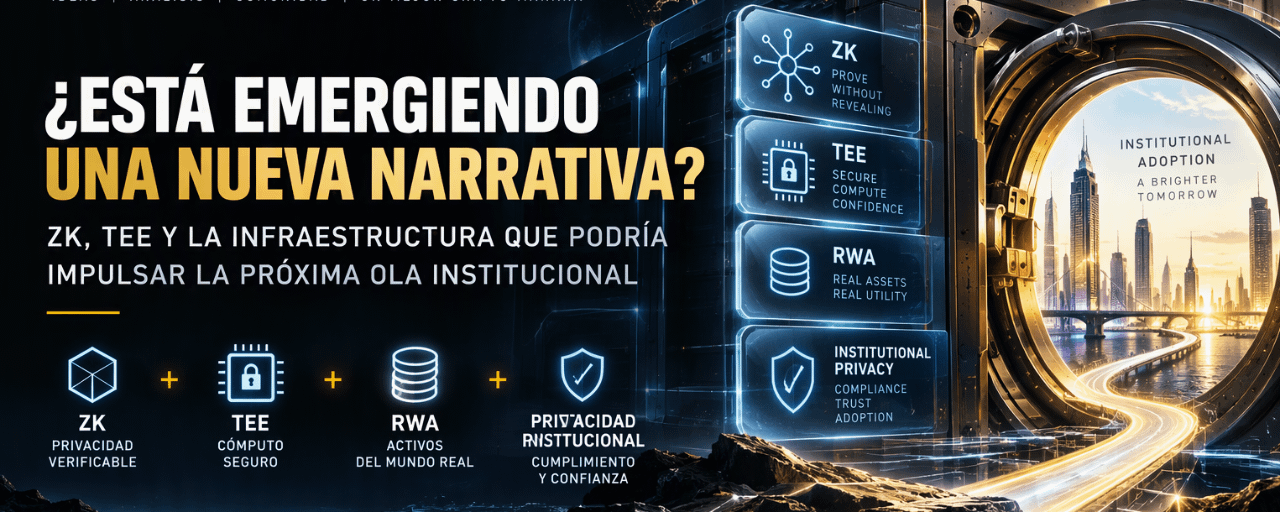
Several emerging projects are developing architectures that combine four technology areas with strong growth potential: Zero-Knowledge Proofs (ZK), Trusted Execution Environments (TEE), Real World Assets (RWA), and institutional privacy.
1. ZK + TEE: verifiable privacy and secure computation
Zero-knowledge proofs make it possible to verify information without revealing the underlying data. Trusted Execution Environments (TEE), in turn, provide hardware-protected execution environments where computations can be performed securely.
Individually, both technologies offer significant advantages. Combined, they can provide a particularly attractive balance of confidentiality, verifiability, and computational performance.
This convergence could be particularly relevant for use cases where absolute transparency is not a viable option, such as sensitive financial transactions, artificial intelligence models, or enterprise data processing.
2. RWA: tokenization needs more sophisticated infrastructure
The tokenization of real-world assets has become one of the most important narratives of the current cycle.
However, institutional tokenization poses complex challenges that go far beyond issuing assets on a blockchain. Investment funds, financial institutions, and companies need to protect sensitive business information, investment strategies, portfolio positions, and customer data.
In this context, verifiable privacy technologies could become a fundamental component in enabling tokenized assets to operate within demanding regulatory and commercial frameworks.
3. From anonymity to auditable confidentiality
The kind of privacy institutions demand is not the same as the kind the crypto ecosystem has historically sought.
While the first generations of privacy technologies focused primarily on anonymity, institutional demand appears to be oriented toward a different concept: auditable confidentiality.
This approach aims to keep certain data protected from the general public while maintaining mechanisms for validation, regulatory compliance, and oversight when necessary.
4. The invisible infrastructure that could underpin the next cycle
Throughout technological history, the greatest opportunities have not always emerged in the most visible applications, but in the infrastructure that made them possible.
Something similar could happen in blockchain.
If trends related to RWA, verifiable artificial intelligence, digital identity, and institutional finance continue to develop, demand for systems capable of offering privacy, verifiability, and computational security could increase significantly.
What the market may be starting to value
When stress events occur, capital does not necessarily leave the market. In many cases, it simply rotates into sectors that participants believe are better positioned to capture future value.
For this reason, it is especially interesting to observe which projects maintain relative strength, preserve healthy technical structures, or increase their activity during periods of uncertainty.
There is no guarantee that a narrative will ultimately translate into real adoption. However, the convergence of ZK, TEE, RWA, and institutional privacy represents one of the most robust and coherent technology theses to have begun taking shape within the blockchain ecosystem.
Beyond daily volatility, the relevant question for the coming years may not be which asset will rise the fastest, but which infrastructures will be positioned to support the arrival of institutional capital once tokenization and verifiable computing achieve broader adoption.